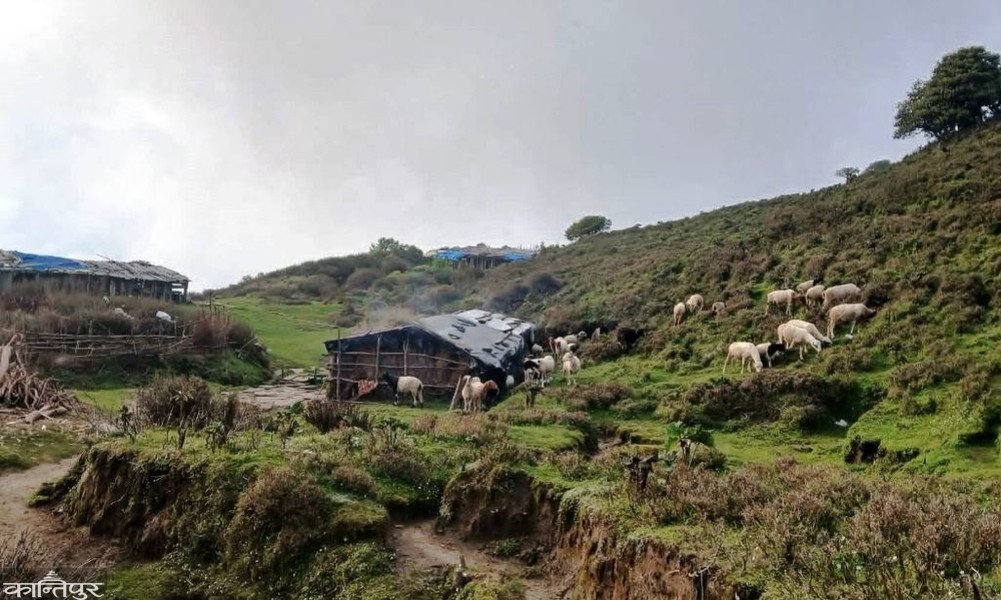
The number of cattle sheds in the pastures of Ajirkot is decreasing due to the lack of involvement of the new generation. Only the elderly are carrying on the cattle shed tradition.
We use Google Cloud Translation Services. Google requires we provide the following disclaimer relating to use of this service:
This service may contain translations powered by Google. Google disclaims all warranties related to the translations, expressed or implied, including any warranties of accuracy, reliability, and any implied warranties of merchantability, fitness for a particular purpose, and noninfringement.
Padam Bahadur Gurung, wearing a belt tied to his back and an east-coat, sets off, and the sheep in the sheepfold flock out to pasture. The dogs kept for guarding the sheepfold run in front of and behind the sheepfold according to Padam Bahadur's signals.
He has already moved the sheepfold to Nagepuri pasture, which is a day's walk from his village Ghyachchok on April 11. Now that the cold weather has set in, Padam Bahadur will descend the valley with only 7 buffaloes and a herd of 100 sheep in Asoj.
Padam Bahadur of Ghyachchok, Ajirkot Rural Municipality-1 has been living his daily life like this for 75 years. Padam Bahadur is now 82 years old. He started walking in the sheepfold at the age of seven. Padam Bahadur finds the Nagepuri pasture dearer than the outside world of the city market. He says, ‘There is a lot of suffering in the pasture, but when you eat milk, mohi, and ghee in the morning and evening, you forget everything.’
Embracing his grandfather’s ancestral profession, he herds sheep in the pastures from Ghyachchok to Marksiyu and Mitodanda, which can be reached after a 4-day walk. In recent years, as the sheepfolds in Ajirkot have disappeared, Padam Bahadur is not forced to look for pastures. ‘Earlier, there was no pasture to keep sheep, the pastures were filled with sheepfolds in Simjung, Mulpani, Ghyachchok, and Dhansira,’ he said. ‘Nowadays, the elderly who used to live in sheepfolds have passed away, their children and grandchildren have changed their professions, and now there are no people living in sheepfolds due to grief.’
He said that the number of sheepfolds in Nagepuri pastures has been gradually decreasing for the past two decades. Until a few years ago, Padam Bahadur had more than 200 sheep in his sheepfold. There were 20/25 buffaloes in the barn. ‘There were 8 buffaloes in this pasture, milking them all day was enough. Milk was plentiful, ghee was plentiful,’ he said, ‘Now I have reduced the number of buffaloes and sheep, it is a real pain to be a shepherd.’
The locals have made a rule that if sheep or domestic animals destroy crops, they have to pay a fine. ‘The penalty for eating grain by livestock has to be paid in grain, some even ask for money,’ he said, ‘When it rains, sometimes the sheep go to the cliff, some get lost, we have to run after them.’
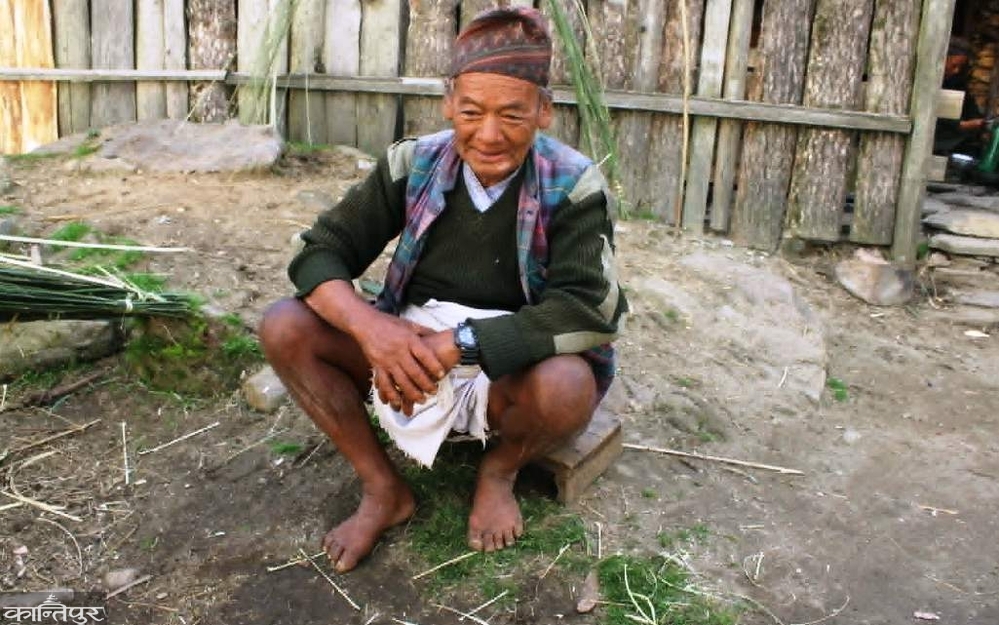
He uses to transport ghee from the barn to the Bhachchek market for sale. He sells sheep from the barn for 20 to 30 thousand. Padam Bahadur carries everything from food grains to salt from the Ghyachhok when he lives in the barn. He finds satisfaction in spending his daily life following the sheep in the pasture. ‘This is what my grandfather did, and I also started doing the same.’ He says, ‘I have come down to Thori twice to carry salt in 2017, I remember carrying salt from Narayangadh after the road was opened.’ Even though times have changed, this place still feels lovely.’
Padam Bahadur has three sons and two daughters. His eldest son Dil Bahadur has helped him in sheep farming. There are now five barns in the Nagepuri pasture, a day’s walk from Bhachhek.’
Hikers who reach Nagepokhari trek often stay in these barns when they need to stay. Manraj Gurung, 73, of Ghyachhok, has a sheepfold near Padam Bahadur in Nagepuri Kharka. He has also been living in a sheepfold for 40 years, embracing his ancestral profession.
His father Khattu passed away in the sheepfold 12 years ago at the age of 92. Manraj has 90 sheep and 13 buffaloes in his sheepfold. He is concerned about the recent disappearance of sheepfolds in this area. ‘The boys say abroad, the old people have always been able to walk on this cliff,’ he said, ‘Life in a sheepfold is not as happy as you think. After it rains, you have to run around looking for sheep, you have to see if a leopard eats it or a bear attacks it, the children and grandchildren have not shown interest in such a sad task.’
He said that the government has also failed to pay attention to bringing the next generation into animal husbandry. There are mobile cattle sheds, cow sheds, and rice sheds in the pastures of Ajirkot, Dharche, and Chumanubri areas of the district. In Lapu, Gumda, Laprak, Lapsibot, and Emagaun areas of Dharche rural municipality, there has been a practice of moving the sheds as per the decision of the shed committee. In this area, there is a practice of moving the sheds for grazing without tying up the pastures.
Yadu Adhikari of Ajirkot-3 Lapsibot said that the number of people keeping sheds in the pastures has decreased by 75 percent in the Ajirkot area compared to two decades ago. He said that despite the decrease in attraction, farmers' income from the sheds in the pastures is good. According to him, cow, buffalo, and sheep sheds are being kept in the pastures of Ajirkot. He said that there is a practice of leaving the buffaloes in the pastures for grazing freely. ‘It is customary for the rich to salt the buffaloes for 15/15 days and then release them,’ he said. He said that buffalo farmers have been selling pada for milk, ghee, and meat. ‘The ghee from the pastures here reaches Kathmandu, the price of a buffalo reaches 1,000 to 1,500 rupees, the price of a buffalo has reached 100,000, and the price of a rago is 70-80 thousand,’ he said, ‘Animal husbandry in this area is sad, the income is good.’ Farmers who previously depended only on the local market now send buffalo milk and ghee to Kathmandu for sale.
Farmers from cattle farms earn income by selling bulls and calves. While the calves are sold from the buffalo milk shed, the sabda of the Chhurpi sheep is sold. Locals say that a single sabda is sold for up to 30,000 rupees. ‘Ghee is also made from sheep milk.’ Ghee made from sheep's milk is also used as a medicine for burns,' the official said.
The rural municipality has also been running a program to improve the sheds to encourage the practice of keeping sheds in the pastures. Ajirkot Rural Municipality Chairman Deepak Devkota said that solar panels, tarpaulins, filters, torch lights, and sleeping bags have been distributed to the sheds in the pastures. He said that emphasis has also been placed on commercializing the traditional way of raising livestock in the pastures. 'Currently, livestock is being raised only for subsistence,' he said. 'We are trying to create an investment-friendly environment through partnerships by raising awareness among farmers.' He said that farmers are being encouraged by emphasizing other issues such as processing sheep wool and using it as waste fertilizer to generate income.