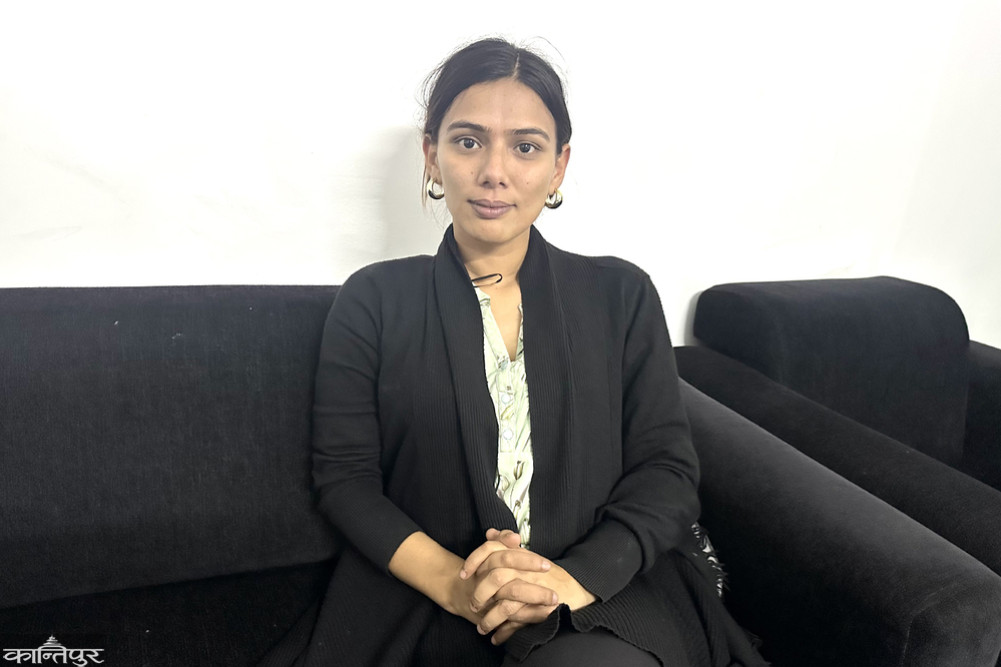
Sarishma Thapa, who has come out in protest against the government's use of bulldozers in squatter settlements, is receiving praise for her factual and logical answers to journalists' questions. Those who support the government's move are criticizing her.
We use Google Cloud Translation Services. Google requires we provide the following disclaimer relating to use of this service:
This service may contain translations powered by Google. Google disclaims all warranties related to the translations, expressed or implied, including any warranties of accuracy, reliability, and any implied warranties of merchantability, fitness for a particular purpose, and noninfringement.
Last Sunday afternoon, a journalist asked a young woman in Maitighar Mandal a question with a mixture of persuasion - 'They kept the squatters for 35 years. Why couldn't you ask questions until then? Now you say that Balen is a murderer and should resign. What kind of demand is this?'
The young woman, who listened to the question patiently, replied - 'Calling today's wrong wrong wrong does not mean that yesterday's wrong is right. There was exploitation yesterday and there will be exploitation today?'
The journalist insisted - 'When talking about development, are we comparing China, India or America?'
The young woman sounded even more determined - 'When you say comparison, do you not understand the difference between equality and equity? We fought for the new government, brought in for good governance, it is a government brought in by killing children. It is only to prevent it from doing wrong.'
An eight-minute video containing similar questions and answers is currently going viral on social media. Sarisma Thapa, who has come out in protest against the Balendra Shah-led government for using dozers in squatter settlements and causing disaster, is receiving praise for her firm, factual and logical answers to journalists' questions. Those who support the government's move are criticizing her.
Two people even committed suicide before and while dozers were being used in squatter settlements in different parts of Kathmandu. At the same time, Sarisma Thapa, 24, had gone to the Maitighar Mandal to protest the government's move. She says that she has always raised her voice about the bad things happening in society and even then she spoke about the victims. 'If the government had demolished them only after management, we would not have said anything. May the country develop for us too.' "I want the country to be better," she said, "but when I saw a dozer being used without any management or information, I raised my voice." She feels that two people have died due to the government's negligence in removing the squatter settlements. "It is not normal for two people to commit suicide after their houses collapsed. Remember the impact on children and people's mental health? I tried to make the same point," Sarisma repeated what she had said, "Yes, I say it again, calling today's wrong wrong wrong does not mean making yesterday's wrong right."
Sarisma says that she felt very difficult after meeting the displaced family. "Two sisters who were living in Thapathali, the pregnant sisters, were receiving treatment at the maternity hospital there. Suddenly, without any arrangements, it was even more difficult to see the pain those sisters went through," she said.
Sarishma says that she has always spoken for the truth and will not be afraid to speak for the truth no matter what government comes. ‘There have been many social injustices.’ She spoke about the bad things done by the previous government. She protested,’ she said, ‘We cannot remain silent when the current government does wrong.’ It is the weakness of a person who cannot call wrong wrong.’
How was she able to raise her voice on the streets without hesitation? To our question, she replied, ‘I too was exposed to social injustice when I was young.’ Gradually, as I grew up, I have been speaking for others because I never hesitated to speak and fight for the truth.’
She goes back to her childhood.
Sarishma was young. She was enjoying herself with her family. At that time, her father and mother divorced. She was deprived of her parents' love in her childhood. Sarishma says that her childhood was very painful. 'My mother and father divorced. After that, they lived separately. I lived with my grandmother. My father and grandmother loved me,' she said, 'But society used to say that my mother had influenced me and sent me away. My mother used to taunt me and abuse me very badly, saying that she had abandoned me. It is difficult to even remember those words used by society.'
Remembering the treatment given to me by society, she again recalls the slums and says, 'It is still difficult to remember the pain she experienced in her childhood,' she said, 'What must have happened to my parents who lived in that slum now?' The house was also destroyed, the school was destroyed, her photo and video are all over social media. The way they are viewed is different because they live in a slum.'
Sarisma feels that everyone has their own story of struggle. 'Everybody has their own struggle in their life. What is important to others? We do not understand what their pain is. You, I, we are all people who came to Kathmandu to find opportunities,' she said, 'Why did others come? Before asking why the slum dwellers lived in a slum, many places in Nepal are also geographically backward. We must understand that social justice is still lacking in many villages.'
She says that discrimination still exists in villages. 'Even now, there have been cases of discrimination against Dalits in villages. And those who have nothing are forced to come to the city,' she said. In the same vein, she believes that people have taken shelter in the squatter settlements because they cannot live in other places. ‘They have found tins from everywhere to build huts in the same squatter settlements. That tin is also loved. No matter what, the importance of a house is different,’ she said, ‘But, it is sad to see people making fun of the squatters without understanding the pain of others.’
Sarishma makes it clear that she is not against the Prime Minister.
‘We are not opposing the Prime Minister. He is the Prime Minister of everyone. Of the squatters and all of us. Not just of any one party,’ she said, ‘After showing hope to the poor, singing their songs and reaching the government, we are not satisfied with the fact that Chameli is being made homeless without being organized. We are not opposing the government. But, humanity is what the government is looking for.'
She said that not only her but also many generations are dissatisfied with the treatment of the squatters. 'And they also did what the government of yesterday said, first 24 come and then 23. They also brought their point to the way of demolition and management first.'
Sarisma feels that if the government comes to the streets, the voices of the people should be heard and justice should be done. 'The government should have listened to the questions of the people who came to the streets,' she said, 'It should have listened to the voices of all the people. As soon as they came to the streets, they went against the government. This is anti-government. It is not right to assassinate their character by saying that they are the pawns of other parties.' She said that when she expressed her opinion, the government used to abuse her very badly. Sarisma says that this makes her surprised to see people's thinking. She feels that the government needs to speak up to be accountable to the people. ‘When the government does not speak, the government’s defenders are created.’ That is what is happening now,’ she said.
000
Sarisma did not come all the way to raise her voice only for the slum dwellers. She is one of those who participated in the Gen-G movement and raised her voice demanding justice for the martyrs and the injured.
Sarisma, who studied up to Plus Two at a charitable school, used to work as a bar tender in the Maldives. She worked as a bar tender for 3 years and used to come and go to Nepal from time to time. She had returned to Nepal from the Maldives only in the first week of Chaitra 2081. She was preparing to go to Dubai for the same work. An offer letter had also come from a newly opened company. At that time, the Gen-G movement took place. She was very active in the movement. She had been raising her voice with various demands for the martyrs and those injured in the incident. A few days after her Gen-G movement, there was a flight to Dubai. However, she did not go. She emotionally recounted that she did not dare to go abroad again because of one word her father said.
‘All the martyrs are dead. Now they cannot speak, you have to speak while staying in the country – I could not go abroad again because of what my father said and seeing my injured brothers and sisters,’ she said.
Sarisma, who is from Udayapur, has been living in Kalimati, Kathmandu. Sarisma, who said that she will now live in Nepal, said that she is thinking of doing a bachelor’s degree in political science.