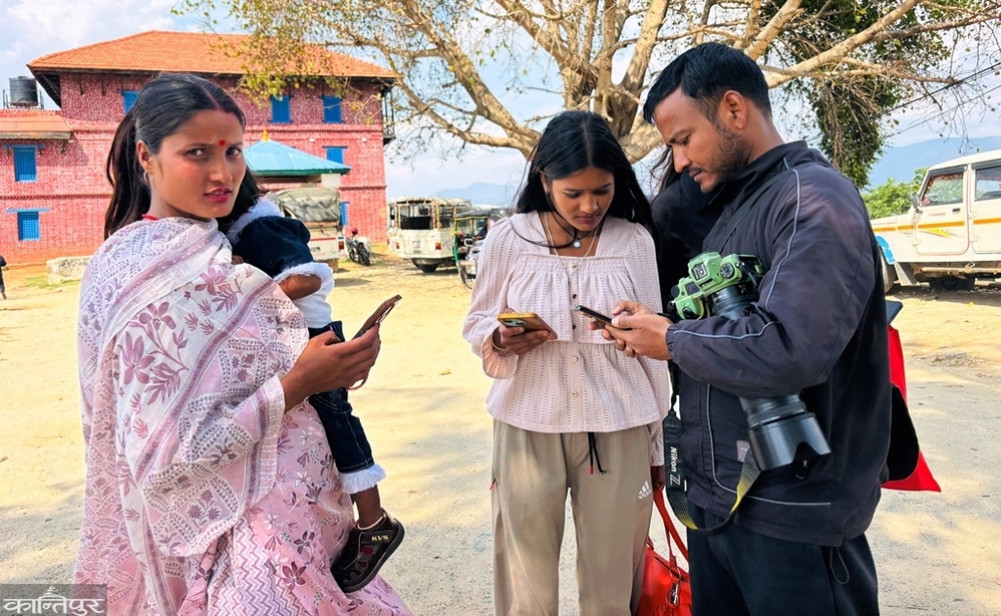
With the development of smartphones and digital technology, the operators of old photo studios in Achham have changed the way they take photos.
We use Google Cloud Translation Services. Google requires we provide the following disclaimer relating to use of this service:
This service may contain translations powered by Google. Google disclaims all warranties related to the translations, expressed or implied, including any warranties of accuracy, reliability, and any implied warranties of merchantability, fitness for a particular purpose, and noninfringement.
60-year-old Dhan Bahadur Bohara still remembers the ‘Canon EOS 1000’ camera he carried when he returned from India. Around 2051, when a kattha of land in the Terai could be bought for 11,000 rupees, Dhan Bahadur of Payal, Chaurpati Rural Municipality-4, did not choose land, but chose a dream - ‘photography’.
Returning from India with 7 years of professional experience and a year of special training in photography, he opened ‘Dhruvatara Photo Studio’ in Mangalsen in 2051. This name gradually became a trusted ‘brand’ in Achham, Dhan Bahadur was like a ‘celebrity’ for Achham.
At the time when Dhan Bahadur returned to Achham, the government had just decided to provide old age allowance for senior citizens. It was mandatory to attach a photograph to fill out the allowance form, but the elderly in the villages had to struggle a lot to take a photo. At that time, some senior citizens from rural areas of Achham took their first photos with Dhan Bahadur's camera. 'Some of the villagers had never seen a camera, for their convenience, I would reach the village carrying a camera,' Dhan Bahadur recalls, 'The glow that was seen on their faces when they took their first photos and made their old age allowance cards is nowhere to be found in today's expensive digital photos.'
In today's digital age, hundreds of photos can be taken in a second. But at that time, it was difficult to get a reel. A total of 36 photos could be taken from a reel. 'I had to take photos based on guesswork, some photos would be spoiled,' Dhan Bahadur recalls, 'But the joy in people seeing their photos was different.'
According to him, it was difficult to get a reel at that time. After taking the photos, it was an even bigger struggle to develop them. Color photography enthusiasts had to wait up to six months to see their faces. ‘The negative reel had to be sent to Nepalgunj, Kathmandu. By the time the photos came back from there, half a year had passed,’ he says. ‘A black and white photo cost one hundred rupees at that time. For that one hundred rupees, months of patience and enthusiasm were mixed into one photo.’
Dhan Bahadur’s professional journey was not easy. In 2058 BS, the then Maoist rebels attacked the district headquarters of Mangalsen and also affected the photo studio. The five years from 2058 BS to 2063 BS were very difficult for Dhan Bahadur. Citing security reasons, the then royal army confiscated his professional camera. ‘For five years, my camera remained in the army barracks. In the meantime, the business came to a complete standstill,' he said, 'I got my camera back only after the 2006 peace agreement. His studio was also closed for a long time due to the Corona pandemic.' These two major periods repeatedly pushed his professional life back.
In the 2050s, along with Dhruvtara, other photo studios also had a good market in Mangalsen. He said that these studios were the destination for those who came from villages to take photos to obtain citizenship. 'At that time, taking photos was like a festival. People would come to the studio very seriously. The rural environment was reflected in those photos.'
Now the bright lights and colorful screens of the studio have become history. According to Durga Bogati Bohra, daughter-in-law of Dhan Bahadur, who is currently the owner of Dhruvtara Photo Studio, the studio business in Mangalsen is in complete crisis. ‘We had to stop taking full-size photos for 4 years,’ says Bohra, ‘now only passport-size photos are taken for those who come to apply for citizenship.’ The main reason for the studio’s closure is the ‘Android’ technology and high-quality smartphones that have reached everyone’s fingertips.
The current crowd is not seen inside the studio, but in the Mangalsen Durbar area and public open spaces. She said that nowadays she has started taking photos in the Mangalsen Durbar area with digital SLR cameras. ‘Technology has taken photos from the world of print to digital,’ says Durga, ‘now we have to take photos and transfer them to our mobile phones within a few seconds.’
Dhansara Saund, 60, of Mangalsen Municipality-1, who took her first photo in the dark room of Dhruvatara Studio, was stunned when she stood in front of the camera on the open stage of Mangalsen on Friday. She was surprised when the photographer sent the photo to her mobile phone as soon as she took the photo. ‘I was so happy to have the photo in my hand in seconds after waiting for 6 months. Times have really changed,’ she said.
Customers who used to pay Rs 100 for a photo are now looking for cheap photos and videos. In public places in Mangalsen, professional photographers now charge Rs 20 per photo and Rs 50 per video. As soon as the photo is taken, the photo reaches the customer’s mobile phone through data cable, ShareIt, WiFi, etc. ‘The situation taught us to go out of the studio and take photos. The days of waiting for customers inside the studio are gone,’ says Durga. ‘Nowadays, photographers have to carry cameras to fairs, festivals, weddings and public events.’ She said that now it is difficult to even collect the rent of the shop after taking photos.
Dhan Bahadur claims that the ‘Canon EOS’ camera introduced 30 years ago gave the Achhami society a taste of modernity. ‘Nowadays, a photo taken for Rs. 20 and a video taken for Rs. 50 may have glamour.’ But I have not seen the importance of those old photos taken at that time,’ he said. ‘The development of technology has simplified the process of taking photos, but it has pushed an old profession and the emotional connection associated with it far away.’ He believes that people’s fascination with taking photos has not diminished, only the style and technology have changed.’