While some are supporting the government's announcement to eliminate the structure of partisan student organizations in schools/universities, there is also criticism that it is an attempt to dismantle student organizations that have carried a legacy for decades. However, the government has taken the initiative to eliminate partisan student structures, concluding that the educational environment has deteriorated due to increased partisan interference in the education sector.
We use Google Cloud Translation Services. Google requires we provide the following disclaimer relating to use of this service:
This service may contain translations powered by Google. Google disclaims all warranties related to the translations, expressed or implied, including any warranties of accuracy, reliability, and any implied warranties of merchantability, fitness for a particular purpose, and noninfringement.
Bhupi Air has been the president of the Independent Students' Union (ISU) of Kathmandu's Padmakanya Campus for two years. She was elected as the ISU president by running as an independent candidate. However, she disagrees with the government's announcement to remove the structure of party student organizations from schools/universities.
ISU president Air says that radical changes are necessary in the student organization, but that its dissolution is unnecessary. 'Recently, the student organization did not do what it should have done, but did what it should not have done. There was more student participation in the Gen-G movement on 23 Bhadra. The movement went elsewhere because the student organization could not include the issues of Gen-G. The student organization deteriorated when it followed the government and parties. Now it needs to be reformed,' she said.
While some who have seen and experienced extreme distortions and anomalies in student organizations are supporting the government's announcement, there is also criticism that instead of moving towards reform, student organizations with decades of legacy are being tried to be dismantled. There is a voice that student organizations should be regulated rather than controlled. Stating that student organizations were born for educational, political and social movements, she emphasizes that these organizations should continue. 'We should not forget the history of the past. The democratic system was brought about by students. Student organizations are still needed. Who gave the government the right to dissolve these organizations?' Air said.
The 'One Hundred Agenda' brought by the Council of Ministers led by Balendra Shah mentions that the structure of party student organizations will be removed from schools/universities within 60 days and a student council and voice of student mechanism will be developed within 90 days. The government has taken the initiative to remove the party student structure with the conclusion that the educational environment has deteriorated due to increasing party interference in the education sector.
While some who have seen and experienced extreme distortions and anomalies in student organizations are supporting the government's announcement, there is also criticism that instead of moving towards reform, student organizations with decades of legacy are being tried to be dismantled. There is a voice that student organizations should be regulated rather than controlled.
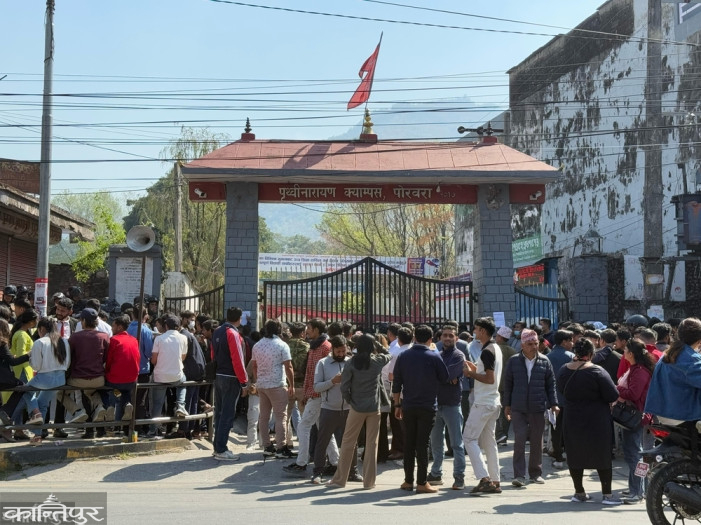
Protests have also started with the argument that the government's decision is against the constitution, the right to freedom and the right to organize. Student organizations have protested, calling the government's decision undemocratic. They have put forward a demand to revoke the government's decision.
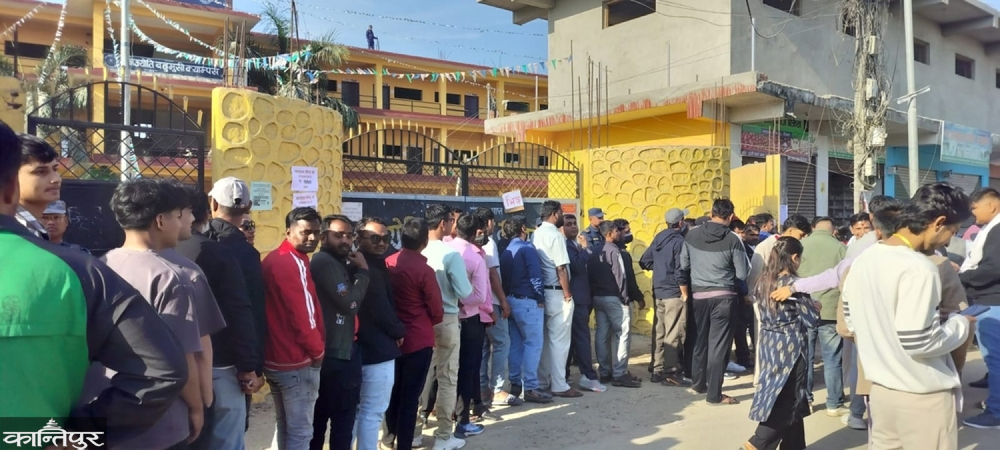
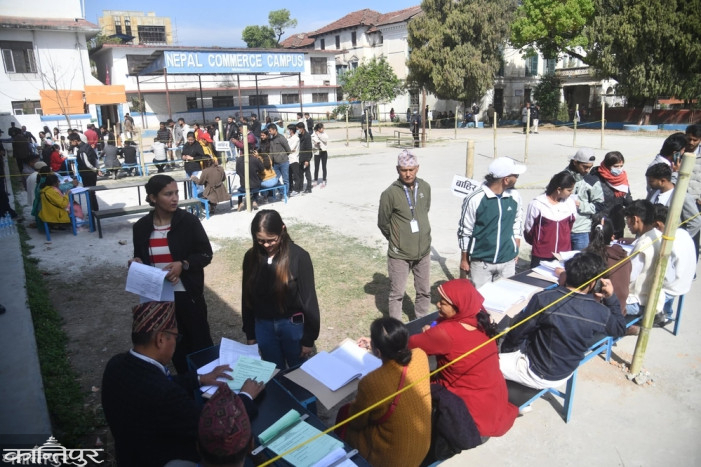
Student organizations of most parties are active from schools to universities. The ruling Rashtriya Swayamsevak Sangh (RSS) does not have a fraternal organization. Student organizations or groups elect SBU office bearers on campus. SBU has been officially representing the educational institution.
Even in the Senate, the highest body of the country's oldest and largest Tribhuvan University, there is a provision for two representatives from the SBU presidents of the campus. The Chancellor and the Prime Minister preside over the assembly, where SBU representatives raise their voices about student rights, problems and educational activities. SBU remains under the patronage of each campus head. Even during the Panchayat period of 2028, a structure of SBU nature existed in educational institutions in the name of the Student Council.
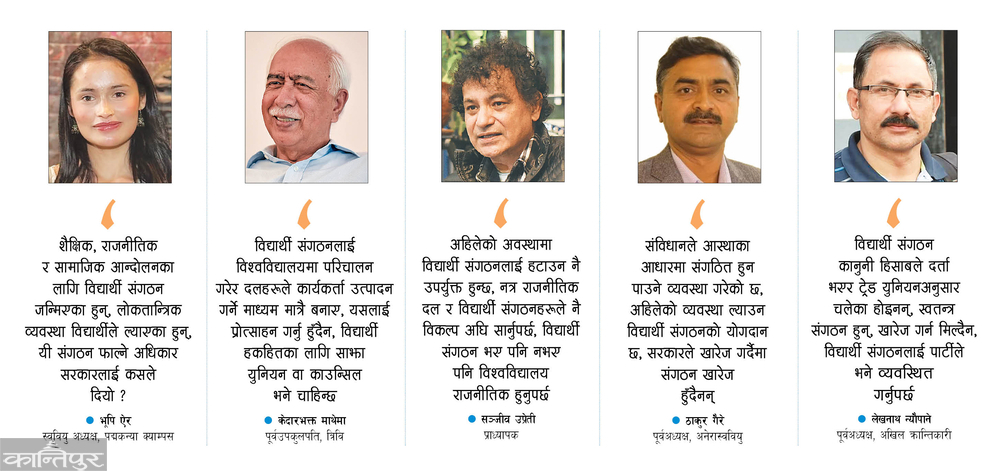
Former UML MP and former president of Anuraswaviyu, Thakur Gaire, says that it is impossible to abolish student organizations. According to the constitution, no one can stop students from organizing on the basis of faith and ideas and carrying out their activities. ‘The constitution has made provision for organizing on the basis of faith. It cannot go beyond that. Student organizations fought against autocracy. Student organizations have contributed to bringing about the current system where even the president is elected,’ he said, ‘Student organizations are not abolished just because the government abolishes them.’
Gaire challenged us not to ignore the role played by student organizations for educational, political, and social change. ‘Why can’t we join the ideas and organizations we like within our own country? Why can’t we propagate them?’ he asked.
He recalled that student organizations fought against the autocracy of the Panchayat and former King Gyanendra Shah. ‘After the political change, students took up educational reforms. When the state adopted a policy of banning parties, they fought in favor of the parties. They fought to bring about a federal republic. We fought for free and compulsory education. We have also fought for nationalism and good governance. We are fighting to make education accessible to all,' former student leader Gaire added, 'Concessions in transportation have been possible through the student movement. Free scholarships for 10 percent of students have been obtained through the student movement.'
Gaire challenged students not to ignore the role played by student organizations for educational, political, and social change. 'Why can't we be affiliated with the ideas and organizations we like within our own country? Why can't it be promoted?' he asked. Gaire sees the need for timely reforms in student organizations. He says that the agenda and form carried by student organizations should be changed. 'Student organizations should also be transformed. The campaign should be focused on educational reform and quality education. We should reconsider the level to which affiliation with the party should be taken,' he said, 'Student organizations should always be able to be the opposition. They should be able to speak the voice of the people, not just the students. The state should work to refine and organize student organizations.'
Article 17 of the Constitution gives every citizen the freedom and right to freedom of thought, expression, peaceful assembly without weapons, to form political parties, and to form organizations. Student organizations are not registered and opened according to the constitution. Student organizations of old parties including the Congress, UML, and NCP were established by the party statutes. They have been conducting educational and political activities in schools/universities.
Bipin Koirala, the founding president of the Nepali Students' Union, which is close to the Congress, argues that student organizations should not be abruptly removed. 'Whether it is Nepali Students' Union or Akhil, it cannot be banned by force. Student organizations with history should be regulated through dialogue. Conclusions cannot be reached by forcibly stopping them,' he said. 'Student organizations should also pay more attention to the academic agenda than politics. Student organizations have not matured. Student organizations have also become weak because leaders have started interfering. Student organizations should move forward independently of the party.'
Koirala said that the entire organization cannot be accused and banned just because a member of the student organization caused disruption to peace and security or administration. ‘Yesterday, we threw books and papers against the Panchayat in favor of democracy and jumped into the movement. I am a striking student leader. I fought against the Panchayat. The leader and the party were banned. Students had no choice but to fight. Today, the situation has changed,’ he added, ‘Students can no longer be the pawns of the party. They should be academically aware. Student organizations should be kept away from political parties, but not from the university.’
Lekhnath Neupane, former president of the All Revolutionary Party, which is close to the NCP, says he will reject the government’s decision to dissolve the student organization. ‘Student organizations are not legally registered and run according to trade unions. They are independent organizations, they cannot be dissolved. Dissolution is not even possible,’ he said.
Neupane says that a common platform like the student organization and the Swaviyu is still needed to make the youth cultured and politically and socially aware. ‘Forming a foreign youth council to train the youth, abolishing the student organization and encouraging the youth council is not acceptable,’ he said. He suggested the government to ban foreign youth councils. He added, ‘Student organizations are always the opposition of the street. The party should organize it.’
Former Vice Chancellor of Tribhuvan University Kedar Bhakta Mathema commented that the parties have only used the student organization in the university as a means to produce their cadres. ‘How many student organizations can a vice-chancellor, a campus head deal with? One student organization is enough for the rights of students,’ he said, ‘When I was the vice-chancellor, I dealt with many student organizations. Party-based student organizations should not be encouraged. Party-based student organizations are disappearing in foreign universities too.’
Mathema says that a common union or council is essential for student rights. ‘Having separate student organizations of different parties inside the university has led to a lot of unhealthy competition. A common student union or council is needed. Parties can keep their student organizations active outside,’ he said.
Mathema says that a common union or council is essential for student rights. ‘Having separate student organizations of different parties inside the university has led to a lot of unhealthy competition. A common student union or council is needed. Parties can keep their student organizations active outside,’ he said. Civic leader and professor Sanjeev Upreti says that the presence of student organizations should be reconsidered as there is too much partisanship. So far, his analysis is that partisan student organizations have not been able to give good results in the university. ‘Student organizations have always resorted to lockouts, attacks, and sabotage. In the current situation, it is best to remove student organizations,’ he said. ‘If not, the old political parties and student organizations should come up with alternatives.’
If the alternative is not given, the government's decision will be considered appropriate, Upreti said. He said that the university should be political regardless of whether there is a student organization or not. 'My argument is not that the university should be made apolitical by removing the student organization,' Professor Upreti said, 'The university should be more political than it is now. Students should be aware of political awareness, democracy, society, and social justice. There should be a series of debates in the university.'
In recent times, student organizations of political parties have been carrying out provocative activities such as attacks on professors in educational institutions, vandalism, arson, lockouts, extortion, and sharing of appointments. But due to impunity, some individuals have been getting away with illegal activities. The government, the political parties concerned, and the student organizations have been failing to take action against the guilty, due to which the entire student organization has been getting defamed.
Trichandra Campus's SBU President Govinda Koirala claims that banning student organizations will only curb thought and consciousness. ‘It is not the student organizations that should be banned, but the activities of those who commit mischief in student organizations,’ he said. ‘Democratic, socialist, and leftist ideologies are allowed. We do.’
According to his ideology, Koirala says that banning organizations will curtail rights. ‘Those who commit illegal acts in student organizations should be prosecuted according to the law,’ he added. ‘In our country, arbitrariness has flourished because action has not been taken. Politically affiliated student organizations are present in universities all over the world. They should be present in ours too.’
He suggested that the government should focus on improving the educational sector rather than stopping student organizations in a malicious manner. ‘There are things that need to be improved in universities. Professors’, employees’ unions, and students’ unions are different. Student organizations should now change the way they work. They should seek autonomy from the party. They should carry an educational agenda,’ he said. Swavi President Koirala also urged the government to withdraw the decision to abolish the student organization. The last Swavi election was held in Chaitra 2081. At that time, the elected office bearers had one year left in their term.
Demand to revoke the decision to abolish the student organization
14 student organizations close to political parties have commented that the government's decision to abolish the student organization structure from schools and universities is undemocratic. Nevisangh, ANRF Swavi, Akhil Krantikari, and others have issued a joint statement demanding the cancellation of the decision.
‘Nepal’s student movement has been continuously active in the cause of nation, nationality, democracy, social justice, educational reform and student rights, developing on the foundation of sacrificial struggle. Its history has not been achieved through anyone’s kindness, mercy and grace. It has heroically presented its history on the foundation of sacrificial struggle from the Rana regime to the republican movement,’ the statement said. The statement also mentioned that the government’s decision to ban and prohibit student organizations in the name of solving complex problems in the education sector, ignoring the historical background of the student movement, cannot yield positive results in the long term. The student organization has also clarified that it has been realizing the need to restructure the student movement in a time-relevant manner. ‘Efforts have been made to make the association/organization more disciplined, responsible and result-oriented by introducing an age limit of 28 years in the SBU and age limits in organizations, among other reforms. These practices have brought about positive changes to a large extent and their results are starting to be seen in practice,” the statement said. The student organization has stated that the right to join an organization based on ideas is a fundamental right guaranteed by the Constitution of Nepal. 'The act of restricting someone's ideas is against democratic values and norms and is also inconsistent with international human rights standards. Such efforts risk creating obstacles in the natural political socialization process of the youth,' the joint statement of the student organizations reads, 'Although the government's prioritization of the restructuring of the student movement is positive and welcome, it is clear that any decision intended to restrict freedom of thought, expression and organization in the name of reform is immature, apolitical, unnatural, unconstitutional and undemocratic.' The statement also states that the government's decision to ban and prohibit student organizations in the name of solving complex problems in the education sector by ignoring the historical background of the student movement cannot yield positive results in the long term. The student organizations have stated that they are always committed to constructive dialogue, cooperation and reform with the government to continuously move forward in a constructive and creative manner by correcting the anomalies in the student movement. They demand that the government ensure democratic values, constitutional rights and participatory processes and build consensus through meaningful dialogue with all stakeholders.

