Sarin Tamang, who was born in Sarlahi, worked in Israel for 14 years, and received death threats after changing her gender identity, moved to Dharan to save her life. The city gave her 16,000 votes in the first election and 27,000 in the second. No gay person has ever been elected to parliament through direct elections, but Sarin's vote in Dharan is the biggest achievement in that direction so far.
We use Google Cloud Translation Services. Google requires we provide the following disclaimer relating to use of this service:
This service may contain translations powered by Google. Google disclaims all warranties related to the translations, expressed or implied, including any warranties of accuracy, reliability, and any implied warranties of merchantability, fitness for a particular purpose, and noninfringement.
The counting of votes began at the Dharan Assembly Hall on the afternoon of 22 Falgun, the day after the voting for the House of Representatives elections ended. By the time the counting of wards 1, 2 and 3 was completed, the candidate of the National Independent Party (RSWP), Goma (Sarin) Tamang, was leading. ‘I was hoping to win with the lead in the first round, but I was not sure,’ Sarin recalled that day, ‘because there were still 24 wards to be counted.’
When all the votes were counted in Sunsari-1, which falls under the Dharan Sub-metropolitan City and other surrounding areas, Sarin received 27,249 votes. However, that was not enough to win. Hark Sampang, the chairman of the Shram Sanskriti Party and former mayor of Dharan, defeated Sarin by more than 8,000 votes. Sarin came close to winning but fell short.
Sarin was one of the few gay candidates in this election. Advocate Sagar Chemjong said that the support Sarin received in Dharan, when gay candidates in other constituencies received very few votes, showed the generosity of this city. “The fact that a candidate from a sexual minority community received such a large amount of support has given Dharan a distinct identity,” Chemjong said.
Political representation of sexual and gender minority communities is still limited in Nepal. Sunil Babu Pant was the first gay MP elected to the Constituent Assembly in 2064 from the NCP United Party under the proportional system. Pant had filed a writ petition in the Supreme Court in Poush 2064 to recognize same-sex marriage. At that time, the Supreme Court had issued a directive order to the government to study and submit a report on citizenship with identity, the creation of laws friendly to sexual and gender minorities, and same-sex marriage. Later, in another writ petition, the Supreme Court made a historic decision to recognize same-sex marriage in Nepal in Jestha 2080.
After Pant, no one from the community could reach the federal parliament for 18 years. Bhumika Shrestha reached the parliament through the recent elections. Shrestha, the first 'transwoman' to reach Singha Durbar, also reached the parliament through the proportional system like Panta. However, no one has been elected through the direct system so far. This time, even though homosexuals were in the race in Kathmandu-1, Rupandehi-2, Morang-4, Okhaldhunga-1 and Kavre-1, they could not get the expected votes. However, in Dharan, Sarin came very close to such a historic victory.
Homosexuals in society do not only face identity problems, they face countless discrimination, mistreatment and abuse in society. A study conducted by the Blue Diamond Society and UN Women two years ago showed that 81 percent of people from this community in Nepal have experienced some kind of violence at least once in their lives. Such violence takes many forms, including physical, mental, sexual, and economic. Various studies have shown that homosexuals initially face abuse and violence from their families, then from society, schools, the health sector, and the police.
Namaste Shrestha is one of those who have suffered such abuse. A teacher in a private school, she quit her job after being constantly insulted and abused by her colleagues and administrators because of her gender identity. She entered the sex industry after having no other employment options. However, last August, she was abused by the police. She says that during her detention, the police made derogatory comments about her physical appearance and asked her questions with sexual innuendo.
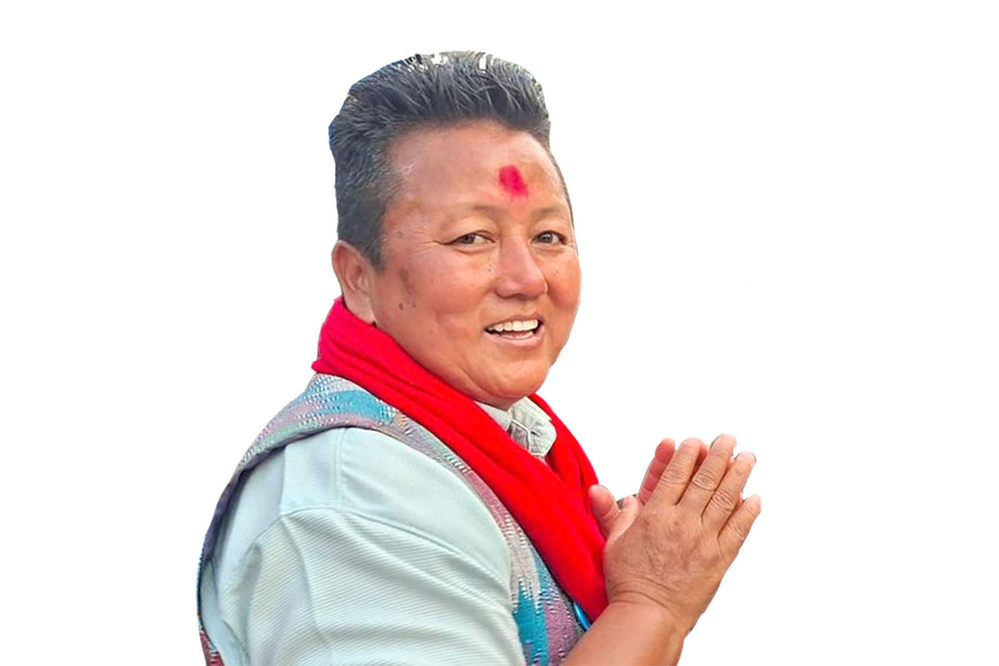
Sarin was also not immune to such abuse in society. Goma, who appeared as a daughter-in-law in a veil, became a victim of further abuse after changing her gender identity and becoming Sarin Kumar. Born in 2030 in Motihar, Sarlahi, she is a mother of two children. After living in Israel for 14 years while working abroad, she returned to Nepal. After a disagreement in their marital life, she divorced her husband and married Devika Karki as a lesbian. She says that after changing her gender identity, she became more independent and felt her true identity.
Voters did not reject me based on my gender identity. Instead, they liked my work and plans. She says that she moved to Dharan to save her life after receiving death threats because of her different gender identity. In 2075, she decided to stay in Dharan, where her parents and brothers lived. She became involved in various social service activities during the Corona pandemic that began immediately. Her political journey began with that social campaign.
She ran for the House of Representatives in 2079 as a candidate of the Rashtriya Swayamsevak Sangh (RSS) from Sunsari-1. At that time, she was defeated by Ashok Rai, the coalition candidate of the JSP Nepal and UML, by 453 votes. She received 16,606 votes. She was sad when she lost by a narrow margin. But, she says, the votes she received made her feel like she had won. ‘The voters did not reject me based on my gender identity. Instead, they liked my work and plans,’ she says. ‘That love from the people encouraged me and inspired me to continue in politics.’
She never thought she would receive so much love from the people here in the four years since she moved to Dharan. ‘I was afraid that the people here would also assassinate my character because of the abuse I had suffered before.’ It also made me frustrated,' she said, 'When I was a candidate for the first time, the people liked my identity so easily, that is a matter of pride for me.'
As the election date approached, the number of character assassinations, sexually insensitive comments and hateful expressions against her on social media increased. 'Even though they tried to assassinate her character with fake IDs, voters did not behave in that way,' she said. During the election campaign, she went door to door with voters on issues of local problems, development plans, education, employment and social inclusion. Sarin says, 'Voters asked me what my plans were more than my identity, they told me their problems,' she said, 'From this, I understood how much the voters wanted to change the country.'
Sarin got about 11,000 more votes than in the previous election. Is this increase in votes a result of Sarin's increased acceptance and support in Dharan or a wave seen across the country in favor of the Rashtriya Swayamsevak Sangh (RSS)? 'If there had been a wave of the RSS, I would have won,' she said, 'This is the vote given to Sarin. I got more than last time, this is my victory.'
Chandra Rai, Principal Associate Professor at Mahendra Multiple Campus, Dharan, says that education, international contacts through military recruitment, and demographic characteristics have contributed to Dharan's emergence as a liberal city in eastern Nepal. According to him, after the establishment of the British Gurkha Recruitment Center in 2010, the population, employment, and economic activity in Dharan began to increase significantly. This made Dharan not only a center for military recruitment, but also an important transit city connecting the eastern hills and the Terai.
Associate Professor Rai said that through the British Gurkha recruitment process, international contact between British military officers and Nepali youth brought foreign culture, lifestyle and liberal views to Dharan faster than other areas. The Lahurs who returned from foreign employment brought newness to modern lifestyle, fashion, language and behavior. He said that the openness here, the tendency to accept gender and social diversity and the inclination towards education have given Dharan a different identity from other cities. Due to this, Rai said that a relatively open and accepting approach has also developed towards the gender and sexual minority community. ‘That approach has been expressed through the elections,’ he said.
Poonam Rai, 54, of Dharan-12 says, ‘We need development, employment and transparency now. Who the candidate is, what his gender is is not important.’ Similarly, local Raghu Limbu, 40, said that a large number of voters voted for Sarin based on her ability and contribution rather than her identity. ‘She couldn’t win. But, we voted for her because of her ability and determination to develop,’ he said. ‘It is her right to live independently.’ That is why we should look at her ability rather than her gender identity.’
Social activist Leela Bhujel said that Dharan voters look at a candidate’s ability and continuous social service. Bhujel said that the votes received by Sarin in Dharan show that Dharan voters are different from the neglect faced by members of the gender and sexual minority community across the country.

