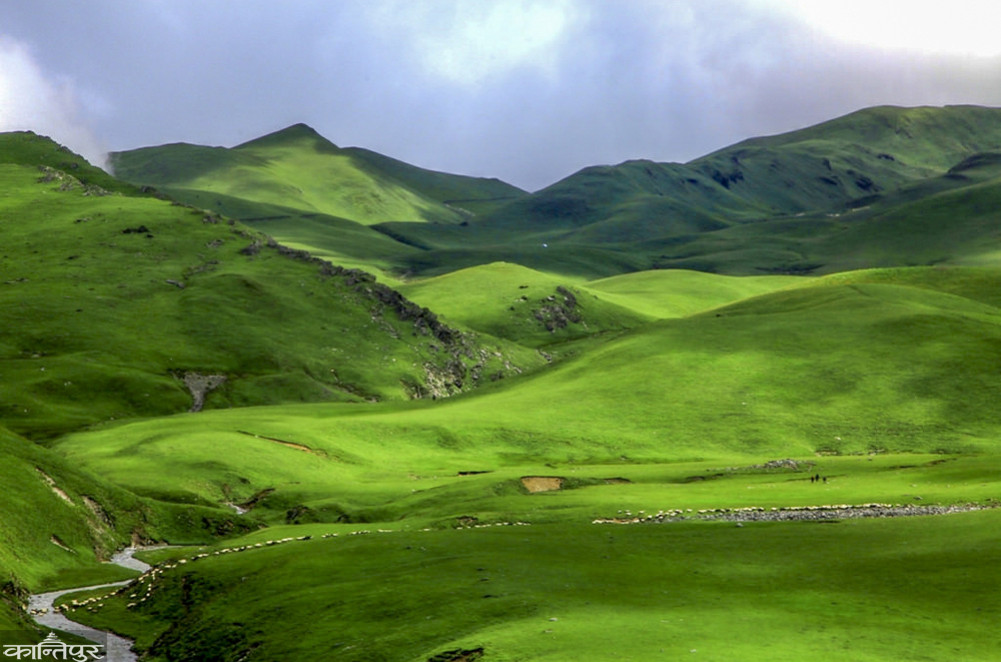
After Balendra Shah called it the 'father of Switzerland', Badimalika Temple has become more popular as a religious, cultural, and tourist center. What is the attraction of Badimalika? And how to reach it?
We use Google Cloud Translation Services. Google requires we provide the following disclaimer relating to use of this service:
This service may contain translations powered by Google. Google disclaims all warranties related to the translations, expressed or implied, including any warranties of accuracy, reliability, and any implied warranties of merchantability, fitness for a particular purpose, and noninfringement.
Badimalika became a hot topic after the Nepali Army renovated the old temple and built a new temple in accordance with archaeological standards in Ashar last year, overcoming many challenges. This time, during the election campaign, senior leader of the Rashtriya Swayamsevak Sangh (RSS) Balendra Shah said at a meeting organized in Dhangadhi, "People say that the country should be made like Switzerland, but if Badimalika, the father of Switzerland, and its culmination, Rama Roshan, are here, why should it be made like Switzerland?" The discussion about Badimalika revived.
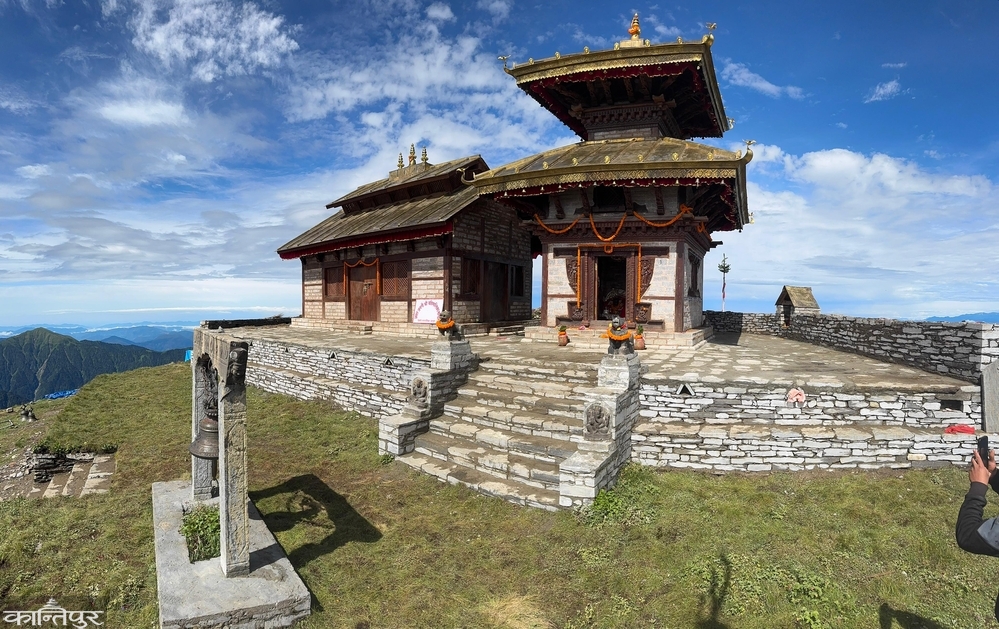
Among the Shaktipeeths of the Goddess, the temple built in Badimalika is the highest artistic temple in the world. There is a preliminary study by the Nepali Army that no artistic temple of the Goddess has been built anywhere else at an altitude of 4,200 meters. Second, completing the construction of the artistic temple in Badimalika, where it snows most of the time, was not an easy task. It was possible only due to the hard work and risk of the Army.
Shah's comment about Badimalika went viral before he became the Prime Minister. About two months later, Shah became the Prime Minister. The first meeting of the Council of Ministers after he became the Prime Minister issued a 100-item agenda for governance reform. Item 72 of the agenda states that a study of systematic tourism, including trekking routes, in Badimalika in Bajura will be conducted and an implementable blueprint will be presented within a month. Tourism professionals say that the decision reflects the religious and tourist importance of Badimalika and the potential for tourism development. The detailed process and progress of the study of systematic tourism, including trekking routes, in Badimalika, as specified in the agenda, have not been made public.
Since then, the Sudurpaschim Province government has also stated that it is working by forming an 'Action Plan Preparation Task Force' for the tourism development of the Badimalika region. The provincial government has formed a 14-member task force under the coordination of provincial MP Padam Bahadur Shahi, representing Bajura, on November 2. The task force includes Bajura provincial MPs Naresh Kumar Shahi and Juna Dani, the ministry's secretary, forest director, tourism unit chief, mayors of Triveni, Badimalika and Budhinanda municipalities in Bajura, and tourism entrepreneurs, said Dan Bahadur Thapa, a forest officer at the Ministry of Industry, Tourism, Forest and Environment. According to Thapa, the task force has been formed with a five-month period.
Thapa said that so far, the task force has held meetings with stakeholders in Bajura and meetings at various stages in the ministry. ‘The main objective of the task force is to review the programs carried out in the past in Badimalika, prepare a short-term and long-term action plan to be taken in the coming days to develop infrastructure and promote tourism,’ said Thapa. ‘The members of the task force had not been able to reach Badimalika before due to snowfall, and now they are preparing to go again.’ He said that as mentioned in the recently issued work schedule by the federal government, there will be coordination between the provincial and federal government bodies during the implementation. ‘So far, there is no information about the responsible body to implement the Badimalika reference under the work schedule. Once the responsible body is known, we will work in coordination between the provincial and federal task forces,’ said Thapa.
Under the Badimalika development plan being prepared by the provincial task force, an action plan is being prepared based on the need to develop nature-friendly and local resource-based infrastructure that provides easy access, hiking trail development, accommodation and food, and basic facilities for tourism development in the area. Janakraj Giri, a member of the House of Representatives representing Bajura, said that he had recently informed the Finance Minister about the tourism development of Badimalika and requested him to take forward the necessary plans on priority.
History of Badimalika Temple
According to Netraraj Padhyay, a priest of Badimalika, the Badimalika Temple was established in ancient times. As mentioned in the Manaskhanda of Skanda Purana, after Satyadevi burned the fire in the yagya of her father Dakshaprajati, Mahadev started traveling the earth with the dead body of Satyadevi. In this way, Satyadevi's organs started falling down and falling down. Shaktipeeths were established wherever Satyadevi's organs fell. In the same process, her left kum fell on Mallagiri mountain (Badimalika) in Bajura. It is said that a Badimalika temple was established in that Mallagiri and worship began.
According to Jahar Singh Thapa of Bajura, a scholar of Badimalika, the first temple of Badimalika Devi was built by Deepraj Chhatyal of Bajura. Then in 1591, the Kalyalvamshi king of Jumla, Birbhadra Shahi, had the temple built in Badimalika by transporting stones from a place called Kalapani in Dhadakot, Bajura.
In 1679, the Kalyalvamshi king, Shuradarshan Shah, had the Badimalika temple repaired and the idol installed. Then, around 036-037, the temple was built with the active participation of the then District Development Chairman of Bajura, Chhatra Bahadur Shah and the priests of Paima. Last year, the Nepali Army built the Badimalika Nepali style temple as per the Ancient Monuments Act 2013, as designed by the Department of Archaeology. The army brought in Kaligarh, who had experience in building the royal palace of Bhutan, to build the temple. Badimalika, a treasure trove of biodiversity, is considered a unique gift from nature to humanity. Badimalika is located in Triveni Municipality-6 of Bajura.
Worship tradition at Badimalika
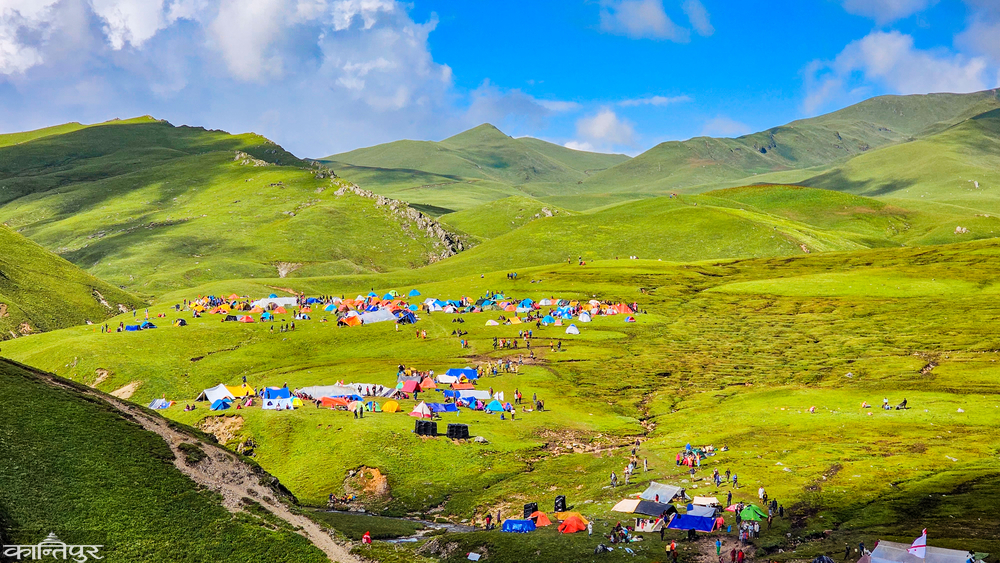
It is customary to worship at Badimalika temple on the Chaturdashi of Shravan Shukla (the day before Janai Purnima) every year. Due to the popular belief that visiting Badimalika will grant you the desired boon, there is a rush of people coming here. Pilgrims from not only Nepal but also from places like Kumaon, Garhwal, Pithoragarh in Uttarakhand, India, reach Badimalika.
For the worship of Badimalika, government worship materials (doli) were sent from Jumla representing the then Sinja state, while the tradition of sending government worship materials (petaro) from Doti representing the Doti state is still in force. The tradition of a government team leaving for Badimalika on the day of Nag Panchami from the Jumla District Administration Office with Chandannath's doli is still in force.
It was a tradition to send 'petaro' from Doti to Badimalika since the time of Amar Singh Thapa. The official Puja material is called a doli. Since it is customary to reach Badimalika from Siliguri in 15 days, the puja team departs from the district headquarters Siliguri for Badimalika on the day of Shravan Pratipada.
It is customary to include Dipayal's Bhurudi (rice leaves) and Achham's Vaidyanath's Akshata in the Doti. After a special puja at the District Administration Office Doti, it is customary for a contingent of the Nepal Army, Nepal Police and Armed Police Force to bid farewell with a salute. Then, after puja at the Shaileshwari and Malika temples in Siliguri, the contingent moves towards Badimalika. There is a religious tradition that the contingent reaches Badimalika only on the 15th day.
Meanwhile, the journey begins by worshiping the doli at the Durbar Malika temple in front of the District Administration Office Jumla. In the process, a contingent of the Nepal Army After offering the salute, there is a tradition of Jumla's government doli departing for Badimalika to worship at Badimalika.
It is a religious tradition that the Jumla government worship team with the doli reaches Badimalika after an 18-day walk and returns to Khalanga, the headquarters of Jumla, after worshipping. It is also a tradition for the government team from Kalikot and Bajura to go to Badimalika from the district administration. Badimalika Municipality Mayor Amar Bahadur Khadka says that it is a tradition for the government worship team departing from Bajura to be greeted by a detachment of the Nepal Army, Nepal Police and Armed Police Force on the open stage in front of the District Administration Office in Martadi.
Devotees from all over the country and neighboring India come to perform pilgrimage at the Badimalika fair. Triveni Dham, which is located at the confluence of three rivers, has a special significance. After bathing in Triveni, the pilgrims They climb towards the temple. The next morning, they worship at the Badimalika Temple and return to the Nateshwari Temple in Triveni Municipality of Bajura on the same day. It is believed that after worshiping at the Nateshwari Temple, the cycle of Badimalika darshan is completed.
There is also a ritual and tradition of worship at Badimalika. ‘Initially, Gorakhnath’s petaro is offered along with the doli from Doti, and then there is a tradition of offering Chandannath’s petaro from Jumla,’ says priest Netraraj Padhya. ‘Three days ago, it is customary to worship the Ashagurja (silver worship vessel) taken by the Badimalika priest and the Chhatra taken by the Brahmin of Kalikot. Then, the priests leave for the Badimalika Temple with the puja water.
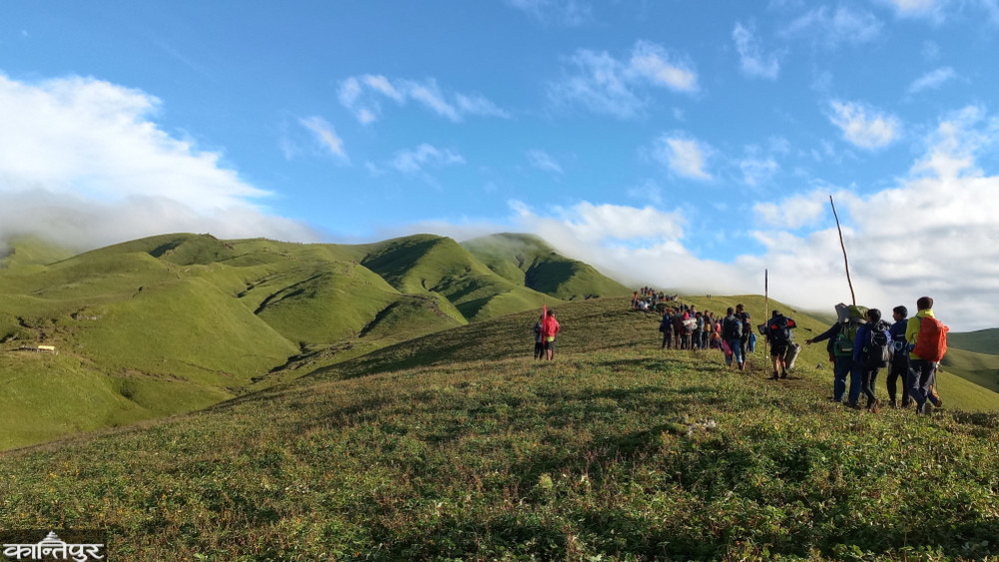
A fair has been held and worship has been taking place at the Badimalika Temple since ancient times. The Badimalika Temple According to the priest Padhyay, there are records of his family worshipping it for 14 generations. The priest family says that in 1883 B.S., King Rana Bahadur Shah certified Badimalika as a place of national religious faith by placing a red seal. It is said that King Rana Bahadur Shah himself also visited Badimalika.
After worshipping Badimalika, there is a tradition of visiting the Nateshwari temple in Triveni Municipality. The priest Padhya of Badimalika says that after visiting Badimalika, it is a religious tradition to visit the Nateshwari Bhagwati in Triveni Municipality of Bajura. Pilgrims worship at Nateshwari and return to their respective destinations after tying the Rakshabandhan.
The captivating Badimalika
Those who returned from the visit say that the natural beauty of Badimalika is indescribable. Hearts filled with religious faith, On the other hand, pilgrims and tourists say that the natural beauty of Badimalika, which is located at an altitude of 14,000 feet, makes all their worries disappear.
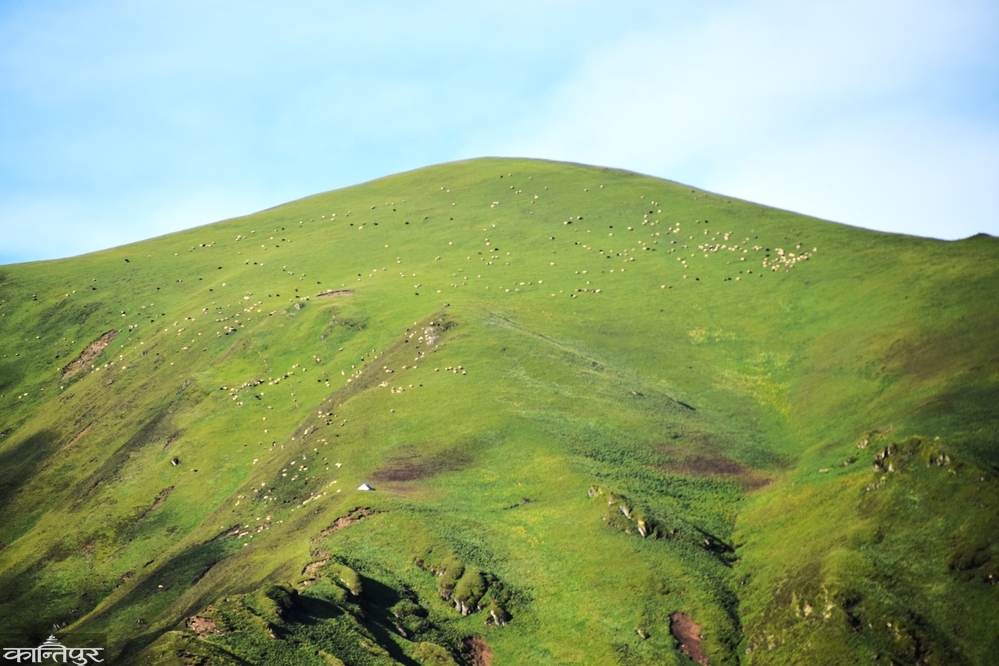
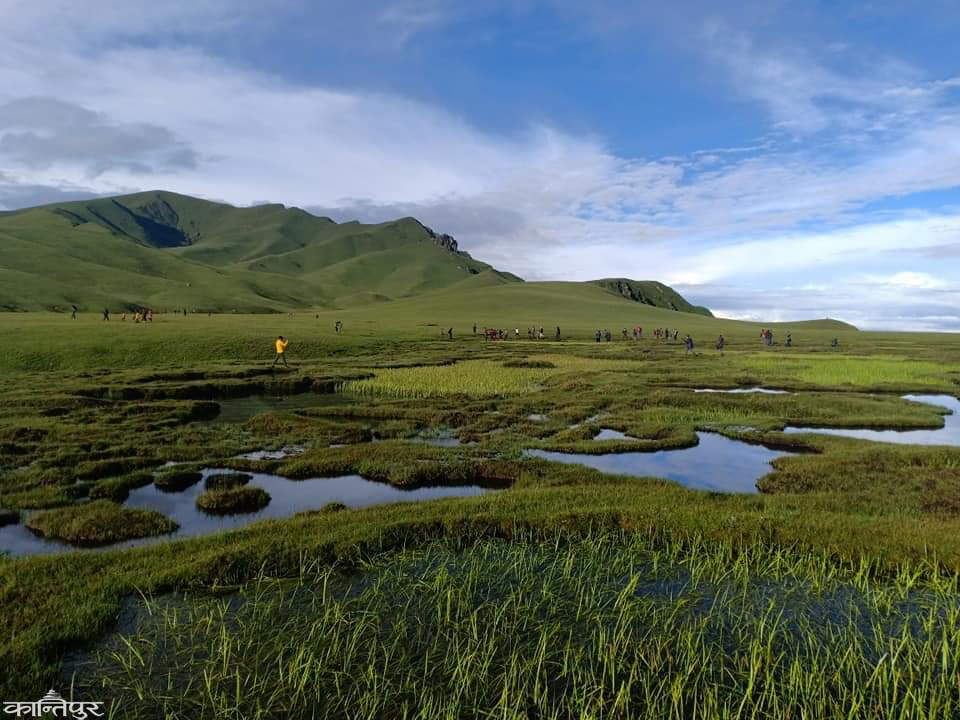
‘Flat plains are called patans in the local language.’ Seeing herds of white sheep, horses grazing in large pastures, and many species of birds and deer on these green plains is heartwarming,’ said Bharat Shah of Kailali, who first reached Badimalika on a bicycle two years ago for the purpose of publicity. ‘Since it feels like God has truly appeared in the minds of believers, the devotion towards Badimalika automatically increases in the faith of the devotees. And for nature lovers, there is hardly a more enchanting place than Badimalika.’
To establish the potential of Badimalika’s religious and natural tourism, the Far West region Tourism entrepreneurs say that economic development will change the course. ‘If Badimalika is to attract Indian tourists from the neighborhood, then thousands of them can earn a lot of income by selling worship materials,’ says Padma Bikram Singh, president of NATA Sudurpaschim. ‘The Badimalika area has 22 flat fields, colorful flowers blooming like in a garden, Triveni, Bishnupani, Khetibeti, Lauri Vinayak, and Dharmadwar.’ Singh says that there is a possibility of ice skating in Triveni Patan during snowfall. The Badimalika Triveni area receives heavy snowfall from Kartik to Chait.
Not only this, the Badimalika area is rich in biodiversity. Bajura is also one of the 18 districts of Nepal considered rich in biodiversity. Badimalika, which is considered a potential area for development as a scientific research site, has been in operation for a few years. Earlier, more than 45 species of rare and valuable herbs including Kutki, Forest Garlic, Sugandhawal, Padamachal, Bhutkes, Vayojadi, Panchaule were found in abundance. Similarly, it is also the main habitat of wild animals including musk deer, deer, snow leopard, Himalayan Thar, Himalayan bear, forest dog, Nair. Forest technicians say that hundreds of species of herbs are found here. Forest officer Dan Bahadur Thapa says that this area is also the habitat of rare wild animals.
Lack of protection
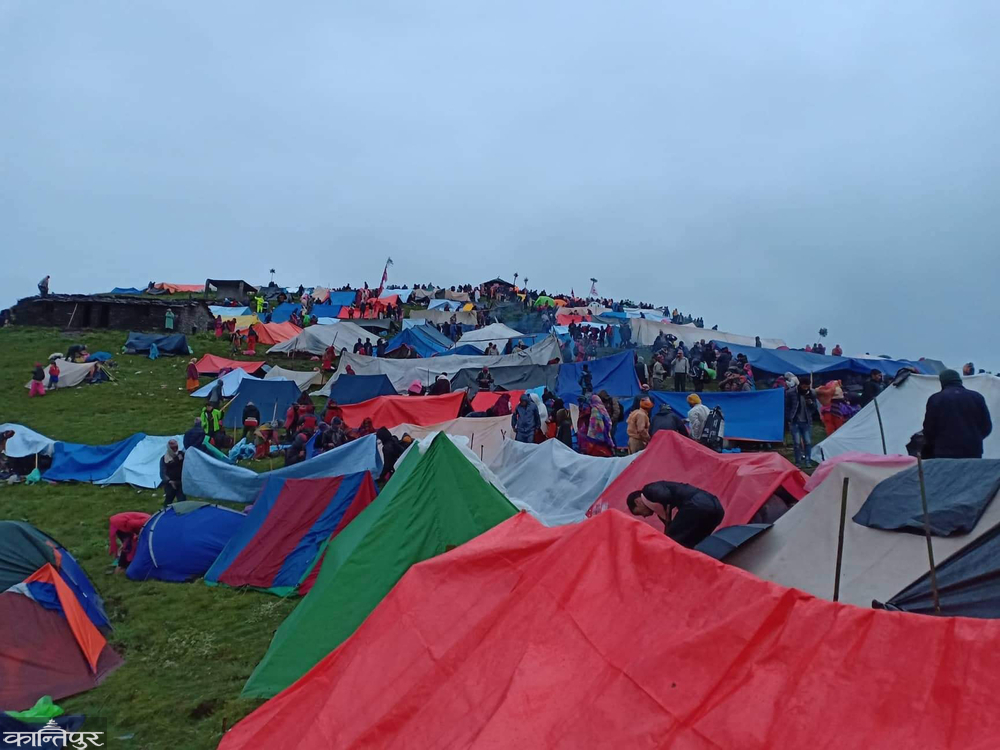
Experts say that encroachment has increased in recent years due to the lack of protection in the Badimalika area. Due to the increase in wild grazing, arbitrary collection of herbs, and illegal poaching, the biodiversity here is being destroyed.
From Chaitra to Bhadra, local residents of Bajura and Kalikot in the Triveni area of Badimalika भेडाच्यांग्रा, घोडा, खच्चड र भैंसीलगायतका वस्तुभाउ छोड्ने गरेका छन् । जडीबुटी पाउने सिजनमा संकलन गर्नेहरूको पनि उस्तै ताँती लाग्छ । लोपोन्मुख वन्यजन्तुको बासस्थान रहेको बडिमालिका क्षेत्रमा चोरी सिकार पनि मौलाउँदै गएको स्थानीयको भनाइ छ । ‘बडिमालिकाको सुन्दरतामा पहिला र अहिलेबीच कैयौं गुणा फरक परिसक्यो,’ बाजुराका दीपक अयडीले भने, ‘यस क्षेत्रको जैविक विविधता जोगाउने हो भने तत्काल संरक्षण योजना थाल्नु पर्छ ।’
अतिक्रमण बढ्दै जाँदा अहिले जडीबुटी र वन्यजन्तु घट्दै गएको पुजारी नेत्रराज पाध्याय बताउँछन् । यहाँ लौठसल्लो, गोब्रे सल्लालगायत औषधीय गुण भएका विविध वनस्पति पाइन्छन् । जिल्ला वन कार्यालयका अनुसार बडिमालिका क्षेत्र १४ हजार फिट उचाइमा करिब पाँच सय वर्ग किलोमिटर क्षेत्रफलमा फैलिएको छ । सरकारले ०६८/०६९ को बजेट वक्तव्यमा यस क्षेत्रलाई संरक्षित क्षेत्र घोषणा गरे पनि उक्त घोषणा कार्यान्वयन भएन ।
बडिमालिका क्षेत्रको दीर्घकालीन विकासका लागि पञ्चवर्षीय विकास गुरुयोजना निर्माण गरिए पनि काम भने हुन सकेको छैन । ०७३/०७४ देखि ०७७/०७८ सम्म निर्धारित पूर्वाधार निर्माण गरिसक्ने भनिए पनि हालसम्म काम सुरू भएको छैन ।
कसरी पुग्ने ?
धनगढीदेखि एक दिनको सडक यात्रापछि बाजुरा सदरमुकाम मार्तडी पुगिन्छ । काठमाडौंदेखि नेपालगन्ज हुँदै हवाई यातायातबाट बाजुराको कोल्टी विमानस्थल हुँदै मार्तडी आएर पनि बडिमालिका पुग्न सहज छ ।
बडिमालिकामा जानका लागि बाजुरा सदरमुकाम मार्तडी, कोर्द, पोरखे, जगन्नाथ, नाटेश्वरीलगायत कालिकोटबाट मुख्य मार्ग छन् । बाजुराबाट मुख्यगरी दुई वटा मार्ग छन्, सदरमुकाम मार्तडीबाट र कोर्दबाट । बाजुरामा जहाँसुकैबाट प्रस्थान गरे पनि बडिमालिका मन्दिर पुग्न तीन दिन पैदल हिँड्नैपर्ने परम्परा छ । फर्किंदा त्रिवेणी नगरपालिकाको नाटेश्वरी मन्दिर पूजाआजा गर्ने परम्परा भएकाले तीर्थालु त्यहीँबाट फर्किने गर्छन् । यद्यपि बडिमालिका जाने पदमार्ग भने सहज छैन । बर्सेनि लडेर दुर्घटना हुने गरेको छ ।
बडिमालिकामा आवास सुविधा उपलब्ध नहुने भएकाले यात्रीहरू आफैंले टेन्ट लिएर जाने गर्छन् । मेलाका बेला सामान्य अस्थायी होटल हुने भए पनि अघिपछि भने यात्री आफैंले खानाको प्रबन्ध गर्नुपर्ने हुन्छ ।