The latest investigation began on September 26, 2025, after a citizen group called Patriotic Genji filed a complaint.
We use Google Cloud Translation Services. Google requires we provide the following disclaimer relating to use of this service:
This service may contain translations powered by Google. Google disclaims all warranties related to the translations, expressed or implied, including any warranties of accuracy, reliability, and any implied warranties of merchantability, fitness for a particular purpose, and noninfringement.
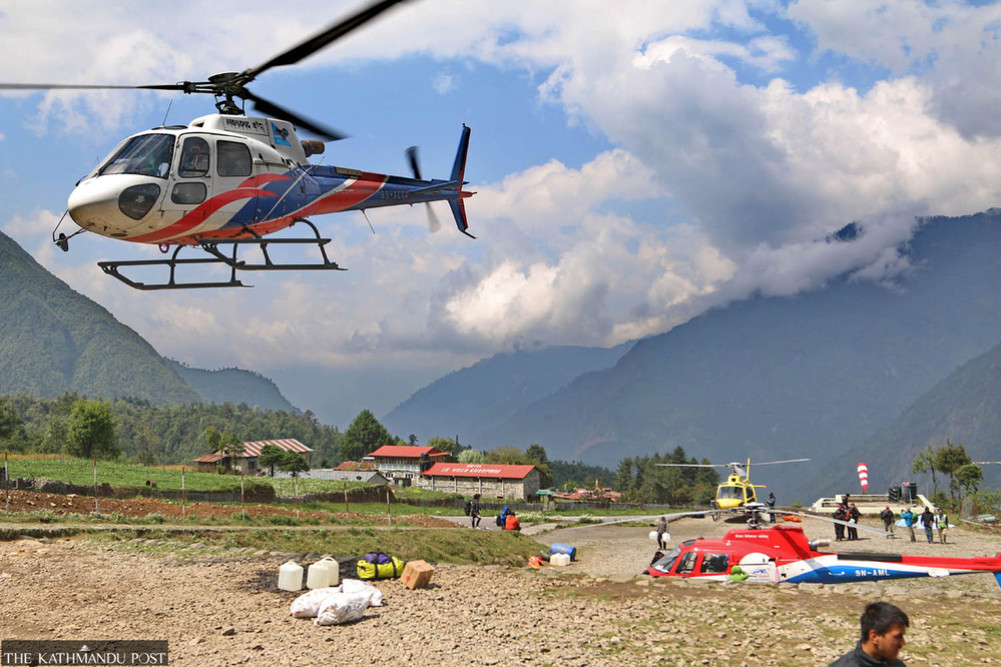
Helicopter rescues in Nepal are life-saving operations. Oxygen levels are low in the high mountains and the weather can change without warning. The ability to rescue tourists in distress by helicopter has saved many lives. In the same name, there is also a practice of extorting huge sums from insurance companies by pretending to be rescuers.
Nepal's fake rescue scam is not new. The Kathmandu Post first exposed it in 2018.
A few months later, the government formed an investigation committee and released a 700-page report. And, it announced reforms. But they were never implemented. In February 2019, The Kathmandu Post published a long investigative report on the same issue.
Last year, the Central Investigation Bureau (CIB) of Nepal Police reopened the file. In this process, fraud has not stopped, but has increased, the CIB's investigation shows.
How does the scam work?
The fake rescue network is active. The mechanism is straightforward: first, an illness is faked, a helicopter is called, the tourist is taken to the hospital and the necessary documents are prepared to claim insurance.
But the fraud and its network at each stage of this process are complex to detect. It is equally challenging for insurance companies operating from Australia or the UK to confirm what is happening in the Himalayan valleys above 3,000 meters.
CIB research has identified two primary methods of staging the ‘emergency’ drama. The first is to use tourists who do not want to return on foot.
For example, after a long trek to the Everest base camp, such tourists do not want to return on foot. The guide suggests that they pretend to be sick. Then the helicopter arrives. The guide will take care of the rest.
The second method is a bit more difficult. It is natural to see slight signs of altitude sickness at an altitude of more than 3,000 meters. The amount of oxygen in the blood may decrease, the hands or feet may feel numb, and the head may hurt.
However, the guide and hotel staff do the opposite at such times to scare the tourists. According to the CIB, they say that the tourists are at risk of death. Then, they say that only immediate rescue can save their lives.
In some cases, Diamox (acetazolamide) tablets, which are used to prevent altitude sickness, have been used with excessive water. Which shows bad symptoms and forces the patient to call for rescue.
In one case, baking powder was mixed with food and fed to the tourist, due to which the tourist becomes physically weak and a rescue flight can be called.
When a rescue flight is called, then the financial drama begins. A helicopter is carrying many passengers. However, each passenger's insurance company is sent a bill claiming the full amount. Suppose, they had chartered the flight alone. The insurance claim for a charter flight paid for by Rs 4,000 becomes $12,000.
Medical officers in the hospital misuse the digital signatures of senior doctors to create discharge documents. However, those doctors were never involved in the incident. In some cases, such a fake work is done with the knowledge of those doctors.
The CIB investigation has also shown an example of tourists who were supposedly admitted for treatment sitting in the hospital canteen drinking beer.
An office assistant at Sriddhi Hospital said that he had given his X-ray report to a different hospital a year ago. He said that the report was used by a foreign trekker for treatment and the insurance claim was made.
Police investigations have clearly exposed the commission structure of the fraudsters. Hospitals pay 20 to 25 percent of the amount to trekking companies. Another 20 to 25 percent is given to helicopter operators.
The bill is sent in a high volume. From which the guides and their companies benefit. In some cases, tourists are paid for participating in fake rescues.
How much was the fraud?
According to the CIB investigation, 4,782 foreign patients were treated at various hospitals from 2022 to 2025.
Of these, 171 cases were completely related to fake rescues. During this period, Era International Hospital collected $15.87 million from such activities. Sriddhi Hospital received $1.22 million.
Among the operators, Mountain Rescue Service operated 171 fraudulent flights out of a total of 1,248. Of this, it collected about $13.1 million from the insurance company. Nepal Charter Service operated 75 fraudulent rescue flights out of 471 flights. It claimed about $8.2 million.
Out of 601 flights of Everest Experience and Assistance, 71 flights are suspicious. The insurance claim is $11.05 million. According to the police, four tourists were rescued on one flight.
But the insurance claim is that they were brought alone on different flights. The total rescue bill is $31,100. An additional $11,890 has been submitted as hospital expenses.
Dr. Girwanraj Timilsina, during his statement, said that in a single incident, his hospital paid about 9.1 million rupees to Nepal Charter Service, 1.5 million rupees to Heli on Call and another 1.5 million rupees to trekking operators as commission.
‘My hospital has also paid commission to trekking companies and rescue companies from its own income to promote business,’ he said.
Have all tourists been cheated?
Not all foreign tourists who come to Nepal are victims of fraud. According to the CIB’s investigation, some of them themselves participate in such business.
In the WhatsApp messages studied during the investigation, German tourist Petra Homens complained to Nepal Charter Service Chairman Rabindra Adhikari that she was double billed.
‘Your company charged double!!,’ she wrote in the chat, ‘My insurer has already paid for the helicopter directly.’ The officer offered to refund the money after finding a double charge.
This conversation is important because it confirms that the helicopter bill was inflated for insurance purposes. And, the Homans themselves, who made such a complaint, are linked to the fake treatment claims.
On the other hand, Canadian tourists Sylvie Marie Hélène and Karin Chassagni filed a complaint with the CIB in late 2025. They allege that they were offered fake treatment during their November trek.
Their complaint describes a pattern that everyone understands. They alleged that the insurance company was shown very low oxygen levels (50 to 51 percent), unnecessary CT scans and ICU admissions were claimed, and the hospital exaggerated the situation to justify its documents.
Was the system supposed to be sound?
New research reveals systemic failures in Nepal. After the news was published in The Kathmandu Post in 2018, a government inquiry committee conducted a months-long investigation into 10 helicopter companies, 6 hospitals, and 36 travel and trekking agencies.
The 700-page report was submitted to the then Tourism Minister, Rabindra Adhikari. It included multiple insurance claims, including claims for single helicopter flights, pressure on trekkers to agree to unnecessary airlifts, and allegations of inedible food being served to tourists to make them sick.
The committee had suggested that all helicopter companies, hospitals, tour operators and insurance companies should submit detailed details of rescue flights and treatment to the Tourist Search and Rescue Committee, Tourist Police and Tourism Department.
The aim was to eliminate middlemen and make tour operators responsible for their customers throughout the tour period. But these measures were not implemented.
‘This fraud continued due to negligent actions,’ CIB chief Manoj Kumar KC said in a recent interview with the Post, ‘When steps are not taken against crime. Then it flourishes. That is why insurance fraud also flourishes.’
The latest investigation began after a complaint was filed on September 26, 2025, by a citizen group called Deshbhakti Genji. The complaint filed with the CIB demanded that the file, which had been stuck for years, be reopened.
Why is it so difficult to verify insurance claims?
Most travel insurance policies state that you must contact the insurance provider before any rescue can take place. However, contacting from the mountains can be challenging. In some places, the phone signal is not very good. By the time the insurance provider receives the information, the rescue has already taken place.
The patient has already arrived at a hospital in the capital, Kathmandu, far from the mountains. The local rescue company or trekking operator has already started preparing the documents.
Large insurance providers have set up their own 24-hour emergency response teams. Small providers do the same in collaboration with global aid companies. When an incident occurs in Nepal, local Nepali aid companies, representing these global companies, collect expense details, medical reports and flight details.
Fraud is easy to hide here. Local aid companies also prepare documents in collaboration with intermediaries, just like hospitals and rescue operators. Whereas, insurance providers based abroad trust the documents sent by local business partners.
Rescue companies bring more and more people on each flight, but send different bills to the insurance providers.
Trekking companies recommend using the same rescue operator, who pays more commission. The hospital admits patients, conducts unnecessary checks and maintains relationships with operators who give them business.
There is no party in this cycle whose interests are linked to the provider company that pays the insurance claim.
A strong indication of this is given by the charge sheet filed earlier this month. On 12 March 2026, the CIB filed an organized crime case against 32 people. Of these, 9 were arrested, the rest are absconding.
Operators and employees of three helicopter companies (Mountain Helicopters, Manang Air, which was rebranded as Basecamp Helicopters, and Altitude Air) are on the list of those facing charges. They also include physicians and administrators of Swacon International Hospital, Sriddhi International Hospital, and Era International Hospital.
During the investigation, the CIB found CCTV footage of a person who was said to be seriously ill and admitted to the hospital for treatment, sipping beer at a cafe. The cafe was run by one of the physicians in the chargesheet.
What is the impact of this on Nepal's trekking industry?
This investigation has raised uncomfortable questions for international insurance providers, tour operators and trekking agencies that send tourists to Nepal.
The fraud uncovered by the CIB was not the work of a few bad people. It is a The business was run by a structured, commission-based network.
The network operated openly for years. Licensed health workers who were supposed to serve patients were involved. Registered companies have sent millions of Nepali rupees through formal bank channels.
After the fraud was exposed in 2018, reform measures were announced with good intentions. But they were never implemented.
Various grounds are needed for the current investigation and prosecution to be successful. Will the Nepalese courts arrange for fines to reverse this business calculation?
It is equally important whether the Department of Tourism can form a mechanism to investigate inflated claims before any amount is paid.
A new government has just been formed. Many are watching how the government views such incidents and whether the results of such investigations will lead to conclusions.