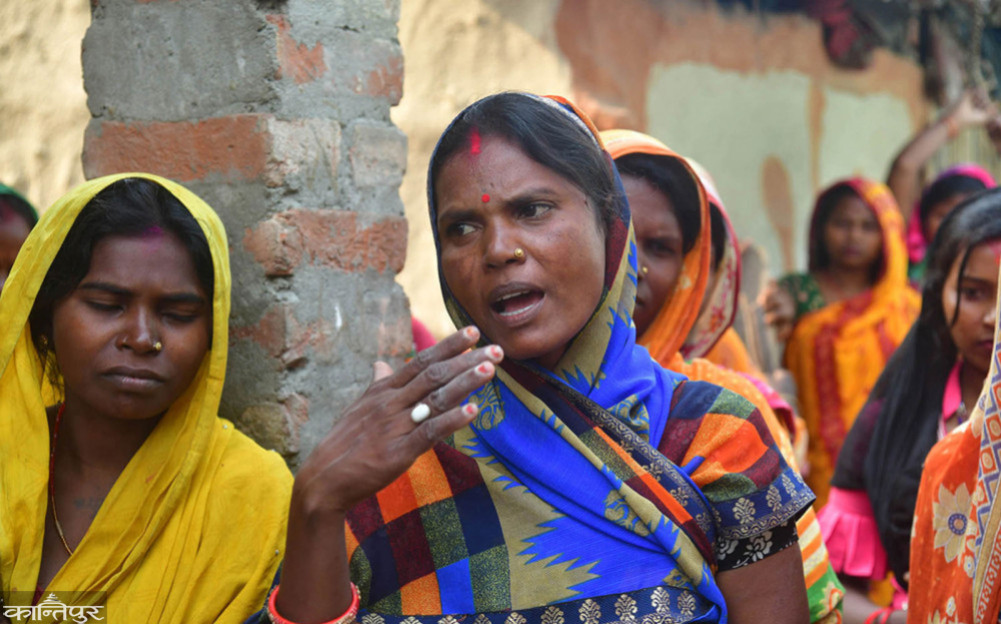
Seven parliamentary elections were held in 34 years, a constitution was made that promised proportional justice, but the representation of the extremely marginalized Madhesi Dalits in parliament has once again dropped to zero. With 80 percent of the elected members from the Bishwakarma community, other groups within the Dalit community have been left out.
We use Google Cloud Translation Services. Google requires we provide the following disclaimer relating to use of this service:
This service may contain translations powered by Google. Google disclaims all warranties related to the translations, expressed or implied, including any warranties of accuracy, reliability, and any implied warranties of merchantability, fitness for a particular purpose, and noninfringement.
Advocate Raksha Ram Harijan has filed a similar petition in the Supreme Court twice in the last 8 years. In the 2074 election, he had approached the Supreme Court and argued, ‘Madhesi Dalits have not been included in the party’s proportional list, this is a direct violation of the constitution.’ The court did not rule until the remaining term of the parliament was over. After it expired, it said in Chaitra 2080 that since the parliament no longer exists, there was no justification for this case.
In the 2079 election, Harijan approached the Supreme Court with a similar petition. The argument was the same. The Supreme Court did not give an order. The hearing of the case has been scheduled for a month from now. However, the parliament in which Madhesi Dalit representation was demanded was dissolved after the Gen-G movement toppled the government. After that, elections for a new House of Representatives have also been held. Harijan knows that the same verdict will be given in this petition.
Ahead of the last election, NCP worker Ghanshyam Prasad Rajak also approached the Supreme Court with a petition similar to Harijan’s. The Supreme Court ordered on 2 January that this case needed an immediate decision, saying, ‘It has been given priority.’ However, after the elections, the proportional seats were distributed and the MPs received their certificates, but the court did not hold a hearing. It has not been decided when the hearing will be held. ‘The 2079 petition is no longer justified,’ said Harijan, ‘There is a risk that this new one will be the same. Even the Supreme Court seemed indifferent to implementing the constitution.’
17 Dalit MPs have reached the House of Representatives since the 21st Falgun election. One through the direct system (Khagendra Sunar from Banke-3) and the remaining 16 through the proportional system. Dalits make up 13 percent of the country’s population, but their share in parliament is only 6.2 percent. This gap has not been filled in the elections of more than three decades. However, there is another big gap in this limitation of Dalit representation – out of the 141 Dalit seats elected in the elections since 2048, most of the hill Dalits (about 80 percent) were allocated. Although Madhesi Dalits made up 20 percent of Dalits in the 34-year total presence in the House of Representatives, this number has dropped to zero by 2082. It was negligible even before that.
Vishwakarma is also seen as a majority among the hill Dalits. Vishwakarma accounts for about 82 percent of the Dalit MPs elected in this election. The figure for seven elections has reached 50 percent. However, the largest Dalit group in Madhesh, Musahar, does not have a single representation. This raises the question, is the reservation in the proportional system designed to correct exclusion not benefiting one caste/community within the excluded community and producing more excluded people?
Advocate Harijan, a former member of the Madhesh Province Planning Commission, says that such unbalanced results are being achieved because the provisions of the constitution have not been implemented. Article 40 of the constitution states that the rights of Dalits are a fundamental right. Clause 7 of the Act states that the benefits received by the Dalit community should be distributed fairly so that Dalits from all communities receive them proportionally. Harijan's legal battle is to get an order from the court to force the Election Commission and the major parties to implement this provision of the Constitution. 'The current election results were neither proportional nor fair,' he said. 'The court should have intervened and made it right, but it did not do that either.'
After the 2062/63 people's movement, the electoral system was reformed to increase the political representation of the excluded community and the proportional system was adopted. The results were immediately visible. In 2064, there were 51 members in the parliament, which had one in 2048 and zero in 2051 and 2056. About 9 percent of the 601-member Constituent Assembly. However, the party leadership basically decides who will become MPs under the proportional system.
In the proportional system, parties submit closed lists before the election. The party leadership decides whose names will be placed in which order of priority, in accordance with the percentage of reservation determined by law. For Madhesi Dalits who are not in any party structure, the possibility of being placed at the top of such a list depends on the grace of the main leader. ‘From ticket distribution to proportional representation, leaders who make lists first choose those from their own community,’ says researcher Bhola Paswan. ‘They do not get access to the internal discussions of Madhesi Dalit parties. They are not even allowed to enter the room where the decision on ticket distribution is made.’
Rights activist Dr. Ramji Ram says that ‘the issue of representation in a democracy should not depend on the grace of any party or leader.’ He says, ‘It is a matter of rights.’ The low representation of Madhesi Dalits in parliament is not limited to this election. In the 2048, 2051 and 2056 elections, when the first-past-the-post system was adopted, only one Dalit was elected, and there was no Madhesi Dalit among them. In the 2007 and 2012 Constituent Assembly, which had 601 members and a proportional representation of 60 percent, the number of Madhesi Dalits increased, so there were 16 and 11 Madhesi Dalits, respectively. However, the 2017 constitution increased the size of the House of Representatives to 275 members and reduced the proportional representation from 60 to 40 percent (110 seats).
The Election Act set the representation of Dalits in the House of Representatives at 13 percent (i.e., at least 14 people) out of the 110 proportional representation. Parties are obligated to meet that number, but they are not obligated to include subgroups within Dalits - even though the constitution states it as a fundamental right, it has not been included in the law. The impact of which was seen in all three elections after the constitution. In 2017 and 2018, one Madhesi Dalit was elected, but this time it was zero. ‘Our policy was not right, our intention was not right,’ says Ram.
The answer to the question of who comes to parliament from the Dalit quota is given by one fact. Since 2048, the largest number of people have come from the Bishwakarma community. They have more access to the political network of the hills than any other Dalit subgroup, and they are 70 out of the 141 Dalit MPs elected in seven elections. This number is half of the total Dalit representation after the restoration of democracy. The elections held on 21 Falgun showed that Bishwakarma's grip on Dalit reservation is even tighter. Out of the 17 MPs elected, 14, or 82 percent. While the Gandharvas of the hills and the Musahars, Dusadhs, Chamars, Dhobis, and Tatmas of Madhesh remained zero.
'So far, the majority of those who have come have come from the hills, mainly Bishwakarmas, and then to a lesser extent Pariyars and Nepalis. The Gandharvas have not come at all. Zero representation in the political structure,' says Shivahari Gyawali, a researcher on the political representation of the Dalit community, 'The representation of Madheshi Dalits is similarly small. Musahar, which has a population of 600,000, has never come, and the Paswan and Chamar communities have a little bit.' Researcher Gyawali says about the reason for this, 'The Dalit movement in the hills has not been able to assimilate the Dalit community and movement in Madhesh. There is a problem of seeing it through the eyes of nationalism.'
Rights activists from the Madheshi Dalit community suggest that a separate cluster should be created for the group as to how such a gap between subgroups of the Dalit community can be bridged. They suggest that 4.5 percent of Madheshi Dalits should be included in the reservation allocated by the proportional system to ensure participation of Madheshi Dalits according to their share of the population. 'Other communities (like the Pahari Dalits) only look after their own interests. That is why a separate cluster had to be created for Madheshi Dalits while distributing proportional seats,' says rights activist Ramji Ram, 'It is not hatred against them that the Pahari Dalits got them. The main anger is towards the party leaders, who have violated the constitution and alienated the Madhesi Dalits.’
Similarly, advocate Harijan also said that the law should be amended to force the parties to distribute proportional seats to Dalit groups in a proportionate and fair manner. Rights activist Paswan, saying that the issue of representation is now becoming secondary, says, ‘It will not happen unless the law forces it.’ However, researcher Gyawali’s argument is different, he says that dividing Dalits into castes may reduce the weight of Dalits in politics that they have gained through population strength. Instead, he suggests that the constituency itself should be reserved under the direct system and that it can be changed for each election. “Since there will be competition only among Dalits, whoever wins will come from the Dalit community. By adopting this system for at least four elections (20 years), the Dalit community will have developed its competitive capacity,” he said. “It is appropriate to use the proportional system to bring in people from any caste who could not come directly.”
Rights activist Ramji Ram also believes that the next step in policy reform should be to reserve certain constituencies for Dalits for direct elections on a cyclical basis. “Only then will parties be forced to empower Dalits,” he said. The Supreme Court, in its decision in Chaitra 2080 on Harijan’s 2074 petition, had called Madhesi Dalits “oppression of double backwardness” and wrote about our electoral system, “A system that ensures Madhesi representation and Dalit representation separately but does not ensure Madhesi Dalit representation cannot be called inclusive.” The court then dismissed the petition, saying that since the term of Parliament had ended, the justification for this petition had also ended.
That is, the Supreme Court accepted the validity of the constitutional argument but dismissed the petition citing the delay in giving the decision on time. ‘The Muslim community has a separate cluster. It is not that they should not have one,’ says Advocate Harijan, ‘But, what about the Madhesi Dalits with the same population?’
Related news : Party cheating on landless Madhesi Dalits