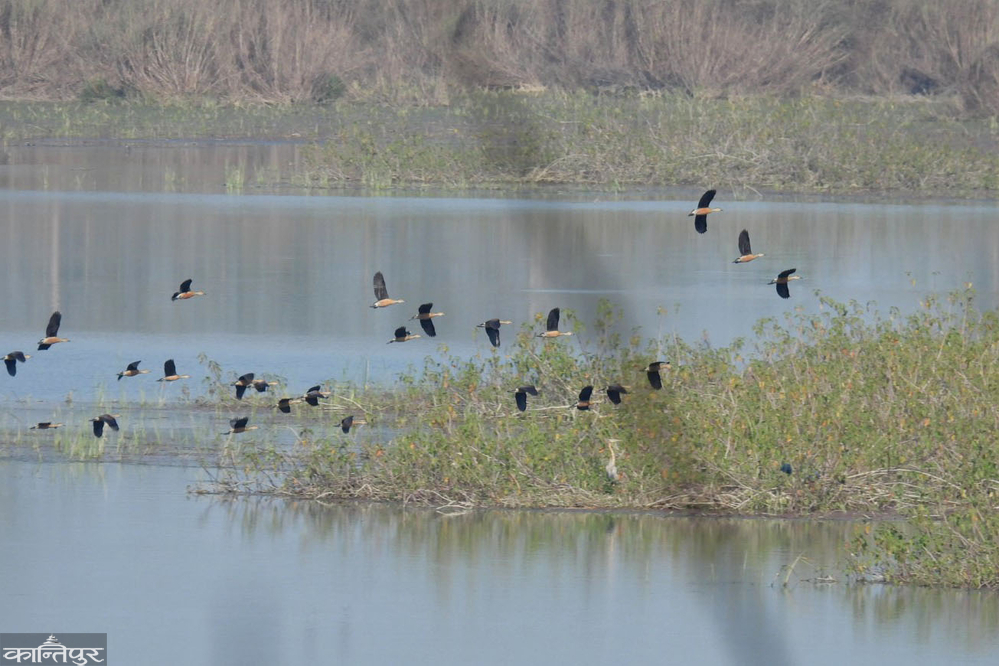
Birds are disappearing due to lack of water in the historic lakes of Chitwan National Park, and if conservation is delayed, these sites are at risk of disappearing in the future.
We use Google Cloud Translation Services. Google requires we provide the following disclaimer relating to use of this service:
This service may contain translations powered by Google. Google disclaims all warranties related to the translations, expressed or implied, including any warranties of accuracy, reliability, and any implied warranties of merchantability, fitness for a particular purpose, and noninfringement.
When discussing Chitwan National Park, not only wild animals but also the stories of the lakes and lakes here are always associated.
Especially the grandeur of Devi Lake and the fame of Nandabhauju Lake arouse curiosity. The questions are often the same – 'How many birds are found in the lakes inside the park?'
Many birds that rely on the water coming from the mountains to escape the winter are gathered on the banks of the Narayani, Rapti and Riu rivers that flow through the park. How many such birds are there in these lakes inside the park?
Manesh Limbu is a nature guide as well as a bird conservationist. A team of 13 people led by the same Limbu, who is also the president of the Meghauli Ghatgain Nature Guide Association, crossed the Rapti from Meghauli on Thursday morning to count the migratory birds that rely on the water. At first, they stopped for a while at the Rapti Bhangalo, beyond the Barahi forest lodge. There were animals including the chakhewa bird.
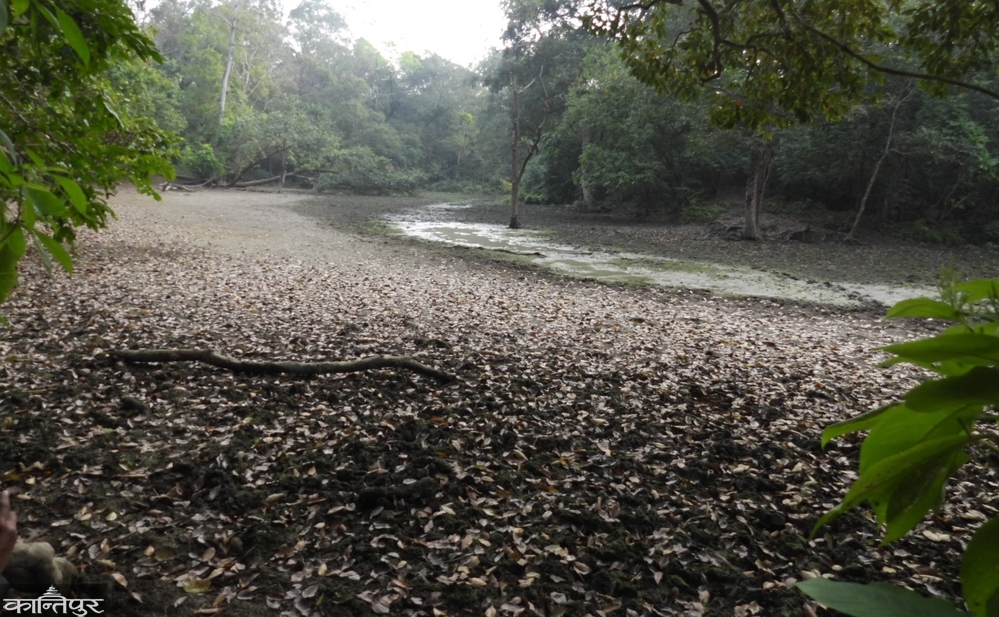
The enumerator team reached Nandabhauju Lake in no time. Here, a dhobi bird that came from near the mountains was found. But there were no other birds that depend on the water that comes across the mountains. Not only birds, but it was almost as if there was no water in the lake. There was damp ground somewhere. A little moisture like a dewdrop was seen in the southern corner. Otherwise, it was not water droplets but fallen leaves.
Then the team came to Bhimle Post and turned east to see birds in Budhi Rapti Ghol. In the summer, at least one rhinoceros always swims in Ghol. This time, not a rhinoceros, but a Magar crocodile and a small jalewa were found. Even though there was water, there were not many birds that depend on the water here. Then the team turned west. After crossing the river a little further, we come to Munda Lake. There was water in this lake too, but the birds were few and far between.
A water bird called a darter with a long, pointed beak was seen basking in the sun on a dry branch of a tree in the lake. As the census team started counting, the darter spread its closed wings. In front of the darter, an Asian open-billed eagle was seen searching for food in the water. ‘This lake too has started to be covered with sand from the other side,’ said the team leader and conservationist Limbu, looking worried.
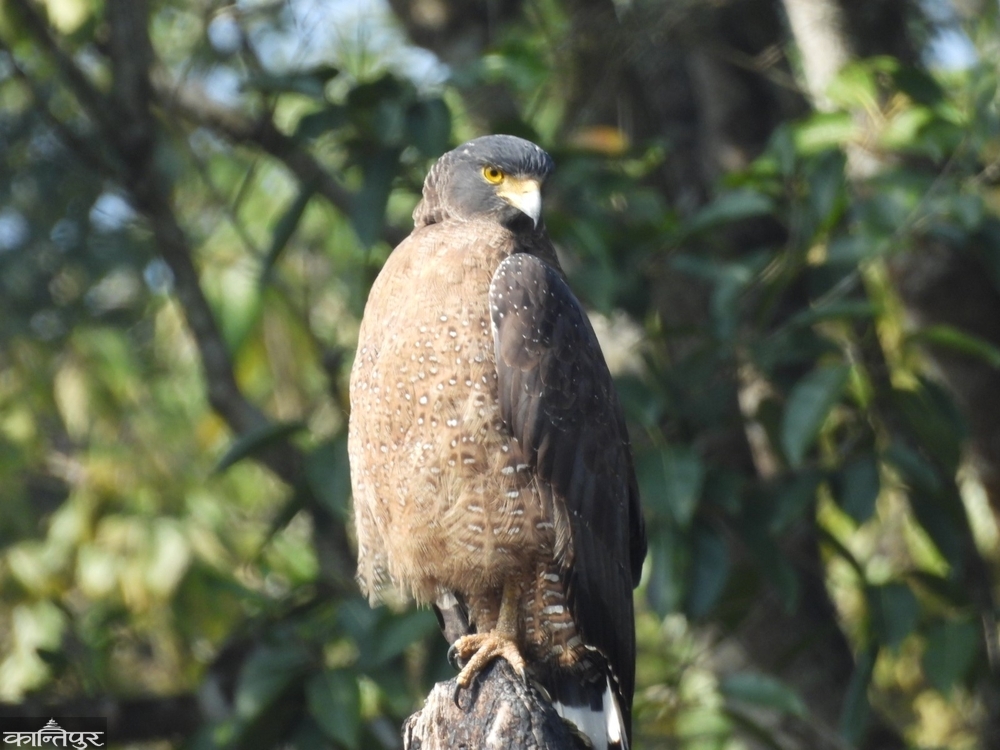
Then the team reached Singe Ghol. There was less water here, but the enumerators were excited when they found more bird species and numbers than anywhere else. A Kakakul eagle was sitting on a tree that had been broken in half. ‘It eats snakes.’ At this time, other snakes go into hibernation, but water snakes, rajagomans and pythons bask in the sun. This is a water snake that has come to bask in the sun,' said Limbu.
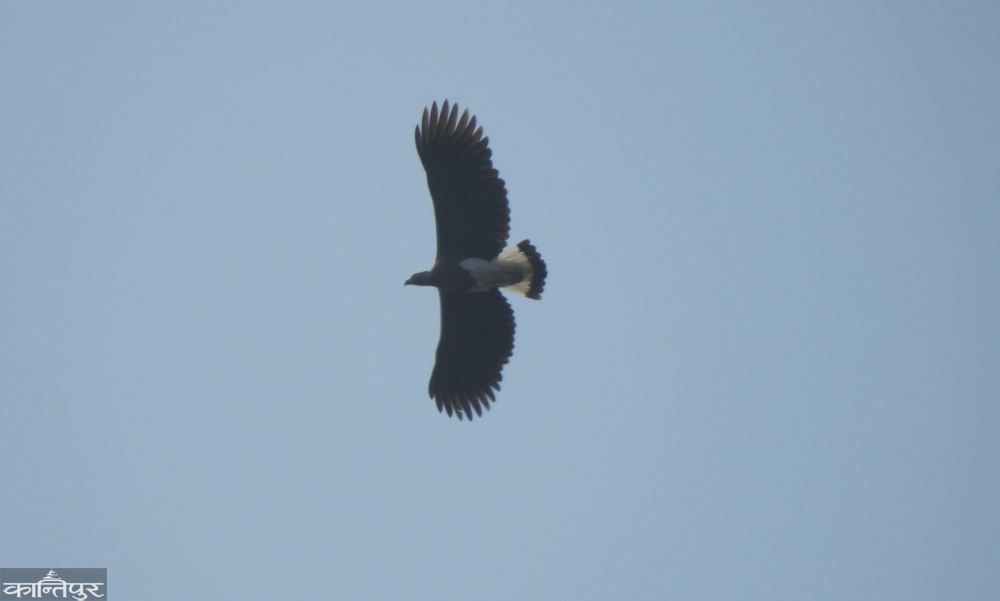
'Grey Headed Fish Eagle' was flying over the lake. Migratory birds and native birds dependent on water were also found here. Then the team headed straight west and stopped at Temple Ghol. Nawalparasi (Bardaghat Sustapur) is south of Danda Bazaar, Amaltari. From here, after crossing the South Narayani, we come to the ruins of the closed hotel Temple Tiger inside the park.
Yes, this hotel is located in the shelter, Temple Ghol. A flock of various species of water birds was seen in the ghol formed by a landslide in Narayani. From the hawk to the eagle, the migratory birds were found here. After recording the details of all the birds, the census team turned east and reached Devital, located on the edge of the park's chur.
As they were about to reach Devital, they saw a large venomous snake, the king cobra, basking in the sun at the foot of a Simal tree, and a herd of Gauri cows. The team was very excited when they reached the lake, but became worried when they reached the lake. The huge Devital is almost covered with weeds and bushes.
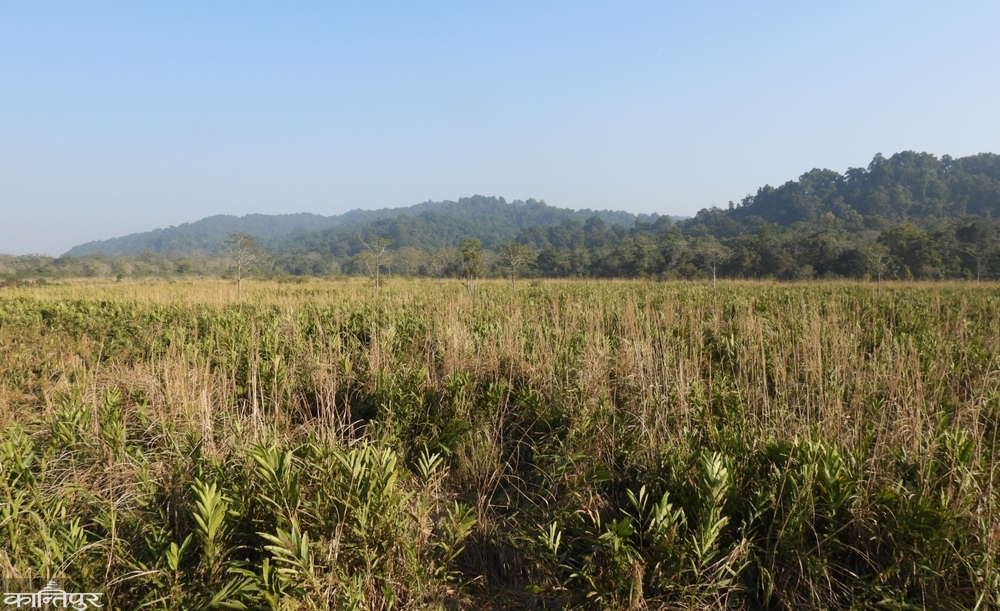
There was no movement of animals or birds around the lake. There was a thinly grown bush on the eastern side of the lake. There were bushes on the western side. A little water was visible in one corner on the south side. Devital's existence was only supported by that little water. Conservationists were very worried when they saw that Devital, one of the vast lakes inside the park, was at the crossroads of life and death.
‘Only three birds were seen in Devital, namely Kakakul, Datar and Khole Hutitayu,’ said team leader Limbu. With the disappointing results of Devital, the team concluded Thursday’s count.
Although the condition of Devital and Nandabhauju lakes was sad, Limbu said that the best was Temple Ghol and then Singeghol. The team had seen 32 Nadun geese in Temple Ghol.
Hathan Chaudhary, president of the Nepal Ornithologists’ Association, says that migratory birds stop in flowing fresh water and are less common in frozen lakes. ‘Birds do not stay in the lake because they cannot swim in the water and find food,’ he said. He says that the lakes are becoming overgrown with weeds and grasses and that the birds have stopped coming. He said that there should be some kind of water outlet in the lakes.
‘The number of grebes found on the banks of rivers and streams is very low, but the diving ducks should come, but they have not come that much,’ Chaudhary sounded disappointed. He has experience that birds used to live in lakes near rivers and streams, but now they are decreasing. There are also examples of birds not coming even after cleaning the lakes. He says that after cleaning the 20,000-meter lake in the Barandabhar forest, the birds stopped coming.
Senior Conservation Officer Ganesh Pant, who is the head of the Chitwan National Park, said that the important lakes within the park are now covered with weeds and are being covered with weeds and the problem of sand coming from the mountains and the accumulation of sand brought by rivers and streams has increased. Pant estimates that only 10 percent of important wetlands like Devital are left. But he complained that there is no budget for the maintenance and management of the old lakes.
‘At least 40-50 lakh rupees will be spent to improve the condition of Devital. But we do not have the budget. We are planning to manage it in coordination with other bodies,’ Pant said.
These lakes, ponds and wetlands are not only the habitat of migratory and native birds, but also the basis of life for other large and small animals of the park. But this basis is deteriorating. Conservation initiatives are necessary even today, otherwise in the future these lakes and ponds will be limited to only stories and photos.