In Chitwan, up to 14 people were killed by tigers in a year, but now this number has decreased dramatically, but the pain of the families who lost their lives due to tigers is not less.
We use Google Cloud Translation Services. Google requires we provide the following disclaimer relating to use of this service:
This service may contain translations powered by Google. Google disclaims all warranties related to the translations, expressed or implied, including any warranties of accuracy, reliability, and any implied warranties of merchantability, fitness for a particular purpose, and noninfringement.
In the last financial year, wild animals killed 13 people in Chitwan National Park. Among them Padma Bahadur Rana Magar of Madhya Pradesh who lost his life due to tiger attack is the only one.
Padam Bahadur of Khairhani municipality-13 Kumroj Simrani village has two herds of buffaloes. Padam Sana, a resident of the squatter settlement of Simrani, was planning to buy paddy cheaply and sell it at a higher price to earn. He used to go to the forest every morning to get grass for paddy.
The house of Padam Bahadur is near the Kumroz Intermediate Community Forest near the park. He estimated that padi can be reared at a low cost by feeding it with grass brought from the nearby forest. He entered the forest early on June 27th like any other day to get grass. But even though the two women who went with them returned, the body of Padam Bahadur was found in the forest. Padam, who was ready to cut grass and put heavy weight, was attacked by a tiger and killed. Padam Bahadur has three children, two daughters and one son.
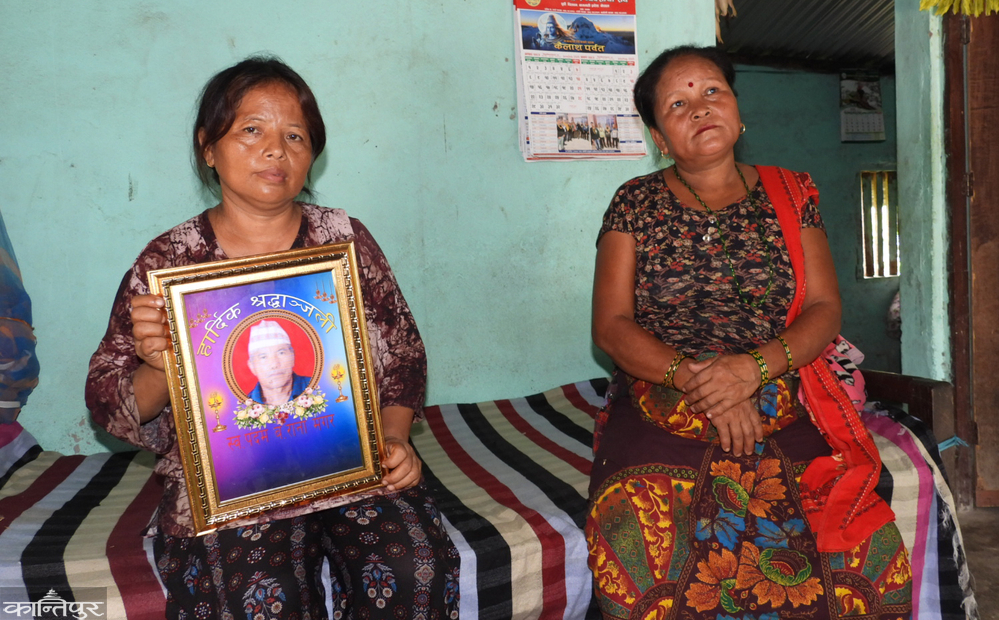
Son Khambir Rana Magar passed away when he went to Malaysia for foreign employment. Padam Bahadur's daughter-in-law Lakshmi Rana Magar says, "First we had a shop in Chitwan Pithuwa". After losing money, we sold it and went to Nepalgunj. But now there is no property, nor the father of the house.'
He also had land in his name in Pithuva and Nepalgunj. They went to Nepalgunj after selling Pithuwa's land to settle the matter. Father Padam went to India and son Khambir went to Malaysia to earn money after not being debt free. But after such an incident in Malaysia, they had to sell the land of Nepalgunj and pay the debt. Then they returned to Chitwan and started living in Simrani. Manmaya, a ward member of Khairhani-13, a resident of Simrni, in Tamang village, more than 200 households do not have the same Lalpurja as Padam Bahadur's family. That's why they raise goats and pada for earning.
Padam Bahadur also used to sell milk when he lived in Pithua. So he also kept a cow . But since the income was not as expected, he thought that it would be better to take care of paddy. Even though he was over 70 years old, he worked hard. But his life ended because of the tiger before he could enjoy the reward . Lakshmi, who lives with her mother-in-law Dilmaya, also has two children. His son is 22 and his daughter is 18. Our problems are increasing. After studying 12, the son went abroad to work. Daughter is studying 12 . The house is under the forest . We have to cut firewood from the forest," said Lakshmi, "Let's cut grass in the field, we don't have land. There is no solution without going to the forest.'
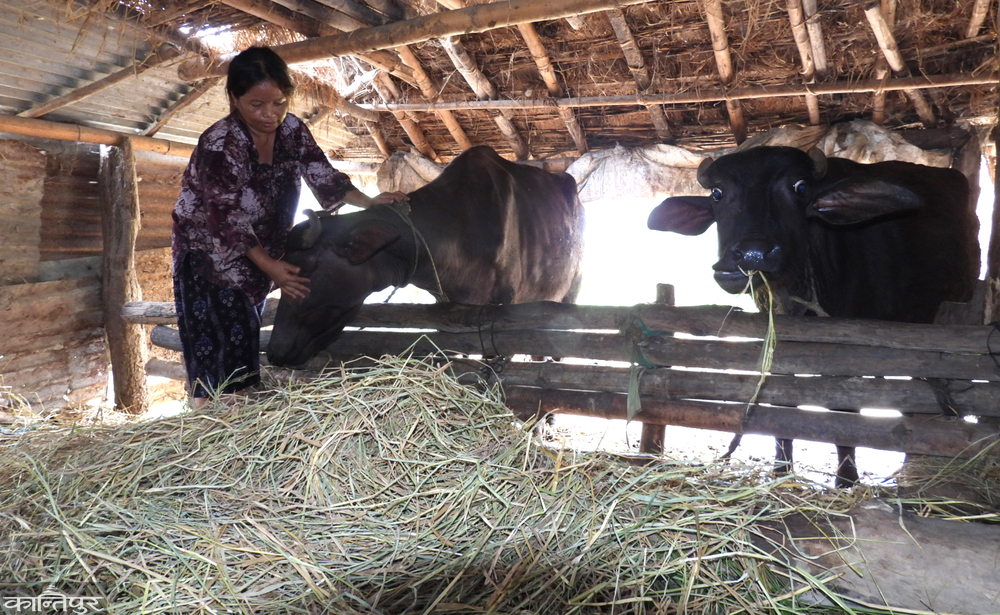
After this incident, the raiders have stopped going to the local forest. Padi of Padam Bahadur's cowshed is full of straw now. Straw became expensive. Not as nutritious as green grass. Therefore, Lakshmi is in a dilemma whether to raise Padi or to sell it. The incidence of local deaths due to tiger attacks has reached a high level and has also decreased significantly. But even if it is only one person who lost their life due to the tiger, the pain of their families is deep.
Tiger attacks are decreasing
Kumroz village was once very disturbed by the human losses caused by tigers. The government announced the number of tigers in Nepal on July 13, 2079, on World Tiger Day. It was announced that there are 355 tigers in the country and Chitwan alone has the highest number of 128 tigers in the country.
The results of the tiger census from November to February 2078 were announced on that day. In the financial year 078/79, there were too many incidents of tigers killing people in Chitwan. According to the details of Chitwan National Park Office, 14 people died in the middle area due to tiger attack in 078/79. However, within that financial year, the park was going to distribute relief money only to the families of 11 people who were killed by the tiger. In that financial year, tigers attacked 6 people in Kumroz Central Community Forest area alone. Four people were killed in the attack.
In the last fiscal year 081/82, 13 people died in the central area of Chitwan National Park after being attacked by wild animals. Out of which only one person who died due to tiger attack is Padma Bahadur Rana Magar of Kumroz. Another person also died when the tiger attacked.
In East Nawalparasi Tamaspur, the park has not kept that person in the list of 13 people after it was discovered that a person who had gone to the forest with the plan to trap and kill a tiger was attacked and killed by a tiger. The statistics show that although it is difficult to be zero, the incidence of tiger attacks, which was once a matter of fear, is decreasing . But as the number of tigers increased, there was concern that the attacks would also increase . "If the number of tigers increases, it does not mean that the incidents of tigers will increase". When the number of tigers increases, there is a danger that the tigers will not only be limited to the old habitat area but also move to the new forest and if the local people do not take precautions in such areas, there is a danger of an incident," said Baburam Lamichhane, a wildlife expert who studied tigers, leopards and human relations. He said that events have shown that by being careful about tigers and taking control of tigers that can cause problems at an early stage, the incidence of attacks can be reduced.
He said that the areas where tigers and people meet should be identified and managed well. Although tigers are growing in the forest, they are relatively less, but the local people go to the forest to cut grass and pick greens. In such a situation, it is suggested that by determining the forest area used by the local people, it should be managed in such a way as to be safe from the tigers and to create an environment where the local people should not go within the forest limits used by the tigers . Tigers do not normally attack humans. Lamichhane says that they attack only when they encounter a sudden encounter and are unable to hunt because they are weak. Therefore, the locals should be made aware of the precautions to be taken in the forest area where tigers are found. In addition to this, the park administration should be prepared to find and control tigers that can cause problems and become displaced due to their inability to hunt in the forest. There is an example of a single tiger killing many people. Such tigers are not caught early," he said.
Lamichhane's study has shown that tigers causing problems by attacking humans are around five percent. Ganesh Pant, Chief Conservation Officer of Chitwan Park, says that in order to avoid the attack of wild animals including tigers, it is necessary to get to know their habits and adopt the same behavior. "Even if there is information about how to go to the forest, what is the appropriate time and method, there is a possibility that the incident will not happen," said Chief Conservation Officer Pant. He said that cameras have been installed to monitor tigers that may cause problems. In addition to this, habitat management work has also been done within the park area. Everyone's influence will reduce the problem," he said.
Wildlife expert Lamichhane says that the incidence of wild animal attacks sometimes increases rapidly and sometimes decreases and the problem seems to increase again . "When there are many incidents, there is more discussion, awareness also increases". But slowly started to forget, the problem may repeat, he said .
problems in management after rescue
The team of Chitwan National Park captured a tiger from the Meghauli area of West Chitwan on Tuesday afternoon on July 6. Although the tiger came near the village, it did not cause any incident. The team of the park was monitoring the tiger thinking that it had returned on its own. But after not returning even for two/three days, it had to be taken under control . Chief Conservation Officer Pant says that when tigers are spotted in the village, the need to control them increases. But it is becoming a problem to keep the tiger under control.
There is a shortage of cages to keep tigers . Chitwan National Park rescued two tigers last year. We kept one of them in this same cage. Due to lack of space, the other one had to be sent to the cage of Parsa Park," said Thapa Magar, information officer of the park.
There are currently seven tigers in the cages of Chitwan. He informed that there are two tigers in Sauraha's cage and three tigers in Kasara's cage. There are two tigers in the wildlife rescue center in Devnagar. "The tiger caught 5/6 years ago is also in the cage," said Thapa Magar.
The officials of the park are not satisfied with the management of the rescued tigers. We are not keeping the tiger hungry, we are feeding it. But the problem has started to arise in making the payment," he said. According to the concept of using the captured tigers for tourism, he said that even though a rescue center was built in Devanagar, it was not used enough. "It is better to keep such animals in the form of a zoo," said Chief Conservation Officer Pant. Pant has seen the need to make standards for keeping rescued animals. Tourism can also be supported by keeping the rescued animals, including tigers, in a wider area, not like a cage. The animals would also get a better environment,' said Pant. Pant says that it is not difficult to achieve success in conservation by reviewing the past efforts in tiger conservation and making a plan.

