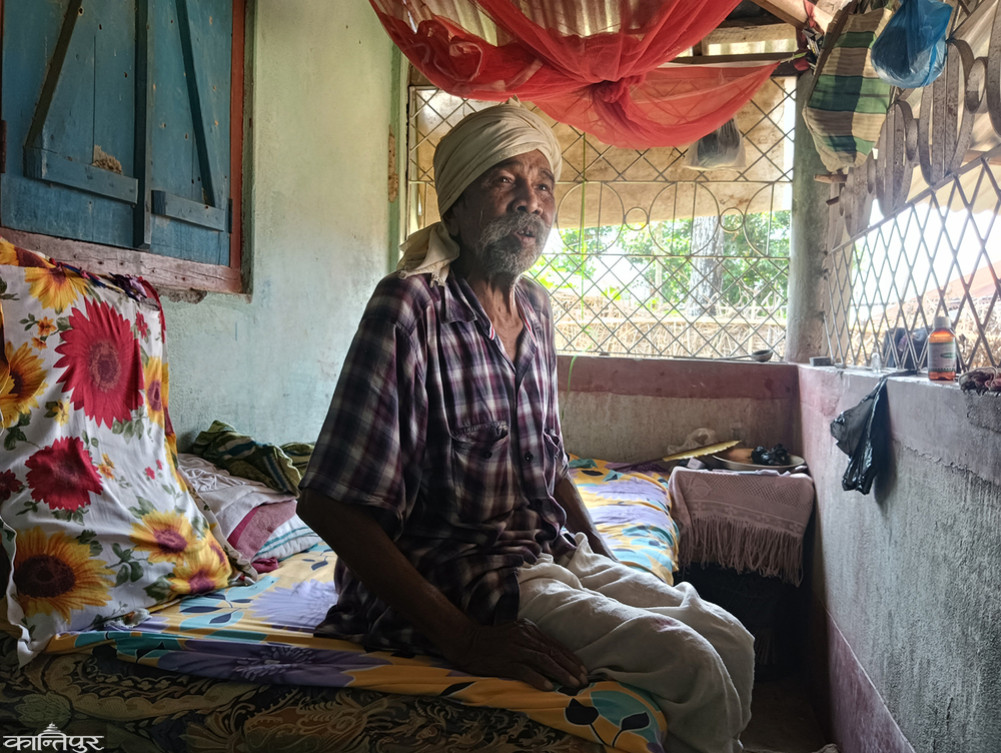
I will see this city today. It feels like a dream. I'm going to bow myself at home! Is this Kankarvitta where I lived?', he says with a laugh, 'today this is not a city. I am new. Like a wallet that lost its way and arrived somewhere. People don't know me. On the other hand, when you moved out, when did you come? They ask that.
We use Google Cloud Translation Services. Google requires we provide the following disclaimer relating to use of this service:
This service may contain translations powered by Google. Google disclaims all warranties related to the translations, expressed or implied, including any warranties of accuracy, reliability, and any implied warranties of merchantability, fitness for a particular purpose, and noninfringement.
Year 2011. The river Mechi, which was flowing at its own pace, was diverted to the east due to floods during the drought. The bank of Mechi was a settlement of the tribal Munda community living by farming in Jamirgarhi. A pre-planned mechi washed away Munda Basti. There was no other alternative for the Mundas. They decided to live in a dense forest about 5 km north of their washed away settlement. And went north towards dense forest.
At that time he was only one year old, bald and bald. He left his rural home with his grandfather Pary Munda, grandfather Arjun Munda and father Dhanraj Munda. The Munda family, who went in search of a place to live, tore up the dense forest and made a place to pour out by making a camp. Dhinda's grandfather was at the forefront of Pari Fandanitta . Finally the name of the place remained, Parivitta .
This Parivitta, which today has been overshadowed by the magnificence of Kankarvitta, a border trading town in the east. Parivitta seems to be basking in the shade of Kankarvitta . The witness of which is 72-year-old Dhinda Munda . Whose birth sign is connected with Mechi river . Who have shed many streams of sweat to make a dense forest a major city .
'The place called Kankarvitta city today did not exist till 2025/26. There was a dense forest, people were afraid to walk during the day,' remembers Munda, who was lying on the bed with a sick body, 'not even this highway (East-West Highway) was like this . Here was a goreto, a small path . But, not many people used to walk.' According to him, at that time, the movement of people was through Naklabanda. To earn money, the people of the eastern hilly district used to go to Mechi via Nakalbanda and decided their destination after reaching Naxal. Kankarvitta was a forest. Who will come?,' he says.
But, over time, its shape changed . Land reform was implemented in 2021. The land began to be measured. The initiative to get land in the name of the people has started . The process of opening the highway started from 2025/26. The dense forest was slowly being torn apart . Small houses made of wood and bamboo started to be seen after cutting the forest. The plan to construct a bus park at Kankarvitta has moved forward. The movement of people started to increase . Small shops started opening for business . Trucks carrying goods started to appear. Now the forest is not just a forest. Here the idea of a new city started.
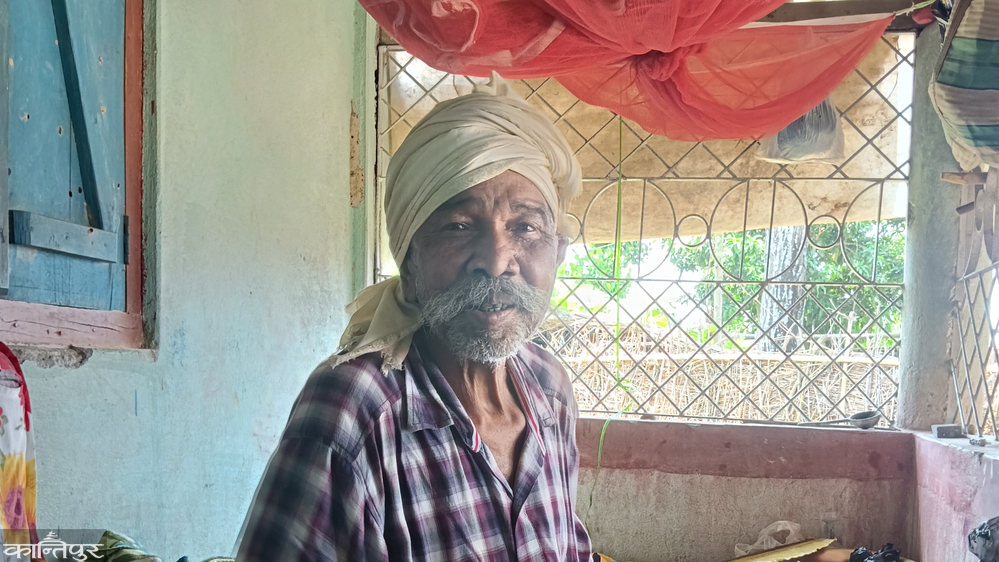
Mechi became a bridge . The trucks coming across the river started crossing the Mechi bridge. Buses started appearing on the highway. Shops covered with tents began to change into mobile shops. In the settlement with 5-7 houses, people of hill origin came and started building houses. Nakbulbanda, which is the center of people's movement, became anonymous from its identity . But, Kankarvitta set his upward journey .
In this decades-long journey of life, Dhinda saw Kankarvitta at many stages. He has seen a difficult journey by train on this highway . They have seen the flood of Mechi who cannot even imagine swimming. Mechi has felt the tears of the family who have been devastated many times. In Kankarvitta, Kamilasari has gone to see the rickshaw pull . He has seen many pictures of this city .
'I will see this city today . It feels like a dream. I'm going to bow myself at home! Is this Kakarvitta where I lived ?,' he laughs, 'today this is not a city . I'm new . Like a wallet that has lost its way and arrived somewhere . People don't know me . On the other hand, when did you move out and move out? They ask that.'
As he said, Kankarvitta changed the form, changed the chinari . And made the new people of the city to the bald heads . Who made a city where people are afraid to walk with blood and sweat. Kankarvitta doesn't see a rickshaw now . Where does Kankarvitta know Rangagadi now and ? Muddy and slippery roads with gravel are hard to see . There are also bamboo and wooden houses in this city! This city is running with twinkling bright lights . The race of smart city is being pushed. And those who make the city are anonymous from the city.
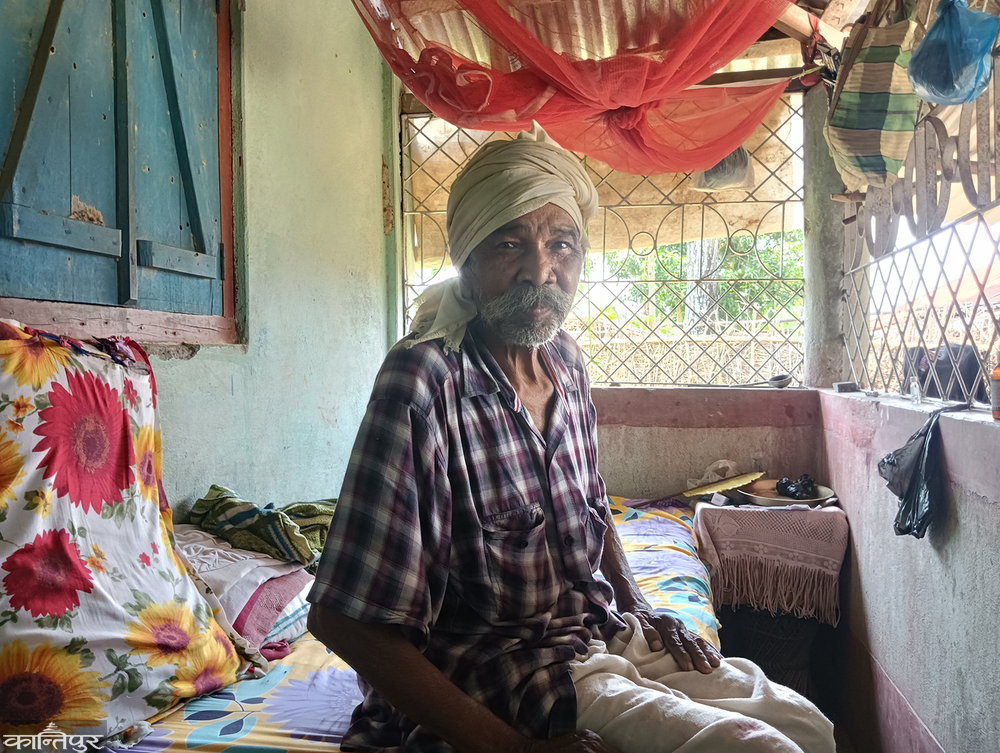
These days, Dhinda hasn't climbed Kankarvitta hill for years. He reached places like Sikkim, Darjeeling, Nepal's Bhojpur, Ramechhap to work in his old age and is now in bed due to illness. He has a disease that does not increase the blood in the body . Mahilo is living with his grandchildren at his son's house. ``My wife left me, and I also got sick . I have lived with my grandchildren . These are the only support,' he said in old age sentiment.
He has made Kankarvitta the home of karma, struggle and life, and he knows this city closely. They have gone to hear and see from the forest to the concept of smart city through the digital age . And he can tell anyone, the story of how this city has changed. He used to get out of bed every now and then and come to Mastir Highway and sit in the shade of a tree and look at the city until a while ago.
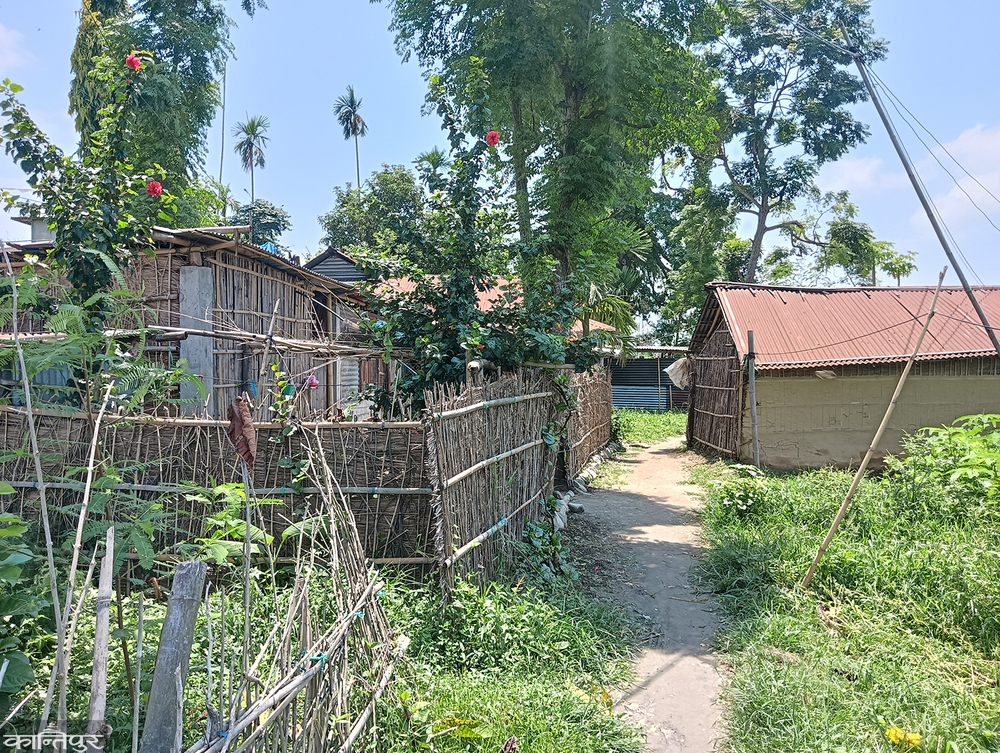 Dhinda's house
But, not the city . Why did this city need a tree as old as a pile and rusted? In the name of making the Asian highway, all the trees on the north-south highway were cut down. Now which tree will he stand on and watch the city?