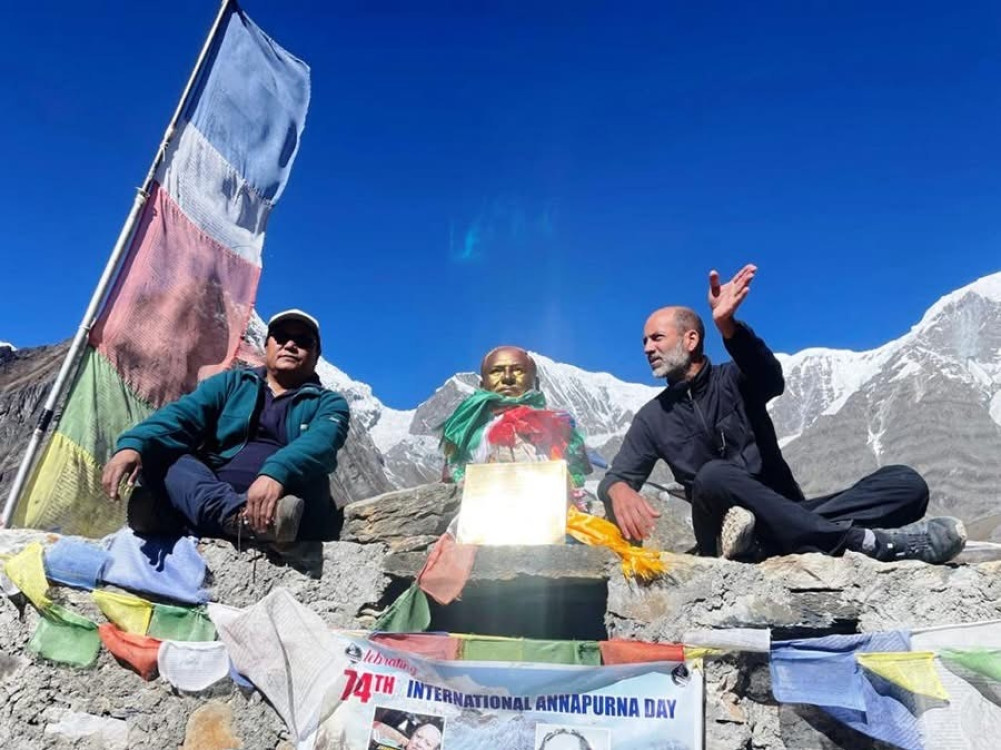
He thinks that fulfilling the responsibility left by his father is like having the entire Annapurna standing before him. He says, 'Annapurna is not just a mountain, it is a symbol of challenges.'
We use Google Cloud Translation Services. Google requires we provide the following disclaimer relating to use of this service:
This service may contain translations powered by Google. Google disclaims all warranties related to the translations, expressed or implied, including any warranties of accuracy, reliability, and any implied warranties of merchantability, fitness for a particular purpose, and noninfringement.
Maurice Herzog, a French citizen who climbed a mountain above 8000 meters for the first time in the world, wrote in his book 'Annapurna', 'There are other Annapurnas in the life of man.' This line of his 'best seller' book, which contains the feeling of climbing Annapurna, means that life is not possible even after achieving a great success.
Life moves on, new challenges come up and we have to make a fresh start every time . After winning one 'Annapurna', another 'Annapurna' awaits us .
1950, June 3 . A date that changed the definition of mountaineering in human history . French mountaineer Maurice Herzog and his friend Louis Lachenal set foot on the summit of Annapurna I (8,091 meters), the highest mountain in the world for the first time over 8,000 meters. It was not just a climb, it was a living symbol of indomitable courage, unwavering faith and the limitless potential of human consciousness .
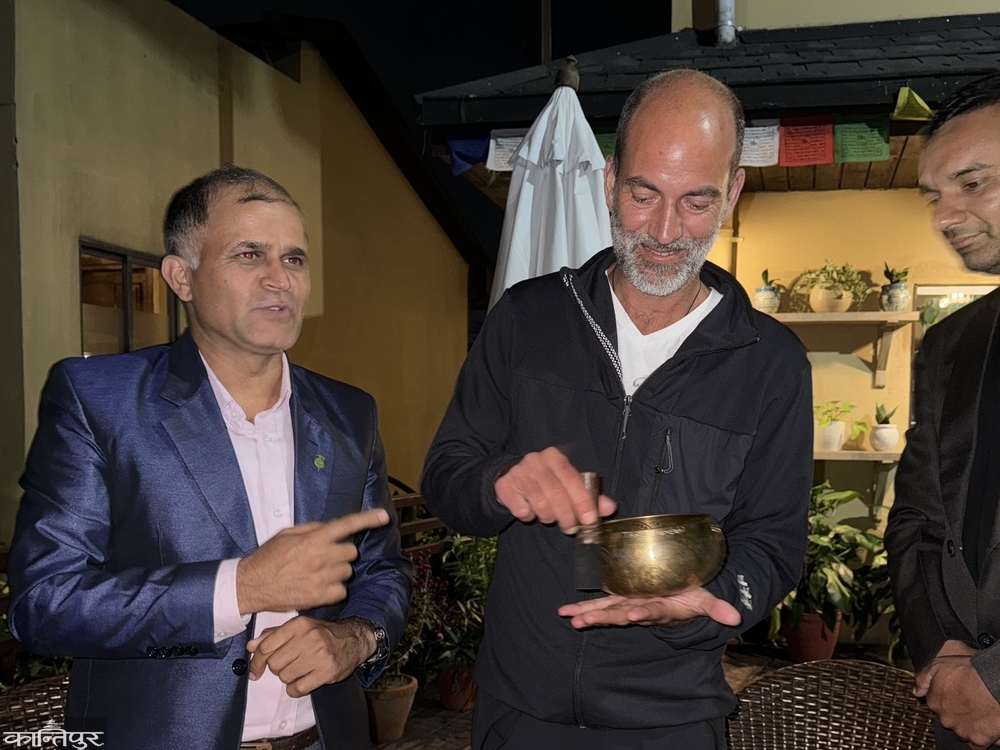 It has been 75 years since the French national team climbed Annapurna on Tuesday. Lewis died at the age of 34 five years after the climb . Maurice died in 2012 at the age of 93. Mathias Herzog, Maurice's son, came to Nepal in October of last year to prepare to celebrate the diamond jubilee of climbing Annapurna this year. He reached 'North Annapurna Base Camp' the same way his father took to climb Annapurna from North Mohda. From Pokhara, he reached the base camp via Beni, Tatopani, Narchang in Myagdi.
Mathias returns to Nepal to celebrate his diamond jubilee, remembering his father's footsteps in the shadow of the mountains but forging his own path. Now he is devoted to yoga and spiritual service but every step is still guided by the story of Annapurna. This time he didn't come alone, he also brought family members and a French musical team. He reached the northern base camp on Monday to celebrate the diamond jubilee.
When he reached the base camp for the first time, he saw the mountains towering around him. His father turned his eyes to Takuro. Did yoga . Be absorbed in meditation . Father's brother-in-law made in the base camp. He cried looking at Salik. It was not a tear of pain, it was of gratitude. 'When I saw my father's old man . I stood there silently . It felt like time stopped for a moment,' he said in a soft voice, 'I felt, I am not following his footsteps, I am on my own path . But that path has His blessings.'
Mathias, the son of Maurice Herzog, who came to Nepal to celebrate the diamond jubilee of Annapurna climbing, was welcomed at the Pokhara airport by Pokhara tourism businessmen. 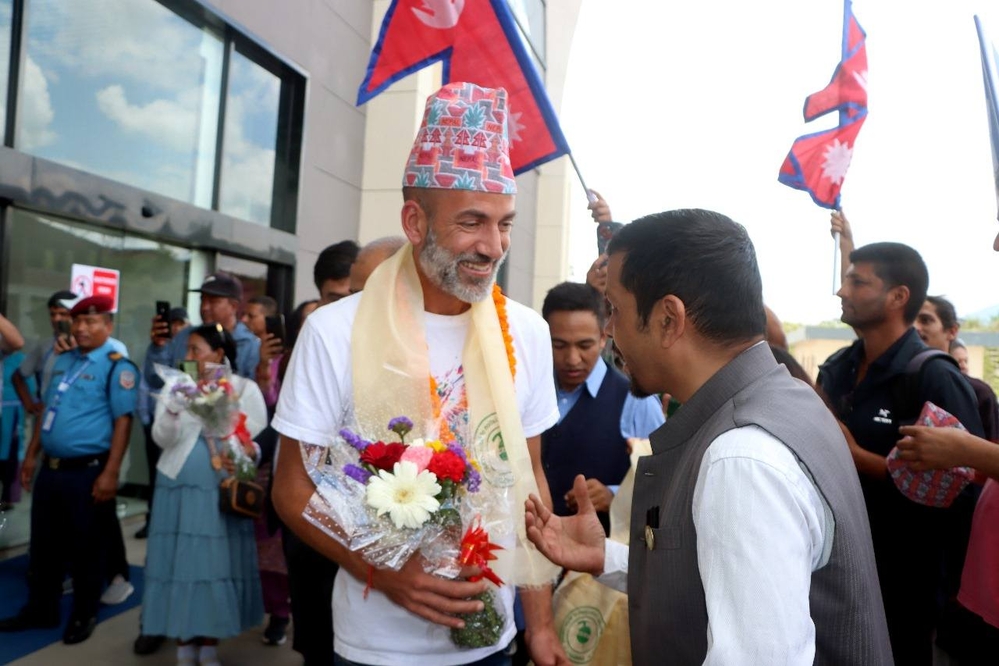 Mathias, the son of Maurice Herzog, who came to Nepal to celebrate the diamond jubilee of Annapurna climbing, was welcomed at the Pokhara airport by Pokhara tourism businessmen.
After returning from the base camp, he met in Pokhara one evening and reminisced with his father. 'Father used to speak less but sometimes he spoke openly. "He was very modest," recalls Mathias, "He never spoke much about his personal experiences." But sometimes, when it was just the two of us, he could see a deep feeling in his eyes.'
According to Mathias, what Maurice experienced after reaching the summit of Annapurna was the beginning of a spiritual transformation. Maurice told Matthias, "After reaching the summit, I felt such a feeling of love that words cannot describe". That moment filled the void in my life .'
In Maurice Herzog's first book 'Annapurna: The First Conquest of the 8000m Peak', published in 1951, such sensations are mentioned only as hints . At that time in France, it was not possible to speak openly about personal or spiritual matters. "He wasn't saying it, but I could tell, something deep inside him had changed," Mathias recalls.
The book based on Maurice's experience told millions of readers the story of the mountain's mysteries, challenges, and human flourishing. This climb was also special as it was done without oxygen, in one season and on the first attempt. Climbing Annapurna in the 1950s was not as easy as it is now. They didn't have quality shoes, jackets, GPS or oxygen like they do today. He only had leather shoes, a cloth jacket and a map in his hand. Both Herzog and Lachenal suffered severe frostbite after the climb. Because of this, Herzog lost all his fingers .
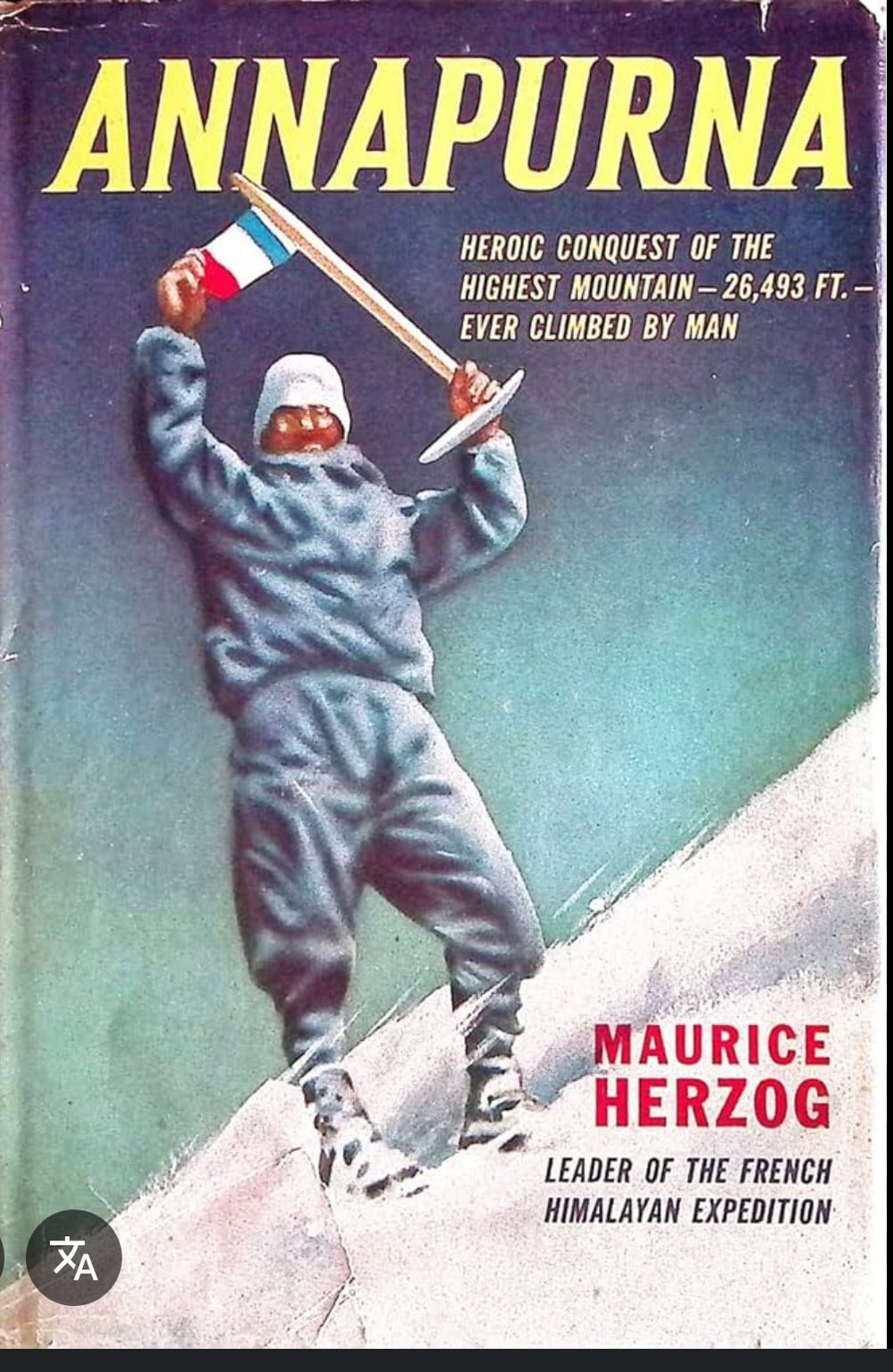 After returning from climbing, Maurice began to read about religion . He deeply studied Hinduism, Buddhist philosophy, Christianity. I think that experience was a contact with the ultimate power for him. Then he began to search for God,' said Mathias, dedicated to yoga and spiritual service.
This spiritual awakening led Maurice to a deeper search . Maurice is known all over the world . 'Because when you experience such a powerful and divine feeling, you want to understand it, you want to get close to that energy,' says Mathias, 'after that moment he began to search for God in many ways.' This also gave birth to Maurice's second book 'Annapurna: Premiere 8000' in 1997. The first book was about the goal, the climb, the peak, while the second book was about his inner transformation. Maurice's two books have been published in more than 40 languages and have sold more than 11 million copies.
Maurice made his son the first reader of his second book. 'That was an extraordinary moment for me,' Mathias says, 'The first book was a story of victory, but the second one was about his inner change.' The last sentence of that book, 'There are other Annapurnas in a person's life' always resonates in Mathias's heart, 'It was something my father taught me - one should climb not only outside the mountains, but also inside.'
Maurice Herzog's relationship with Nepal was not limited to just one climb. It was an unbreakable connection of the soul. He was associated with Nepal till his death. "When I was little, Raja Mahendra used to call our house every Sunday," Mathias said with a smile. Nepal had given him a lot and it was natural for him to give it back. He helped in infrastructure, development and many other areas.'
Mathias was not born when his father climbed Annapurna. But even for him, Nepal was not a new land. He came to Nepal with his father in 1993. He was 14 years old at that time. He still remembers coming to Kathmandu and going to Mount Kailash and Mansarovar. "I brought some photos and gave them to the children on the way," he remembered, "that was a very fond moment for me."
75 years ago, there was no such communication facility as it is now. In the 1950s when Nepal was completely unknown to the western world and climbing the mountains was like reaching the moon. Maurice Herzog's team made history at that time. The Annapurna climb was a French national expedition, not a personal one . Maurice was a member of the French Resistance during World War II. "Even though he was not the best climber, he had leadership experience," said Mathias, explaining why Maurice was selected for the climbing team, "he had the skills to manage people and resources in difficult situations." That's why he was selected.' After reaching the Annapurna base camp, he still imagines - 75 years ago, in a state without technology, leather shoes, without maps, without GPS, how was it possible to climb ? Courage and teamwork are the reasons for his father's success.
Mathias wanted to come to Nepal five years ago. He was stopped by the Corona epidemic. Now he is following in his father's footsteps as a seeker dedicated to yoga and spiritual service and is on his own journey of self . His arrival has once again given freshness to the story of Annapurna.
Maurice Herzog has won the physical Annapurna but Mathias is looking for the spiritual Annapurna of his life . He now runs a yoga school in Germany. Organize meditation camps. Trains international yoga teachers. But his heart is still stuck in Nepal. "I want to open a non-profit school here, where yoga, English and Nepali philosophy of life can be taught," he says, "Nepal's knowledge tradition, Buddhist philosophy, and coexistence with nature are invaluable to today's world."
Mathias' arrival has not only brought memories of the past, it has also inspired the future . He advocates a balance between tourism and conservation. He says, "We have to find a middle way between economic development and environmental protection". International cooperation is very necessary. He suggests that Nepal should be promoted by focusing on tourism, nature and mountain culture targeting the young generation.
At the northern base camp in Annapurna Rural Municipality of Myagdi, a half-length statue of Maurice Herzog, Louis Lachenal and the first Nepali climber Sonam Wangchuk Sherpa has been kept. Prime Minister KP Sharma Oli had previously planned to unveil the salik on Tuesday, but the helicopter could not reach due to bad weather. He reached Narchang and inaugurated the 'Maurice Herzog Pathway' and the open museum. Minister of State for Energy, Irrigation and Water Resources Kham Bahadur Garbuja came to unveil the salik. Nepal Tourism Board, Trekking Agencies Association of Nepal (TAN) Gandaki, Nepal Mountaineering Association, Gandaki etc. are celebrating Diamond Jubilee from June 17 to 22 with various programs.
Mathias will return to Germany after the Diamond Jubilee. His heart says that he should return to Nepal. He thinks that his life has been shaped by his father's relationship with Nepal. I would like to build a beautiful house somewhere around Pokhara, where the mountains can be seen from the window of the house. The house should not only be made of bricks, every wall, roof, window and door should have a sense of peace.
Maurice used to organize conferences of mountain climbers from all over the world . Now he is trying to maintain that tradition with the help of the French government. He thinks that fulfilling the responsibility left by his father is like the whole of Annapurna standing in front of him . Says, 'Annapurna is not just a mountain, it is a symbol of challenges.'