We use Google Cloud Translation Services. Google requires we provide the following disclaimer relating to use of this service:
This service may contain translations powered by Google. Google disclaims all warranties related to the translations, expressed or implied, including any warranties of accuracy, reliability, and any implied warranties of merchantability, fitness for a particular purpose, and noninfringement.
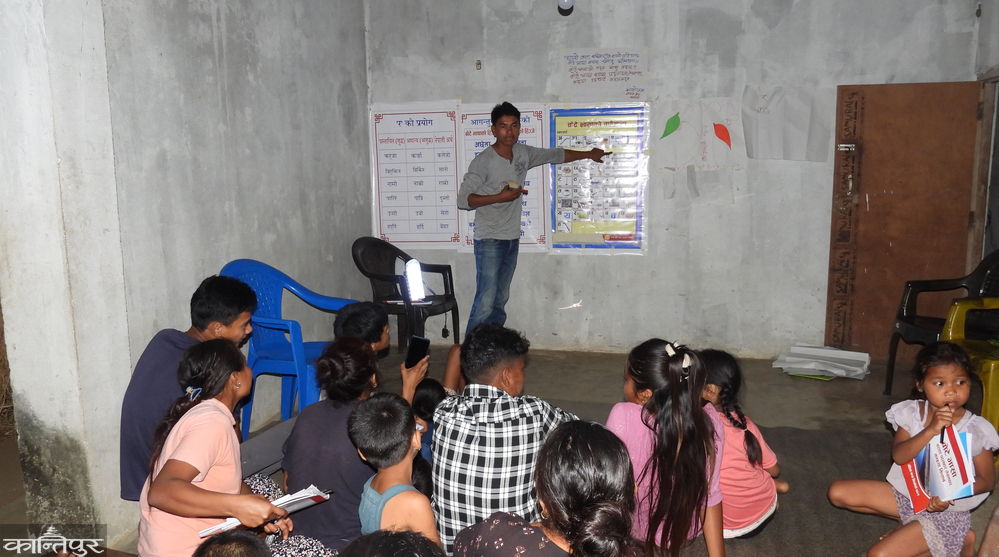
Due to wind and rain, there was no electricity supply even in the evening. Also, 15-20 people had gathered around in the dim light of the emergency lights. Dilju Bote, 50 years old, came with her little grandson after finishing the evening chores.
When almost everyone came, Santosh Bote started, 'K Kapar, G Gangto, T Takuwa, D Dongo, D Dhadiya, B Bahana, L Loggi.' Everyone repeated along with Santosh.
Every evening, Bharatpur Metropolitan City-13 Patihani Rapti riverside Chowki Danda's Bote village has been having such a gathering. The Botes are indigenous to Chitwan. There are settlements of Bote community especially on the banks of Riu and Rapti rivers and Narayani river. "We are a minority. We have a challenge to preserve language, customs and culture. After seeing that the language was disappearing, we started the class like this," said Santosh.
Santosh is the secretary of Nepal Bote Society Chitwan. Language class has started with the activation of Nepal Bote Samaj Center and District Committee. Where reading is done on the basis of alphabet prepared in Bote language and 'Bote Bhasa: Sarasar Padlahar Lekhlahar Kachhya Kitab'. Kapar means head in Bote language which starts with 'ka'. Similarly, from 'g', Gangata, like Takuwa, means a small wooden tool for weaving fishing nets.
Dongo means a boat and Loggi means a bamboo stick that pushes a boat. The traditional occupation of the Bote community is boating and fishing. Many are still doing this profession. Therefore, Santosh said that while introducing the letters, only the objects connected with Bote's routine are kept in the alphabet. "We haven't forgotten to speak the language yet. Sons and daughters also speak Genten. But the grandchildren don't speak at all," said Dilju.
So she sits in class with her grandson in her lap. Dilju cannot read and write. However, she listens attentively to the Bote language words taught in class. If something is wrong, she asks to correct it. Even those who are studying in the school from class 1 to 12 participate in the language class. But like Dilju, older Dalli Botes and Chanmati Botes also live. Santosh said that the class is more effective when they sit.
They have come to see how the study of Bote language is like. You will be amazed to see your children read, write and speak Bote language. Not only the language, but also the knowledge of how to greet a new person or an important person when meeting a new person, what is the culture of the plant, Santosh said. While greeting the Botes, they bow their heads slightly and place their right hand close to their forehead and say 'Binti Bati'.
President of Nepal Bote Samaj Chitwan Pradeep Bote says that the number of his community is very low. According to the 2078 census, the population of Bote caste is 11 thousand 258 in the country, he said. He said that although Chitwan has a population of 3,144, only 2,120 speak the Bote language. He also edited language books. He said that he went from village to village looking for the wrong word.
'When you only speak other languages, you lose your own language. This is how our language dies, other languages spread. We are planning not to let our language die," said Secretary Santosh. Santosh informed that language classes are being conducted in a total of 15 places including Madi, Meghauli, Jagatpur and Padampur, where the Bote community is densely settled. The class of the first phase, which started from Baisakh 24, will last for 20 days.
Sudeep Subedi, Chairman of the Ganganagar High School Management Committee in Bharatpur Metropolitan City-13 and Chairman of the Metropolitan Level Community School Management Committee Federation, said that it is a good step for the minorities to take forward to preserve the language and culture. He pledged to support the provision of additional classes in schools for children belonging to minority tribal communities.
Kaluram Bote, a ward member of Bharatpur-13, said that the campaign started by the community should get the attention of the local, state and federal governments. With the support of some NGOs and INGOs, we have run language and culture preservation programs in our own way. Now the government should also think," he said.
Santosh Bote said that compared to Nepali vowels and consonants, Bote language has fewer vowels and consonants. Bote language has only 6 vowels and only 29 consonant characters. The script is not ours. Characters are also less. Even after much inquiry, this is what was found. That's why it seems that our spelling is wrong according to the words of Nepali language. Now we have conducted basic classes. Later, we will work a little more," said Santosh.
Alphabet was published in Bote language in June 2075. In the year 2056, Bote Kriti Sangalo was published, in which the 70-page book written in Bote language contains 27 songs, 7 stories, 3 poems, 3 mutaks, 2 ghazals as well as village stories, jokes and lifestyle. Santosh said that the goal is to make all the elderly, young and children understand and speak Bote language at home.

