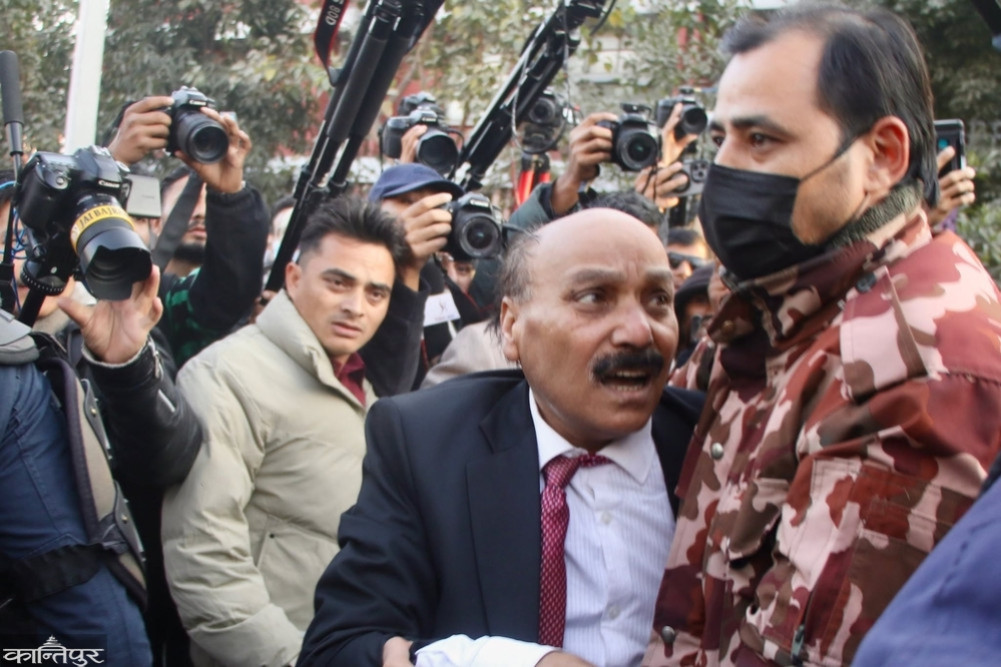
Senior Advocate Dinesh Tripathi was attacked last Wednesday while coming out of the Kathmandu District Court arguing on behalf of the co-operative victims.
We use Google Cloud Translation Services. Google requires we provide the following disclaimer relating to use of this service:
This service may contain translations powered by Google. Google disclaims all warranties related to the translations, expressed or implied, including any warranties of accuracy, reliability, and any implied warranties of merchantability, fitness for a particular purpose, and noninfringement.
Since he is not allowed to choose, when he goes to the court, his suit-pants color is always the same - black. However, he wears different colors of tie and hat. That day he was dragged by the end of his red tie and dragged to the ground.
His hat, which had never come off his head, fell off as dozens of unfamiliar hands suddenly began to drag him, punching and kicking him. Soon after, someone hit Ghuchuk from behind, which caused his head to narrowly avoid hitting the pillar in front of him. The crowd surrounding those who were still surrounding them were saying- Han-Han, Mar-Mar!
'At that moment, if I were to take my life,' Senior Advocate Dinesh Tripathi added after holding the tie and pulling it, 'If they have to kill without putting a finger on the neck in America, they hold the tie and drag it because by doing this, the tie is easily trapped around the neck and there is no finger print of the killer. This information, which he learned years ago while studying criminal law in the United States, never entered his mind. Because, before that, no one had ever laid a tie trap for him like this. The
happened surprisingly that day. Ravi Lamichhane, accused of defrauding the common people by cheating the cooperative, had just walked out of the Kathmandu District Court after arguing that he should be kept in jail for the trial, when he was attacked by an agitated crowd. And, pushing and holding the tie at one point, dragged him.
At that time, I did not have many worries other than the worry that the tie would become a trap. But when I went home and watched that incident on YouTube, I thought that anything could happen,' Tripathi sighed, 'They could even kill me, I have been exposed by chance.' debated whose defendants belonged to powerful positions in the state. During the crisis that followed the 'Shahi Ku', hundreds of people were caught by the joint security forces and kept in illegal detention. To release him, he kept filing writs of habeas corpus daily in the Supreme Court. People used to say - 'Marlan hai raja le ho do!'
He went to Dailekh to debate the case of journalist Dekendra Thapa, who was killed by Maoists during the conflict. Well-wishers stopped Dinesh and said - 'Why are you going to kill your love for a case?' But Dinesh did not shake his hand.
Whether against the killers of Navraj Vick and his friends who were killed in Chaurjahari or against Aftab Alam, the leader who burnt people alive in brick kilns, he continued to debate despite people's warnings that there was danger. And what's more, he didn't even have to endure any threats.
But today, he was attacked day in and day out in a case far more dangerous than the writs he filed against the army and the Maoists during the crisis.
'What happened like this?' he asked himself after the incident. In response, his mind made an analytical argument - 'Even in the Panchayat period, this did not happen as is happening today in the Republic. The country is not going in the right direction.'
The Constitution has a long list of fundamental rights. There are many provisions of freedom in the law. The character of the state is fully democratic federal republic constitutionally. However, in practice, even when arguing against someone, the crowd laughs. "Isn't this anarchy?" Tripathi asks, "Democracy will die when laws are advanced and behavior becomes executioner. Isn't our democracy dying?" However, Tripathi often stood up in the court against the accused who were in power and strength. And yet, despite the suspicions of the mind and the warnings of well-wishers, no one did anything to him, said nothing.
As always alone in the crowd, Tripathi spent a long time going from court to court and from court to court carrying the missiles of the case to his tune and tune. Read the book of law. Although it was debated, it was done in the sub-sections of the law.
Even though he had to express his anger against someone's bullying, he just stood on the bench and expressed it. Otherwise, often in the gatherings, his thoughtful face and his eyes that seem to always be looking for something, even if he is gossiping in the mood, there is no one who knows by seeing and hearing that any personal comment against someone is revealed even in Kafiyat.
In its own way, there was a sudden union attack on the advocate of such noble temperament. At that time, he thought - 'I am alone in Lakhetine.'' But when the incident was widely criticized, the bar issued a statement and protested against the attack on Sunday, Dinesh felt - 'I will not be alone.'
After the first election after the promulgation of the constitution, the government, which was formed after the promulgation of the constitution, declared a prohibition order from Maitighar Mandla to Baneshwar's parliament building and banned processions and protests in that area.
Tripathi filed a petition in the Supreme Court saying that it is unconstitutional to restrict the fundamental right of citizens to protest in a country called full democracy. And the Supreme Court said 'yes' and released it. As a result, citizens got the facility to protest and rally in that area.
Because of this facility, the supporters of Lamichhane were able to protest and demonstrate in front of the district court last Wednesday. Ironically, the same privileged mob physically attacked Tripathi who fought for the same privilege.
'I call this not a rally and protest, but an obstruction of justice,' says Tripathi, 'I did not file a case in court against the prohibition imposed by the government, this is anarchy.' Tripathi said he was worried about the impact it would have on the overall justice process.
He knows that the perpetrators are always more powerful than the victims, on whose side the state apparatus, powerful people and those with access often stand together.
The victim is always weak and cannot speak even about the injustice against him. And since the perpetrators often have advocates on their side, the victims struggle to even find an advocate to speak up for them.
'In the future, when I am attacked, others may not have the courage to advocate for the victim, and because of that, the morale of the perpetrators may increase,' says Tripathi, 'I am afraid that the attack on me will somehow prevent someone else from speaking on behalf of the victim. Don't push.'
Tripathi, who was born 58 years ago in Madhuvani-5 Mahilwari of Ruppandehi, is always inspired to stand for justice by his own life experience and the path decided based on it. At a time when there was no electricity, roads and bridges, he was going from home to school when he encountered a river on the way, which was not always possible to swim, which greatly hindered his studies.
After completing his primary education, he went to Nepalgunj for his further studies where his brother Sachidanand Tripathi lived as a worker.
Tripathi saw chalk-duster, bench-decks and copy-pen after joining Mangalprasad Mavi in Nepalgunj. Before that, he only remembered going to school carrying sacks or sacks from home to sit in the village school. In the school, the teachers used to teach Kakhra by writing and erasing on the stone board. After being able to read and write in Kapikalam, perhaps his interest in reading became high.
Then, after passing the entrance exam in 2037, he studied IL at Mahendra Universal Campus in Nepalgunj and came to Kathmandu and enrolled in BL at Nepal Law Campus in late 2042.
After BL, he also did LLM and started debating professionally. In the almost 35 years since then, there has not been a year where he has not filed a writ against the violation of fundamental rights caused by someone's suspicion or self-interested decision in the government.
In 2006, when he went to the University of Maryland in the United States to do a master's degree in constitutional law, there was a conference of legal scholars. Where Tripathi also got a chance to speak on behalf of the university. He spoke from the international platform against the direct rule of the king that had just started.
'There, I spoke about why people around the world should not ignore the actions of a king who rules directly, saying that the injustice of one place is a threat to justice everywhere, as the injustice of one place is a threat to justice everywhere.' He remembers, 'The crowd of more than five thousand stood up and applauded me many times, that day I understood - when speaking in favor of the truth Even though they don't know each other, people keep coming to join.'
During the crisis, the legal journal 'Guild Notes' printed about him as 'Arthur Kinoi of Nepal' as he filed writ petitions to free more than 350 people from illegal detention. A
Tripathi was delighted to be working with Arthur Kinnoi, a famous lawyer who fought for civil rights in America. And, he got more energy to stand up for the protection of human rights and the rule of law.
With this energy, he is still standing alone right now, on the side of the victims. They say - "I am a lonely person, but even if I walk alone on the path of truth, there is no fear, while even if I walk on the path of crime and untruth, there will be no way to avoid it."