We use Google Cloud Translation Services. Google requires we provide the following disclaimer relating to use of this service:
This service may contain translations powered by Google. Google disclaims all warranties related to the translations, expressed or implied, including any warranties of accuracy, reliability, and any implied warranties of merchantability, fitness for a particular purpose, and noninfringement.
Do you think earthquakes can be predicted like others? Or how does an earthquake occur on the ground we are standing on? After an earthquake, does it only destroy high-rise buildings? How does the collision of the Indian and Eurasian plates cause earthquakes in Nepal?
To eliminate such questions, curiosity and confusion, the consultation officer went to the 'Earthquake Learning Exhibition' organized by the Nepal Science and Technology Academy (NAST) on Wednesday.
Wimarsh, who is studying science in St. Xavier's in class 12, says, "I did not have a good knowledge about the Indian plate and the Eurasian plate that cause earthquakes in Nepal". But here I found out how the two plates are friction and when there is an obstacle, how it causes an earthquake.'
The different plates in the Earth's interior move . Due to the heat inside the ground, the plates move closer to each other, left-right and down-up . He said that if there is an obstacle during the movement, the stored energy will come out and an earthquake will occur on the surface.
Not only that, he is also doing a project in college about the history of earthquakes in Nepal. He said that he came to Nast's exhibition to learn about the earthquake, thinking that it would help his project.
'I thought that earthquakes could be caused by human activities, but after coming here, I became clear about all this,' said 18-year-old Vimarsh, 'Even if nuclear weapons are tested here, earthquakes will not be caused by humans, even though they may cause tremors in the ground.' He shares his experience that the book he was reading was not able to explain the mechanism of earthquakes, and for this the Nastak exhibition was useful. He also believes that this kind of exhibition will reduce the confusion about the earthquake. Location, date and time must be correct to predict
. But Nitya Pokharel, a student studying in the 11th grade of The Celebration Coed College, said that earthquakes cannot be predicted as there is no way to say these things with certainty from today's science. 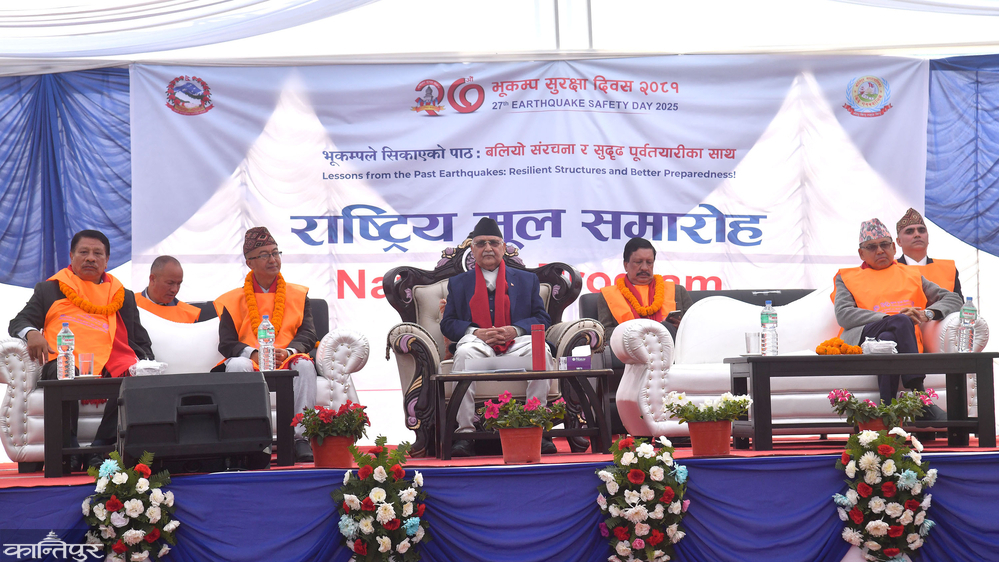
"Current science has found that it is not possible to predict earthquakes," she said, "therefore, the safest way to avoid earthquakes is to have a house as safe as possible."
She also said that she understood from the exhibition that seismologists can only say the probability of an earthquake occurring in a certain area within a certain year.
Swapnil Adhikari, who is studying in the same college, narrated the experience of learning about the epicenter of the earthquake and high risk near it, even if the magnitude of the earthquake is known, it cannot be predicted. "When an earthquake comes, we have to protect our heads as much as possible inside the house," he says.
The Vice Principal of Coed College, Sagar Dahal, said that 34 students studying in class 11 and 12 were brought to Nast's exhibition to give them practical knowledge along with their studies. In his experience, reading books alone is not enough to understand earthquakes, so this kind of learning helps. "It is not possible for us to do the techniques and exercises used in earthquakes," he said, "but if we show them to the students in this way, they will have practical knowledge along with learning." It is easier to learn about earthquakes.' Since Nepal is at risk of earthquakes, he believes that this kind of exhibition will increase public awareness and develop the ability to respond to earthquakes. 8-year-old Evan Thakur, who met at the
exhibition, says that he learned not to panic when an earthquake occurs and to go to a safe place as much as possible. He is studying in St. Xavier's in Lalitpur in class three. Evan, who came to the exhibition with his mother, said, "I saw how earthquakes happen." When an earthquake comes, you should not run away.'
He said that when an earthquake occurs, the elevator will be shut down and you may be trapped inside, so do not use the elevator, do not use the stairs, prepare essential materials before the earthquake, and if possible, the bag He said that he learned to carry and go to an open and safe place.
Nast organized the exhibition in Lalitpur to spread knowledge about earthquakes. Eliza Dahal, who was enjoying the exhibition, said that she knew how the 'P' and 'S' waves of the earthquake would shake the houses. She said, "P wave shakes the house from bottom to top and S wave shakes the house from left to right". But S wave is more likely to cause more damage than P wave. That's why she felt that the base should be strong and earthquake resistant when building a house. From the
exhibition, she understood that there are separate earthquakes that destroy high-rise buildings and Hocha houses in an earthquake. She said that she learned that high-frequency waves of earthquakes cause more damage to low-rise houses and low-frequency waves to high-rise houses. Also, she said that she understood that small and big houses do not matter if they are earthquake resistant.
"This exhibition gave us a better understanding of earthquakes and how to reduce the risk of earthquakes," she added. Ganesh Belbase has the experience that the
exhibition has helped the employees of different fields working in NAST to understand about the earthquake. 'It became a place for us to exchange knowledge,' he says, who is an assistant research fellow at NAST, 'Here we got an opportunity to understand what to do when and after an earthquake.' He said that he learned things such as not to use water as much as possible, not to use telephone service except for emergencies if he is in a safe place. NAST seismologist Shiv Subedi informed that 850 people viewed the
exhibition. 8 models were placed in the exhibition to give knowledge about earthquakes. The first model includes earthquakes, causes of earthquakes, plate tectonics, Gorkha earthquakes and the science of earthquakes. Similarly, the topic of earthquake magnitude and intensity of earthquake in model two and why it is not possible to predict earthquake in model three was in the exhibition. Similarly, model four of the exhibition told about what should be done before, during and after the earthquake and the measures to prepare for the earthquake. In model five, the effects of earthquakes on buildings of different heights, in model 6, liquefaction and earthquakes, in model seven, seismic 'P' and 'S' waves, wave amplitude and in eight, seismometers, how scientists measure earthquakes were exhibited.
``National Earthquake Safety Day'' is celebrated every year on January 2 to commemorate the 1990 Great Earthquake. This day has been celebrated since 2055.
The government's commitment to reducing earthquake risk
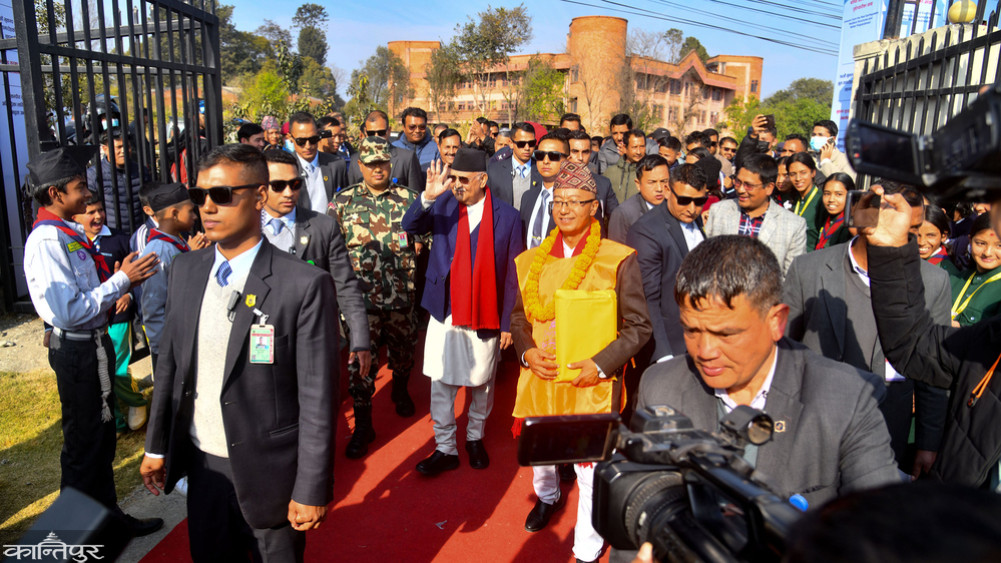
On the occasion of 'National Earthquake Safety Day' on Wednesday, the government has pledged to be safe from earthquakes. The government, community and concerned bodies joined hands and made a collective commitment at 2 o'clock 24 minutes for earthquake risk and mitigation.
This commitment was made at the 27th Earthquake Safety Day program organized by Kirtipur Municipality at BP Koirala Memorial Science Museum in Kirtipur at 2:24 in the afternoon. Likewise, the day has been celebrated by organizing various programs related to earthquakes across the country. In the
program, Prime Minister KP Sharma Olil called for building earthquake-resistant structures that will not collapse soon. A natural disaster occurs. "No one is stronger than nature," he said, "but if we build an earthquake-resistant house, it will not collapse so quickly." "Do not allow damage as much as possible." If there is damage, the government will work for relief,' he added.
Similarly, Deputy Prime Minister and Urban Development Minister Prakashman Singh has said that it is necessary to learn lessons from history and make earthquake resistant structures. "We will work to convey the message that the houses and physical structures are strong and Garlyamgurlum will not collapse," he said, "so I appeal to everyone to follow the building code and build houses according to the rules". Emphasis will be placed on the use of new technology.