In the last 10 years alone, the public debt of Nepal has increased by three and a half times, the public debt was 5 trillion 40 billion in 2071/72, it reached 24 trillion 34 billion in 2080/81, this year the government aims to collect 5 trillion 47 billion public debt, according to which 1 trillion 62 billion 72 crore loans have been raised till October
We use Google Cloud Translation Services. Google requires we provide the following disclaimer relating to use of this service:
This service may contain translations powered by Google. Google disclaims all warranties related to the translations, expressed or implied, including any warranties of accuracy, reliability, and any implied warranties of merchantability, fitness for a particular purpose, and noninfringement.
In the past few years, as the principal and interest payment obligations of the public debt have been continuously increasing, the government has reached a situation where it has to borrow to pay the principal and interest of the debt. The amount of public debt raised annually has to be spent on paying the principal and interest of the previously taken loans, so the government has to borrow to pay the debt.
Deputy Prime Minister and Finance Minister Bishnu Paudel also admits that the challenge of raising development resources is increasing as the burden of public debt increases. According to him, the government's investment in social security and development activities is shrinking due to the obligation to spend most of the revenue on public debt repayment. According to him, the obligation to spend most of the revenue on public debt payment has increased the challenge of pushing away the resolution to achieve the goal of sustainable development.
Finance Minister Paudel believes that developing and underdeveloped countries are facing more problems due to high trade deficit, slow economic growth, decreasing order of development aid and relatively low direct foreign investment and capital flow from the external sector.
In the financial year 080/81, the government has raised three trillion 60 billion rupees of public debt, of which 2 trillion 34 billion 42 billion is internal and 1 trillion 25 billion 66 billion is external debt. In the same year, the government spent three billion 5.37 billion rupees to pay the principal and interest of the loan. Out of that amount, 2 billion 23 billion 34 crore (73.13 percent) and 82 billion 3 billion (26.87 percent) have been spent to pay the loan principal. This data also shows that more than 85 percent of the government debt raised last year had to be spent to pay the principal and interest of the old debt.
Since 080/81, since the debt liability has increased, more budget has to be allocated to finance management than capital expenditure. Economist Dilliraj Khanal says that the ever-increasing public debt poses risks. Since '080/81, allocations under the heading of financial management have exceeded the size of capital expenditure. This is the product of continuous increase in internal and external debt,'' he says. As a result, there is also the danger of financial imbalance.'
 The government is breaking financial discipline and increasing the budget deficit, as the imbalance will increase, Khanal estimates that there may be instability in the macro economy. Due to the increased principal and interest payments of the government debt, the government will have to further reduce capital expenditure in the coming year. It is not enough to allocate sufficient budget in the productive and infrastructure sectors, nor can the budget be given for programs to reduce poverty, increase income and employment. This indicates the possibility of a serious budget crisis in the coming year.
On the other hand, the maturity period of large amount of loans taken in the past is also beginning to be completed. Due to this situation, it seems that there will be a big problem in the effective management and sustainability of government debt in the coming days. If this situation is not improved, the increasing amount of public debt indicates a high risk,' adds Khanal, 'the experience of Sri Lanka and Pakistan shows that any country falls into debt (debt trap) and cannot pay its debt.' This year too, the increase in loans has continued, according to which, in the four months of the current fiscal year 2081/82, the loan increased by 83.95 billion rupees to 25 billion rupees last October. According to the Public Debt Management Office, it has reached 18 billion 50 million, of which 12 trillion 65 billion 89 billion is external debt (50.28 percent) and 12 trillion 52 billion 16 billion internal debt (49.72 percent). Last June, the total public debt owed by the government was 24 trillion 34 billion 9 billion rupees.
In recent years, although the public debt has been increasing, it is not in a state of risk. Shivraj Adhikari says. He says, "But if the loan utilization is not invested in the productive sector, the result will not be good. If the money raised through loans is not invested in a place that gives good returns, problems will arise. Due to the continuous increase in internal and external loans, the allocation under the title of financial management has exceeded the size of capital expenditure since the last financial year. Economists say that increasing debt obligations pose a threat of financial imbalances when the level of capital expenditure has decreased and budget allocations for financial arrangements have increased.
In the current fiscal year, the government has allocated 3 trillion 52 billion 35 million i.e. 18.94 percent of the budget for capital, and 3 trillion 67 billion 28 million i.e. 19.74 percent has been allocated for financial arrangements. In the last fiscal year, 3 trillion 2 billion 70 million (17.25 percent) were allocated for capital and 3 billion 7 billion 45 million (17.55 percent) for financial arrangements. In both these years, the budget allocated for financial management is more than the capital expenditure. Earlier, the allocation budget was always lower than the capital expenditure in the financial system. This confirms that since the debt burden of the state has been increasing in recent years, the government has been forced to give more priority to debt repayment than development. If you understand it in another way, it seems that the government's priority is gradually increasing the obligation to the creditor over the needs of the citizens.
In the first quarter of the current fiscal year 2081/82, the government debt has been significantly repaid. According to the report of the Public Debt Management Office last November, 4 trillion 2 billion rupees have been allocated for debt service (to pay interest-interest) in the current year. This is 26.84 percent of annual budget allocation and 1.90 percent of GDP.
This year, the government aims to raise public debt of 5 trillion 47 billion. According to which 1 trillion 62 billion 72 crore loans have been raised till October. "Compared to the annual target, the total public debt is 30.30 percent," the report said, "of which the share of internal and external debt is 43.64 and 10.01 percent respectively." 1 trillion 95 billion 28 crore rupees external debt should be raised.
In the first four months of the current year, the government has spent 34 billion 15 million capital. During the same period, 1 trillion 8 billion 14 billion was spent to pay the principal and interest of the loan. In 2080/81, the government spent 1 trillion 91 billion 73 crore capital. In the same year, 3 trillion 5 billion 37 crores were spent to pay the principal and interest of the loan. In this way, the trend of spending more on loan principal and interest than on development has been repeating for the last few years. This confirms that the priority of the government is to pay the principal and interest of the loan rather than development.
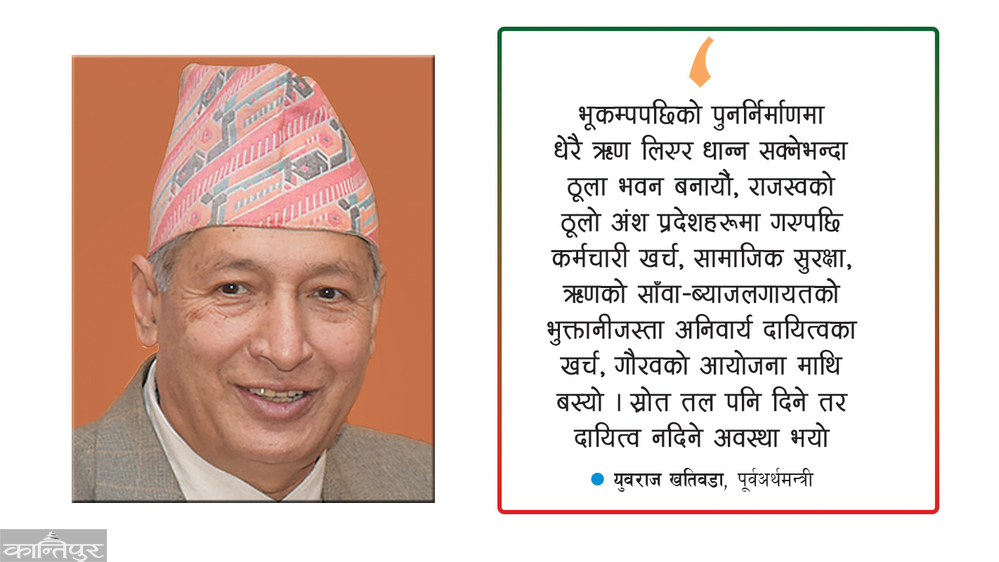
Former Finance Minister Dr. Dr. said that the tendency of those in the government to bring the budget in a flash, showing fear of debt, increasing the size of the budget and reducing the size of the budget after 6 months of the financial year is not correct. Yuvraj Khativada says. He said that this would cause the government's credibility to fall among the public and donors and that this fall was the main cause of the problem at that time. We took a lot of loans for reconstruction after the 072 earthquake. We have built bigger buildings than we can afford. It also has some subsidies. In federalism, we had budget (capital) problem," he says, "After a large part of the revenue went to the provinces, the expenses of mandatory obligations such as employee expenses, social security, loan principal-interest payments etc. sat on top. Gaurav's project sat above. It has become a situation to lower the resources but not lower the liabilities.'
public debt tripled
Nepal's public debt has increased by three and a half times in the last 10 years alone. Due to the increasing tendency of the government to introduce a deficit budget every year, the public debt burden of the country is increasing. Although its growth rate has been low in recent years, it is seen that the debt has increased by an average of 17 percent annually. Public debt which was 5 trillion 40 billion in 2071/72 reached 24 trillion 34 billion in 2080/81. (distant) use of
loans
Where public debt is used matters a lot. It is up to the government to decide how to use the public debt. Various economic studies have shown that when government debt is used for capital and development expenditure, it promotes economic growth. If the loan is used in the productive sector, there is no need to worry about the increase in government debt.
According to the Medium Term Debt Management Strategy (2080/81-2082/83) approved by the Ministry of Finance, the cost of debt in 2079/80 ie the weighted average interest rate is 6.14 percent for domestic and 1.15 percent for external debt. Debt service i.e. interest payment liability as a proportion of GDP is 1.5 percent towards total debt, 0.2 percent towards external debt and 1.3 percent towards domestic debt. Although some experts have commented that the public debt has not been utilized in Nepal, they claim that the data shows a different picture.
'The main part of our public debt has been used for infrastructure construction and social development. The external debt seems to have been spent on the economic sector, general public services, housing, health, education and environmental protection,'' said a former joint secretary with knowledge of public finance. Internal debt is commonly used to manage cash. The loan raised by issuing development bonds has been allocated in the last few days by designating projects. He claims that the statement that the use of public debt is water in the sand is not correct, although it can be questioned whether the public debt has been fully utilized.
A former joint secretary of the government claims that the comment made that 'the government cannot give pension because it takes a loan and distributes the salary' is not correct. In Nepal, there is no situation where operating expenses are not covered by revenue. As far as current expenditure is concerned, the amount of development expenditure in the education and health sector and the capital grants sent to the local level go through current expenditure. Because digging soil is not only development.'
Former Finance Minister Barshman Pun also claims that Nepal's public debt is in a favorable condition compared to other countries and that Nepal will not fall into a debt trap. He says that there is no such risk as the cost of loans taken by Nepal is low. From the point of view of cost and risk of debt, our public debt is in a favorable position compared to other countries. Considering the size and cost of public debt so far, it is unlikely that the country will fall into a debt trap," he says.
economist Dr. Kalpana Khanal says that with the increase in the need for public expenditure in recent years, the dependence on debt is increasing as internal sources of government income, including revenue, cannot be expanded. Foreign aid has increased by 16 percent in the last decade, while the share of debt has increased by 24 percent. This indicates that loans are now increasing instead of grants,” she says.
National Planning Commission Vice Chairman Gobind Pokharel said that the time period for the completion of projects that are said to be developed through loans and grants, the example of construction of infrastructure of national importance in Nepal which is built with foreign loans and grants, and which we ourselves have invested in, is not encouraging. The Babai irrigation project, which started 37 years ago, has not been completed even after spending more than five times. Similarly, projects such as Sikta for about 19 years, Lumbini development for 39 years, Hulaki road for 18 years have become more expensive than the initial cost due to non-completion on time,'' he adds, 'Melamchi water supply project studied around 2047 with the support of the World Bank and UNDP, with the support of ADB and others around 2057. The estimated cost has more than doubled when the project was completed Pokhrel said that people should also be informed about the amount of loss the country has to bear as the results such as social development and job creation are not as expected.
Social and economic development will be affected by increasing public debt obligations, member of the National Planning Commission and executive director of the National Bank. Prakash Kumar Shrestha argues. In recent years, the amount of public debt has increased at a significant rate, and the obligation to pay principal and interest has also increased. The revenue collection of the government is not even enough to pay the principal and interest of the loan,'' he says, 'as a result, there is a lack of funds for social and economic development and it is difficult to increase the productive capacity of the economy if the capital expenditure is not sufficient. This makes it difficult to increase the economic growth rate of the country.'
Ratio of public debt to GDP
The ratio of public debt to GDP of Nepal has been gradually increasing since 2075/76. However, there has been a slight decrease in the last year. The total debt which was 22.28 percent of GDP in 2071/72 has remained at 42.675 percent till June 2080/81. This shows that public debt as a proportion of GDP has risen sharply in recent years. Similarly, the outstanding public debt till last November is 44.14 percent of GDP.
Economist and former vice-chairman of the National Planning Commission Vishwa Paudel argues that the ratio of public debt to GDP should not be seen. He said that the quality of projects we have invested in by taking loans is an important aspect. "Instead, we should look at the revenue collection capacity, not from the GDP, but by raising the revenue," he adds, "how much is the capacity to pay the debt by raising the revenue, if it is not possible, the government will not be able to pay the debt." Government debt, which was 27 percent, has increased to 40.8 percent by 2022. There seems to be some stability in it now, which is a good sign. Economists do not agree on the threshold (tipping point) at which government debt can be taken as a percentage of GDP. According to economist Khatiwada, the use of government debt has helped economic growth, even if it is high in proportion to GDP, there is no need to be afraid. But if there is no contribution to economic growth or it is low, there is a risk even if it is very low in proportion to GDP.
Some international media have analyzed public debt to GDP ratios of up to 90 percent as a 'tipping' point. Even then, their analysis is that as debt continues to increase, the real economic growth rate will decrease. For a low-income country like Nepal, the maximum credit limit (threshold) is 60 percent. However, there is no strict rule that this is correct. But in a country like Nepal with low income, less developed financial market, economic openness and weak institutions, there may be different opinions on what percentage of government debt should be GDP, according to economist Khatiwada.
corporate foreign debt obligations
Out of the total foreign debt obligations, 17 entities have outstanding debts. Out of which the share of multilateral loans is 88.98 percent and 11.02 percent of bilateral loans. International Development Association (IDA) and Asian Development Bank (ADB) under the World Bank account for the most 81 percent of multilateral loans. The share of Japan, India and China in bilateral debt is 10.11 percent. As of last June, Nepal has yet to repay the loans it took from 17 different donor agencies in 10 different types of foreign currency.
Which public body does not pay the debt?
The main entities that have not paid the outstanding principal and interest are Nepal Electricity Authority, Nepal Water Supply Institute, Kathmandu Valley Water Supply Board, Janakpur Cigarette Factory, Udaipur Cement Industry and Biratnagar Jute Mills with a total of 1 trillion 31 billion 88 million 18 lakh rupees (84.44 percentage). As the principal-interest details of the outstanding amount are yet to be updated, it is not possible to ascertain the actual outstanding balance and principal-interest.
In 13 local levels including Kathmandu, Bharatpur and Pokhara Metropolitan City, Hetaunda Sub-Metropolitan City, there is outstanding principal and interest amounting to 2.87 billion 82 million rupees. In terms of internal resource loans, the total amount of loans exceeding the limits of 3 agencies is Rs. 33.38 million and interest is Rs. 1 billion 1653 million principal and 1.62 billion 62 million rupees, totaling 2.79 billion rupees 1.5 million rupees. The General Account of Sources has pointed out that the ministry has not taken effective steps to recover the amount.
State of government debt in Sixteenth Plan
The 16th five-year plan has been implemented since July 2081. It is estimated that 120 trillion 63 billion 320 million will be spent by the government during the plan period. Of the estimated expenses, 45 trillion 71 billion 79 billion current, 27 trillion 71 billion 40 million capital expenditure, 22 trillion 57 billion 75 billion financial arrangement and 24 trillion 62 billion 74 billion financial transfer (grant) are estimated. It is estimated that the federal revenue will contribute 84 trillion 65 billion 150 million as a source to cover the mentioned expenses. It is estimated that the revenue to be distributed will be 95 trillion 30 billion 600 million. What should be done to improve the
?
The government has invested a large part of the loans taken from donors in public institutions. But those institutions have not paid the principal and interest on time. According to the agreement, the government is regularly paying the principal and interest to the donor agencies. The government is facing cash flow pressure due to non-payment of principal and interest on time by the institute. Therefore, it is necessary to show caution in the recovery of loan principal and interest from those institutions.
There is a provision to pay the commitment fee if the financial progress cannot be made according to the agreement with the lender among projects based on foreign loans. Such fee paid by the government has been increasing continuously in the past years. Therefore, it seems that the government should immediately monitor the projects that have to pay the commitment fee without work on time and make them responsible by regular monitoring by the relevant ministry.
-
prepared by Nepal economic journalist Samaj Sejan under 'Sanjay Neupane Research Grant'

