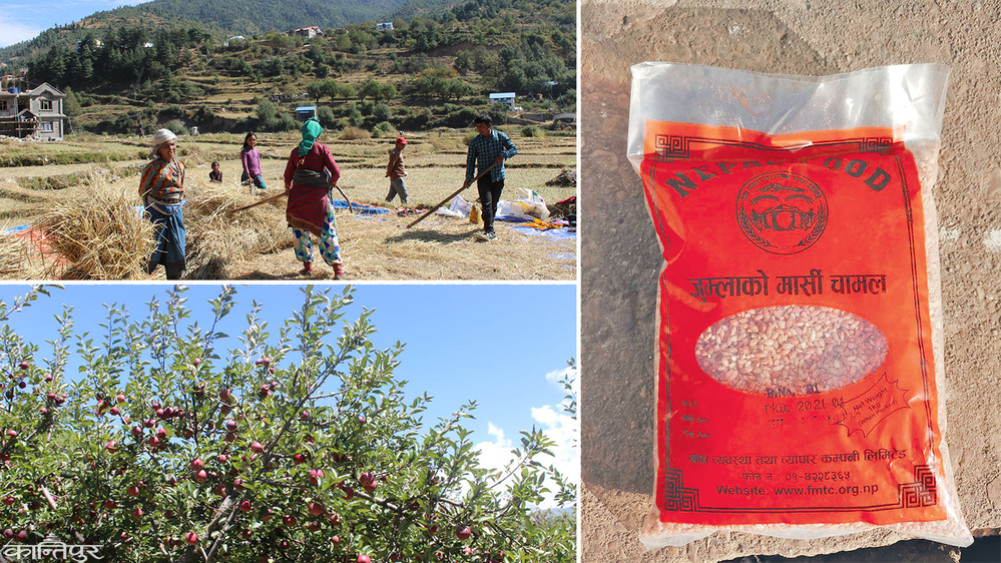
The Karnali state government has implemented a 'valuable' logo program for the production, marketing and promotion of the Raithane crop to preserve the Raithane crop and has listed the local Chino, Kaguno, Uwa, Latte, Phapar, Marsi, Millet, Barley and local beans as Raithane crops. A budget of 10.5 million has been allocated for the program
We use Google Cloud Translation Services. Google requires we provide the following disclaimer relating to use of this service:
This service may contain translations powered by Google. Google disclaims all warranties related to the translations, expressed or implied, including any warranties of accuracy, reliability, and any implied warranties of merchantability, fitness for a particular purpose, and noninfringement.
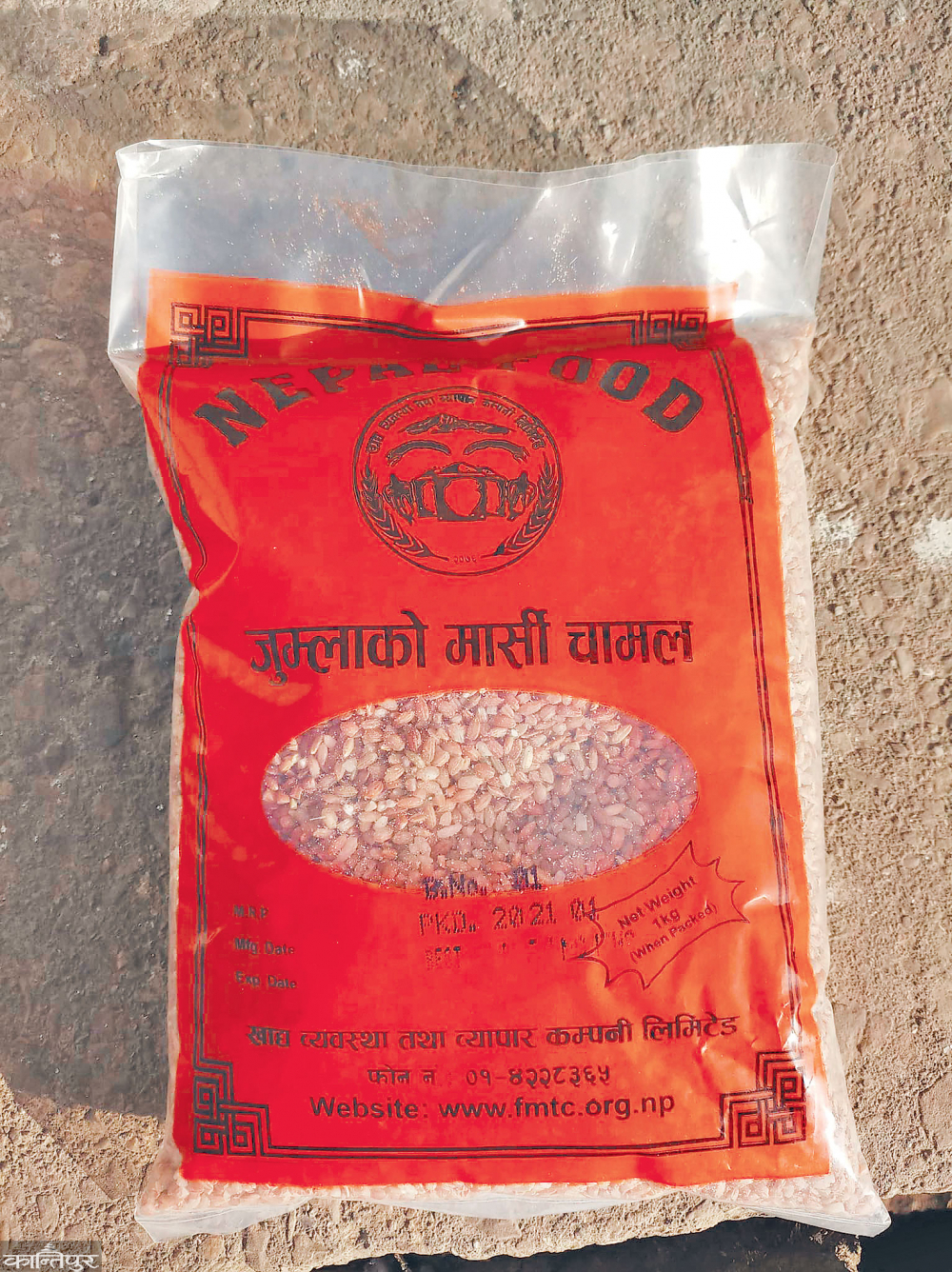
Hriday Narayan Shrestha of Kathmandu Jorpati, who went to Jumla via Raratal in Mugu before Dasain, took about 25 kg of marsi rice, 30 kg of apples, 15 kg of beans and a quintal of potatoes. All the 14 people who reached Jumla with him working in an international non-governmental organization took various food items and fruits with Marcy when they returned home.
Karnali food became the special dish of our family during Dussein and Tihar. Even now, eating Marsi's rice and bean dal reminds me of Karnali,' he said. ;
According to the data of the District Agricultural Development Office, Marcy, who became the identity of Jumla, had a turnover of about 6 million rupees in one year. According to which, out of 2 thousand 900 hectares of arable land, 1 thousand 300 hectares of land were produced by farmers. According to the data of the Agricultural Development Office, 1,144 metric tons of rice are being produced annually in Jumla. Of which 600 metric tons of rice was sold. Agricultural economist Balakram Devkota said that since the demand for marsi rice has increased recently, farmers have started selling it. "Marsi rice, which is produced throughout the district, reaches various cities of the country including Surkhet, Nepalgunj, Kathmandu," he said. But the farmers have been eating white rice from the plains by selling Marsi.'
Farmers who have been gradually abandoning farming because there is a lot of trouble in farming and the production of rice is less, another agronomist, Dr. Dr. Tapendra Shah said. Mayalal Devkota, owner of Jumla-based MT Organic House, said that while the sales of Marsi rice are increasing, it is developing as a 'brand' of Karnali. 'Marsi rice is the choice and priority of everyone, this rice is also going abroad unofficially,' he said, 'I have sold more than 130 tons of rice this year.' Rishi Ram Pandey, manager of Khalanga-based Chandannath Multi-Purpose Co-operative Society, said that after the demand increased in the market, the traders used to go to the farmer's village to buy marsi. This year, his cooperative has sent about 80 tons of rice to Kathmandu, Pokhara, Biratnagar, Chitwan, Butwal, Nepalgunj, Dang, Surkhet and other cities. The price of marsi rice in Jumla is between 100 and 120 rupees, while in Nepalgunj, Kathmandu and other cities, it is up to 250 rupees per kg.
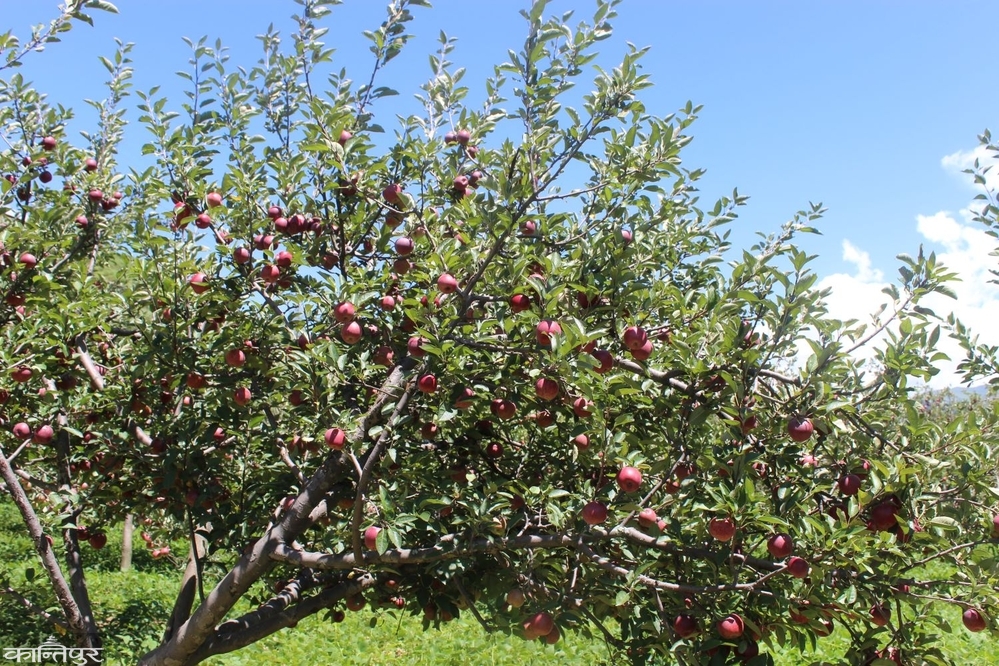
 Similarly, apple is another product produced in Jumla and Karnali region. In Karnali, about 12,500 metric tons of apples are produced in an area of about 3100 hectares in Jumla. Out of that, about 10,000 tons of apples have gone out, according to the data of the District Agricultural Development Office. As the demand outside is increasing, farmers are opening apple farms with huge investment. Meen Bahadur Bhandari of Guthichour rural municipality-5 of Jumla has established an apple orchard for 3 years with an investment of 220 crores. This year, 120 metric tons of apples have grown in his garden, where he planted about 48,000 plants. Traders go to the garden to buy apples. Apples of Fuji, Gala, Kindred, Golden and other varieties are being produced in his garden.
Tank Giri of Guthichaur-3 has also spent two years planting 14,000 saplings on 22 hectares of land with an investment of around 7.5 crores. His garden established in small Guthichaur is shaped like a Nepalese flag. "Earlier there was no road, when apples could not be delivered to the market, it was cattle feed," he said. Businessman Manprasad Neupane said that apples which are sold at 50 rupees per kg in Jumla are being sold up to 250 rupees in the capital Kathmandu. But he complains that the importance of jumli apple is decreasing due to proper storage and management.
After the produce of Karnali started ripening in the kitchens of the city, the Food Management and Trade Company Limited has entered into an agreement with the Ministry of Land Management, Agriculture and Cooperatives of the state government to purchase about 19 thousand 464 metric tons of Raithane crops produced in Karnali. Food has also entered into an agreement to establish a processing center (mill) for the collection, processing and marketing of Raithane crops. According to which, this year, the company produced 8,660 tons of millet, 338 tons of kaguno, 687 tons of chino, 2 metric tons of junelo, 762 tons of papar, 619 tons of lice, 4,470 tons of beans and 3 800 tons of rice paddy has been purchased. Food has been buying Karnali's products for almost 5 years.
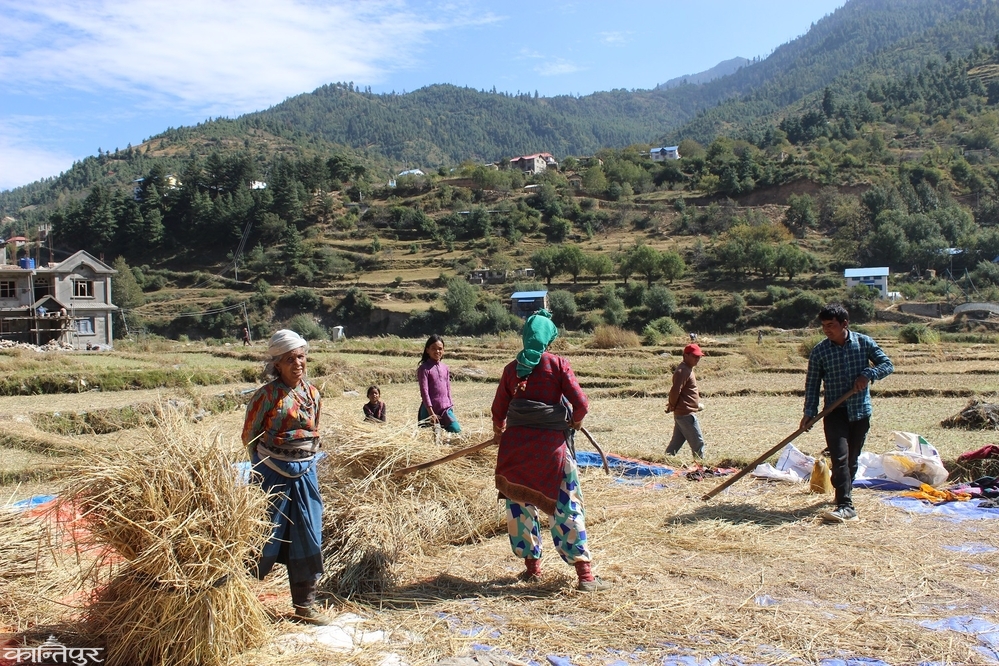 Similarly, various private companies and cooperatives are also sending Raithane crops of Karnali to the big cities of the country and abroad. But recently its production is decreasing. Its production is decreasing due to more suffering than other foods and less production, irrigation inconvenience, disease outbreaks, etc. Pushpa Bahadur Shahi of Natharpu, Mugu's Soru rural municipality, said that Raithane crops were disappearing after the availability of food outside the rural areas with road facilities. According to him, it has become difficult to see Raithane crops even in Lekali settlements including Narthpu, Bhi, Fotu, Jima, Kalai Raralek, where Chino and Kaguno are produced more. "Production is low, suffering is high," he said, "In our childhood, we grew up eating crushed sugarcane and kaguno in Okhal, but now due to climate change, we have stopped cultivating it."
According to the Ministry of Land Management, Agriculture and Cooperatives of Karnali Province, only about 19 thousand 144 hectares of Raithane crop is produced in Karnali. Last year 48 thousand 658 metric tons of Raithane crop was produced. Last year, about 21,000 tons of millet, 921 tons of kaguno, 1,700 tons of sugarcane, 5 tons of junelo, 1,900 tons of papar, 1,500 tons of lice, 11,000 tons of beans and 9,700 tons of rice were produced. was produced. But Hari Sharma, vice-professor of the Midwestern University, said that the Raithane crop is in trouble due to insufficient subsidies, lack of technical assistance, and low government subsidies for cultivation and marketing.
Tikaram Thapa, secretary of the Ministry of Land Management, Agriculture and Cooperatives of Karnali Province, said that farmers are being supported in training, machine subsidy, labeling and packaging for the promotion of Raithane crops. According to him, the state government has implemented the 'Valuable' logo program for production, marketing and promotion to protect Raithane crops. He informed that 9 varieties of Raithane crops, Chino, Kaguno, Uwa, Latte, Phapar, Marsi, Millet, Barley and local beans have been listed as Raithane crops by the state government. This year, the state government has allocated a budget of 10.5 million rupees for Raithane crop development program.
Assistant Departmental Manager of Wagmati Regional Office of Food Management and Trading Company Gyanu Thapa said that they are selling 500 quintals of Marsi, Simi, Chino, Kaguno, Uwa and other products from Karnali in Kathmandu annually and the demand is increasing. The then institute started sales by bringing Karnali beans from 2070/71 and started sales by packaging them from 2076. The people of the valley are understanding the importance of Chino and Kaguno.
 Apart from these, other products of Karnali are also important," she said. Karnali products are available in Bhatbhateni Super Market as well as government owned companies. Panu Paudel, Chief Executive Officer (CEO) of Bhatbhateni, said that although Karnali's products are preferred by consumers, there is a problem in supply. After import, it will be sold. If you can bring it on time, the market is good. The problem is transportation and production," he said.
Timur, ginger, honey and turmeric abroad
Four years ago, 73-year-old Rudy Repka, a British bee expert, reached Kalpat in Nalgad Municipality-1 of Jajarkot. He reached there after knowing that there is good production of honey in Kalpat and stayed in the village for about a month and informed the local farmers about various methods and skills of beekeeping.
Now he is bringing Nepal's honey to the world market. His wife Lydia Aniyala Repka is also marketing Nepalese honey in the UK. With their inspiration, Dharmaraj Rawal of Nalgad-4 Silal is producing bees in 135 hives. Last year, 450 kg of honey was produced from his beekeeping farm. He sent it all to Karnali Agro Station in Kirtipur, Kathmandu, where his brother Hari Bahadur is the owner.
'He has sent all the honey abroad,' Rawal said, 'Now the honey of Karnali like Chino, Kaguno, Marsi has got a foreign market, and the market is also increasing every year.' There are about 250 professional beekeepers. About 5 metric tons of honey produced by those farmers were sent by Karnali Agro Station to America, Japan, UK and other countries.
Honey is produced in an area of 30,546 hectares in Karnali. According to the data of the Ministry of Land Management, Agriculture and Cooperatives of the Karnali State Government, 391 metric tons of honey are produced across the state. According to the ministry, 35 metric tons of honey is produced in 1185 hectares of beekeeping in Jajarkot, 38 tons in Salyan with beekeeping in 7725 hectares, and 21 metric tons of honey in Humla in 2640 hectares of beekeeping. Out of that, almost half of the honey produced is going to India, Britain, Japan, America and other countries through various organizations, farms and cooperatives, said Ministry spokesperson Kathayat. According to him, honey production has increased by 25 percent this year compared to last year. According to him, farmers are selling honey for 1,000 to 1,500 rupees per kilogram.
Similarly, the ginger produced in Salyan has been going abroad for a long time. The Organic Valley, established in Kalidmar, Surkhet's Veriganga Municipality, is exporting Karnali's ginger and turmeric to various countries in Europe. "The ginger and turmeric produced here are organic, quality and pesticide-free, so we are sending almost 95 percent of the processed ginger to Europe," said Samir Neva, the owner of the industry He informed that he had started. Ginger and turmeric worth an average of 600,000 euros are being exported from the industry. The industry, which is processing about 1200 metric tons of ginger and 300 metric tons of turmeric, is sending ginger and turmeric worth about 600,000 euros to Europe every year.
Likewise, the demand for Timur produced in Karnali is also increasing in Europe. Uttarkumar Gautam, a herbalist, said that Timur, which is produced in all the hilly districts of Karnali, is now going to India, Japan, South Korea, America and European countries. He said that about 3 metric tons of Timur was sent out through Saikumari Agro Mart, which is operating in Kathmandu. Similarly, another businessman Santosh Thapa said that he has sent around 5 tons of Timur to America, Japan and Korea through various cooperatives and farms.
Timur worth about 15 million goes to various third countries including India every year from Karnali, said Kathayat, the spokesperson of the ministry. According to him, demand for Timur is high in Germany. Timur also goes to other countries from there. Timur is sold from 5 to 800 rupees in the local market.