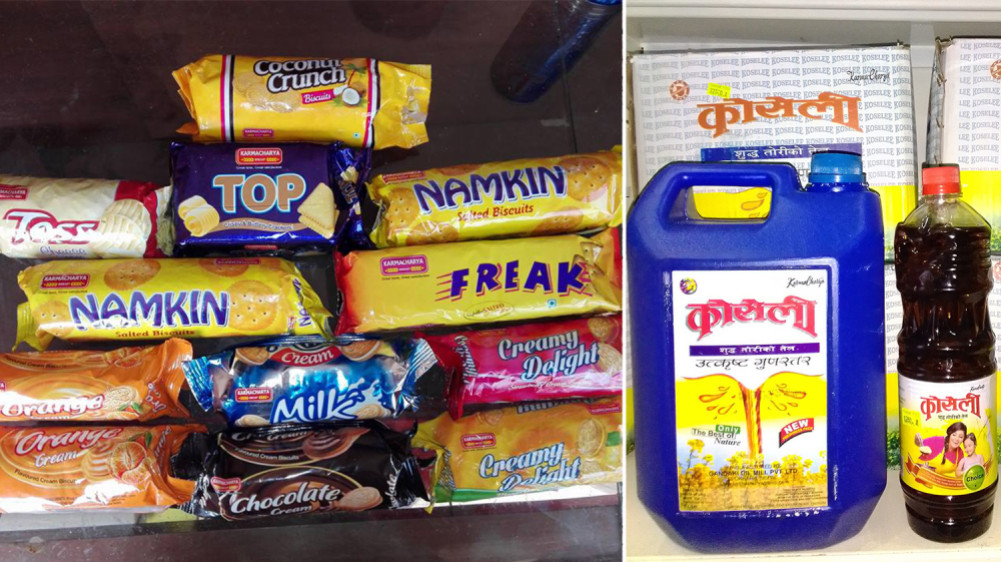
Karmacharya Group of Pokhara is expanding from grocery stores to sink noodles to edible oil to biscuit industry
We use Google Cloud Translation Services. Google requires we provide the following disclaimer relating to use of this service:
This service may contain translations powered by Google. Google disclaims all warranties related to the translations, expressed or implied, including any warranties of accuracy, reliability, and any implied warranties of merchantability, fitness for a particular purpose, and noninfringement.
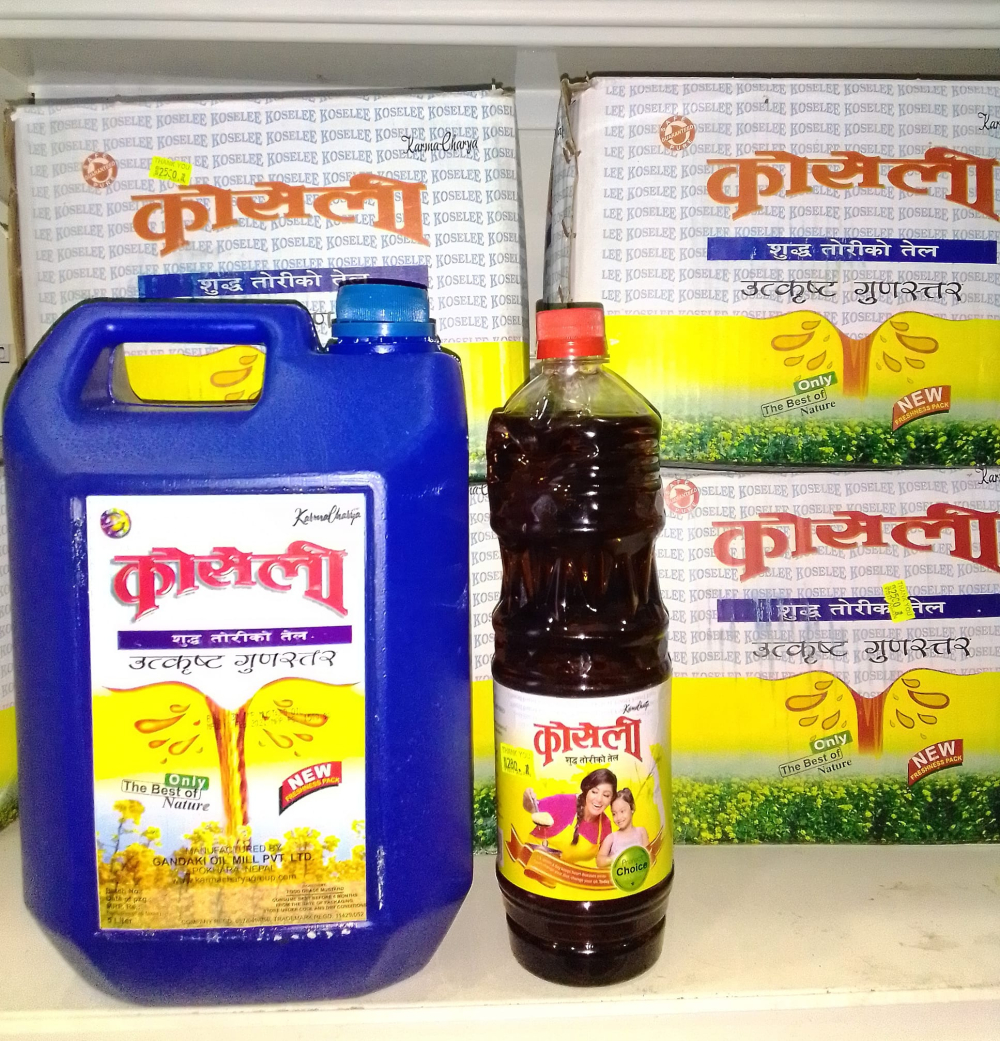
Be it kerosene or mustard oil, it used to come in tin cans. Karmacharya Group of Pokhara established Gandaki Oil Mill in 2042 and started selling oil in Jerkin. Mustard oil sold openly was packaged in jerkin and given the 'brand' name, Koselli.
After learning that oil was being sold in packets in India, this group brought a machine from Hyderabad and did the same in Pokhara. The business of selling mustard oil in packets was started by replacing tin cans.
Karmacharya Group Chairman Chandrakrishna Karmacharya still remembers the pain of setting up the oil industry. Traders from Birganj and Bhairahawa used to send mustard oil in tin cans. Cough oil used to come to Pokhara in some quantity. To get oil, one had to go to the store with rent from home. Karmacharya saw that buying oil in that way would be both difficult and unhealthy. He consulted his two brothers Govinda and Hari. He decided to open his own industry in Pokhara and produce oil. Establishing a
industry was not as easy as he thought. Oil mills were discouraged because they did not operate in the hills. Bringing mustard to Pokhara was not easy. He started the industry by bringing mustard from Jasotso Narayangadh. As the oil did not arrive, it had to be brought from Nepalganj. Contacted Chhotelal, a mustard trader from Nepalganj through Trunkal. The businessman replied that he could not send mustard to Pokhara. "We reached Nepalgunj after coming there and saying that we will pay if we pay," he recalled, "After going that way 2-3 times, he started sending them from there." Even the traders of Jaipur refused to give mustard except to the traders of Birganj. He brought two businessmen to Pokhara at his own expense. "They didn't believe that people of Pahari origin would do industry," he said, "After coming here and seeing it, they started sending mustard from there." He says that Koseli was probably the first "brand" to sell jerkin and then mustard oil in packets throughout the country.
 Initially popular in Pokhara, Koseli oil then started reaching Gandaki, Dhaulagiri, Lumbini areas. Also expanded its market in Kathmandu and Narayangadh. Sunflower and soybean oil are now being produced from this brand. Chandrakrishna Karmacharya, president of Karmacharya Group, said that Koseli mustard oil has a market share of 25 percent in Gandaki province alone.
The business history of this group starts from Kathmandu Valley. Jagatkrishna Karmacharya of Bhaktapur used to do itinerant trade in groceries. Biscuits started burning in a red clay oven. He arrived in Pokhara in 2013 along with his three other friends while selling groceries. After the business was good, he repeated it two or three times. At the end of 2013, he started a grocery store in Pokhara. In 2015, his wife Sanumaya, son Gobind and younger son Hari Karmacharya also came to Pokhara. Eldest son Chandrakrishna came to Pokhara after completing SLC in 2025.
Ranipauwa's grocery shop moved to Mahendrapul. By then all the three sons had entered the business. In the year 2036, he brought a Chinese machine from Kathmandu to his home in Pokhara's Nayabazar and opened a noodle industry. Sinkay noodles under the name Danfe and Fewa took over the market. Oil industry opened in 2042. Karmacharya Group's business continued to expand. Gandaki Plastic Products Pvt Ltd started production of plastic bags.
 30 years ago, this same group started manufacturing two-wheeler tires and tubes by opening Everest Rubber Industry in Ghandakot, Navparasi. But the industry could not take off when cheap black market goods came from India. Even though the then Finance Minister Bharat Mohan Adhikari was taken to the industry and explained about the situation, the problem was not resolved. After the industry went into losses, it was closed within 5 years. The
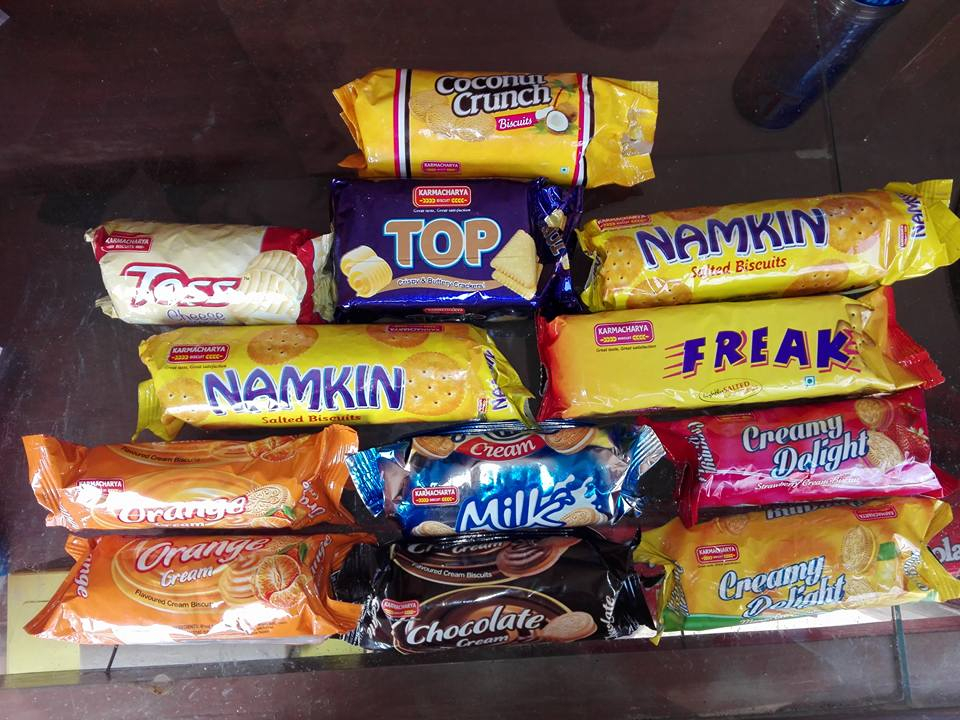
group used to sell the products of Bhairahawa's Gorkha Biscuit Industry as a dealer in Pokhara. At that time, another businessman, Jit Prasad Dwa, offered the Karmacharya group to run his closed biscuit industry in Budhi Bazar. The group started manufacturing biscuits like Glucose, Thinararot, Maree 20 years ago on industrial lease. After four years, he established his own plant and started producing biscuits.
This group is particularly focused on the food processing industry. Koseli Mustard Oil produced by Gandaki Oil Mill and currently Koseli Health Sunflower Oil are in the market. Karmacharya Bakes and Foods Pvt Ltd is also producing Digestive Biscuits since 2017. Biscuits of various 'brands' including Karmacharya Top, Beesmari are produced by this industry. Karmacharya Foods Greench Pvt Ltd produces Kumari Rice, Kumari Gold Buckwheat and Kumari Gold Chiura. Paper and packer production is being done through Country Confectionery Unit. Crunch wafer chocolate is also being produced by this company.
is working as an authorized dealer in Gandaki Dhaulagiri through Karmacharya International Pvt Ltd and Karmacharya Brothers of various products. Currently, Karmacharya Group is selling and distributing the products of Pooja Soap and House Hold Pvt Ltd, Makalu Soap Pvt Ltd, Nebula Foods Pvt Ltd, Surya Nepal Pvt Ltd, Eastern Sugar Mill, Everest Sugar Mill, Wagmati Sugar Mill through this trading firm.
After Chandrakrishna, Govinda and Hari, the third generation is running the Karmacharya Group. The group has Chandrakrishna as chairman, Milo bhai Govind as vice-chairman, Chandrakrishna's son Michael and Govind's son Vikram as directors. The younger brother, Hari Karmacharya, established Fistel Dairy Pvt. Ltd. and produces milk and milk products of the Nova 'brand'. Jagatkrishna passed away four years ago.
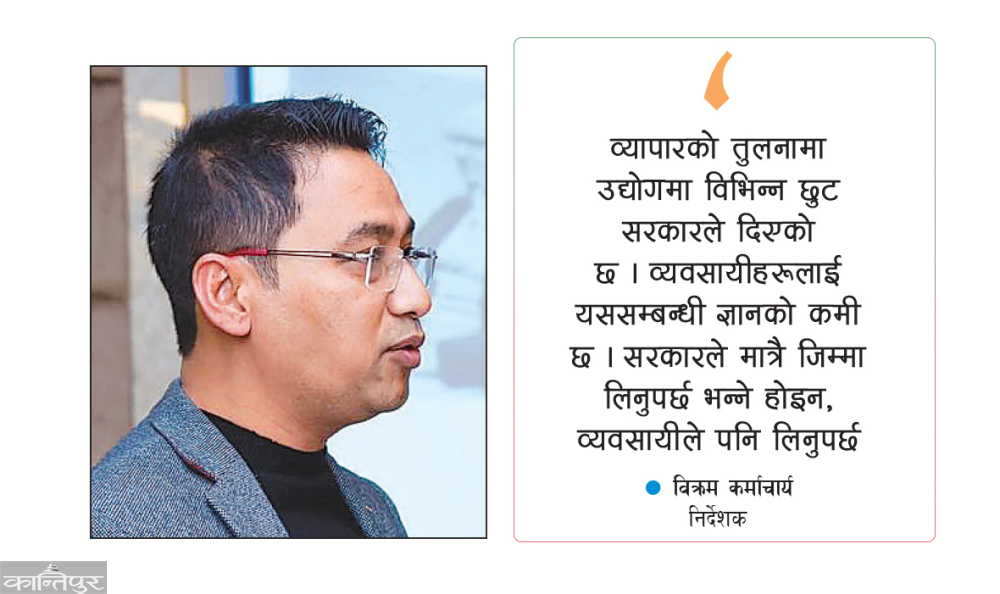
 Karmacharya Biscuits are now competing with the products of multinational companies, says Director Vikram Karmacharya. There have been many ups and downs in the biscuit industry. There were challenges like price competition, but we did not compromise on quality," he said. "We believe that consumers should not compromise on quality and quantity after paying money. It is felt that Karmacharya Biscuits has come a long way in the Biscuits Industry of Nepal by winning the trust of the consumers.' He has seen the difference between business then and now. He remembers that even 30 years ago, there were not so many imported goods sold in Nepal. He remembers that while working as a Karmacharya Group distributor, the market for Mahashakti Soap Udyog's Pooja Soap, Solti Soap, Everest Toothpaste of Everest Cosmetic Products Pvt Ltd was high. Later, foreign media also started playing in the Nepali market. Along with its effect, the industry here gradually migrated because they did not understand the impact of advertising," he said. "In order to save the industry here, the industry should work on 'brand' and advertising. Multinational companies should give the same quality. If we want to compete with that, we went ahead to give Ganastar. We were successful.'
He says that there is no policy problem to operate the industry in Nepal. According to him, there is a level of difference between the customs duty on import of raw materials and finished goods. Low taxes on raw materials, high taxes on imported ones. The Revenue Department of the Ministry of Finance has imposed an income tax of 25 percent on business and only 20 percent on manufacturing industries. Industries that employ more than 100 people will get 10% exemption of 20%, i.e. only 18% income tax. One-third are women, Dalit or disabled workers, while 18 percent are given another 10 percent discount. By doing this, only 16.2 percent income tax will be paid.
The government has given various concessions to industry compared to business. Practitioners lack knowledge about this. It is not only the government that should take responsibility, businessmen should also take responsibility," he says. "We businessmen also have the illusion that doing business is easy and doing industry is difficult. It is said that tomorrow it may sink, it may deteriorate. Imported and sold goods from outside, businessmen are moving towards business because the risk is less. The government's policy has encouraged the manufacturing industry.
Nepal is not self-sufficient in flour, sugar and ghee needed for biscuits. While the demand for wheat in Nepal is 2 million metric tons, 10 million tons are produced in Nepal and the rest has to be brought from outside. Sugar is also 300,000 tons of Nepal's total demand, but only 140,000 tons are produced here. He argues that when land is expensive, the production is also reduced after seeing the benefits of plotting over agriculture.
Karmacharya Group is providing direct employment to 500 people. He presented the argument that the youth exodus can be stopped if the common people here use indigenous products and the government also brings programs to encourage them to use indigenous products. If you buy products produced in Nepal so that your family members do not go abroad, the demand for local products will increase. When demand increases, production should increase. It also increases employment," he says. "When employment increases, it can be prevented from going abroad. If the general public is not aware, it will not be only by abusing the government.'
Karmacharya Group's products were also in the Netherlands, America and the UK for a few years. He found out that developed countries give concessions on customs rates to developing countries while doing business. He saw the potential as the customs duty would be lower when exporting out of Nepal. Most of the goods will be imported in Nepal. In this way, cargo ships and ships that bring goods return empty. Therefore, it is cheaper to try to export from here," he said. "There is no raw material here, businessmen are thinking about what can be exported. But if we can export from here, we can enter the market there to secure investment.'
Another director, Michael Karmacharya, says that the government should run an awareness program to use products produced in Nepal. His experience is that after the undeclared blockade of 072/73, the awareness that Nepalese products should be used has increased to some extent. Stating that the end of load-shedding, the easy delivery of products by roads to the villages is a positive thing, he expressed the opinion that the private sector, the people and the government should be responsible in their respective places.
He says that the government of Nepal has paid less attention to the fact that the people's livelihood should be made easier by controlling inflation while focusing only on revenue collection. "Increasing the minimum wage of workers every year is not the only solution to the problem, controlling inflation is also a major issue," he says. How to control inflation is the government's responsibility.
According to him, Karmacharya Group is not limited to old businesses, it is also investing in agriculture, education, hydropower and banking sectors. "Yesterday, Nepali industrialists thought that biscuits worth more than 10 rupees would not be sold, now digestive biscuits worth 50 rupees are being sold," he said, "The purchasing power of consumers is increasing. Consumers are now looking for quality products, not cheap ones. One should understand this and try to produce a branded product.'