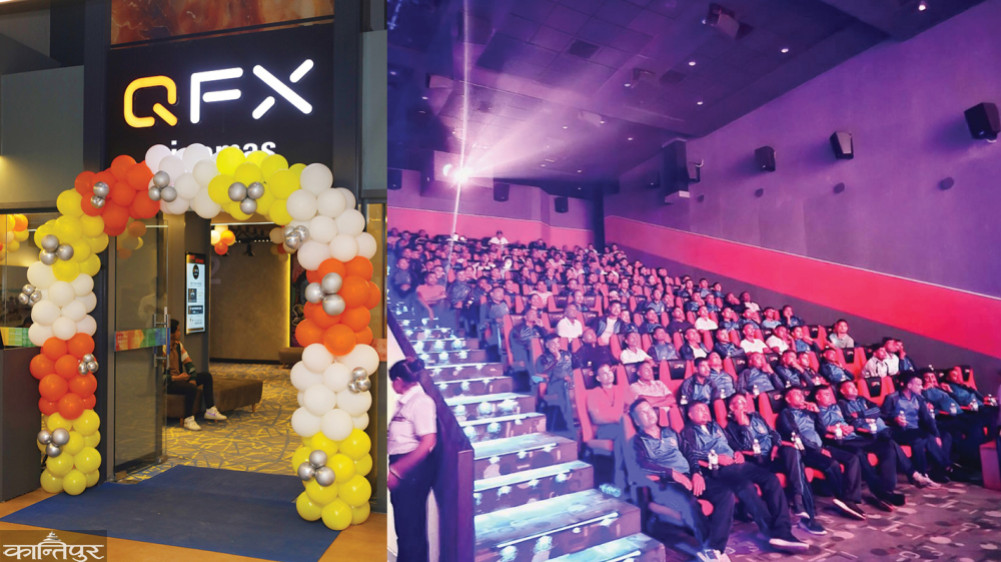
'QFX' has been given the award for developing quality movie halls in Nepal, bringing a significant transformation in the way films are shown through the use of cutting-edge technology and playing a major role in bringing about changes in the traditional narrative style and visual language of Nepali films.
We use Google Cloud Translation Services. Google requires we provide the following disclaimer relating to use of this service:
This service may contain translations powered by Google. Google disclaims all warranties related to the translations, expressed or implied, including any warranties of accuracy, reliability, and any implied warranties of merchantability, fitness for a particular purpose, and noninfringement.
Manakamana, Tara, Hiraratna, Ashok, Chamunda, Nagarjuna, Ranjana, Shivdarshan, Gopi, Guna, Vishwajyoti - these are all the famous movie halls of Kathmandu Valley that once ran magnificently, packed with audiences and cheered by enthusiastic crowds of actors who became one with the audience. . All these 'stand alone' halls are now closed, some have been converted into party palaces and some into apartments.
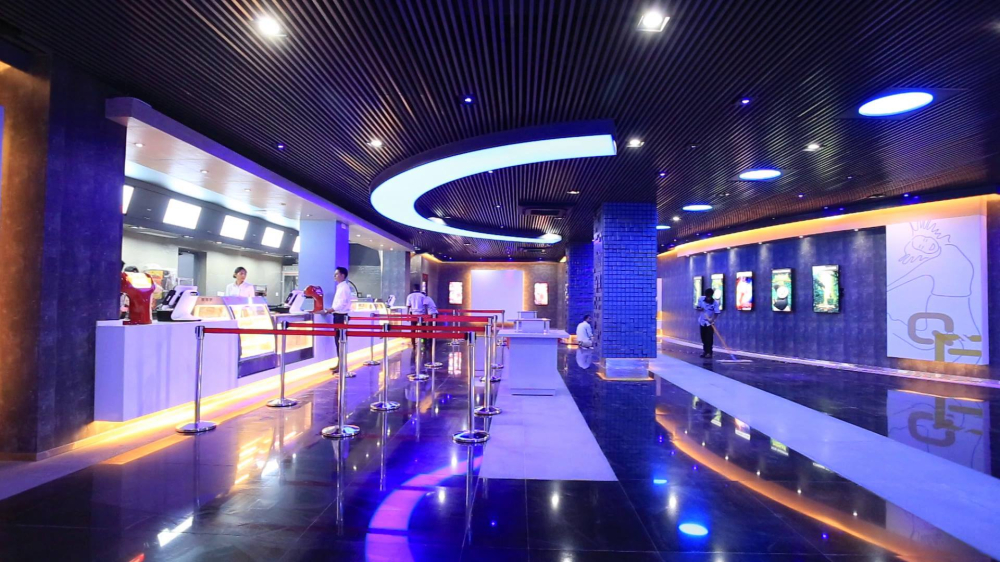
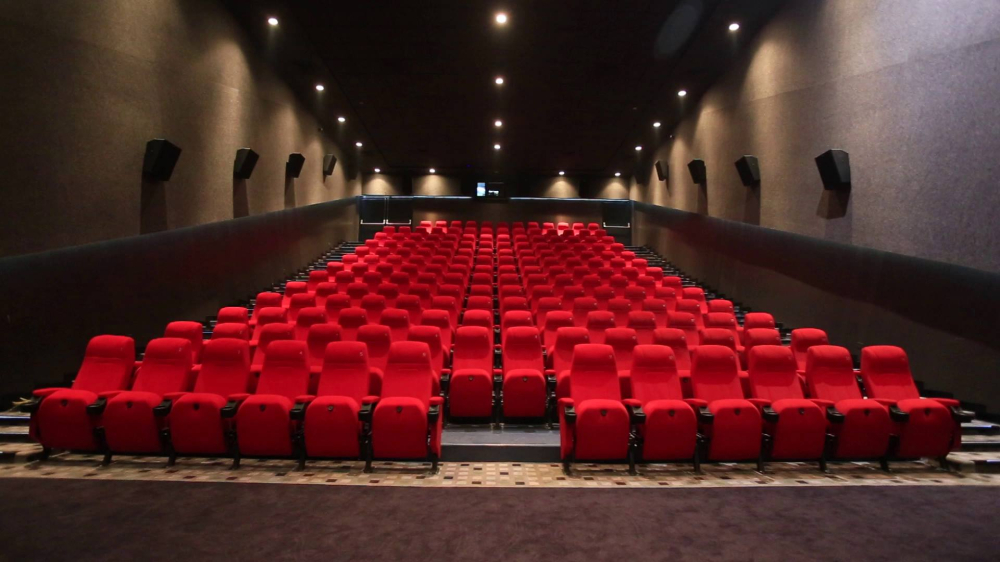
Now the film hall is called 'QFX', 'QFX' is a clean, spacious, well-equipped, beautiful hall with modern technology on the upper floors of shopping malls. QFX is credited with developing a quality movie hall in Nepal, bringing a significant transformation in the way films are shown through the use of cutting-edge technology, and playing a major role in changing the traditional narrative style and visual language of Nepali films. Another less discussed aspect of this is that 'QFX' has increased the number of female viewers in movie halls.
Now as many women are seen in theaters, two decades ago not so many women went to movie theaters. Also, women were not allowed to go to the theaters alone to watch films, which is a common theme in today's 'Independent Era'. "It used to be difficult for women to buy tickets in the crowd, they would pinch and push them, due to which the number of female viewers in the movie hall was low," says Bhaskar Dhungana, director of "QFX" operating company "Team Quest" Pvt. In some films, there is a majority of female audience. It's a safe movie-watching environment.
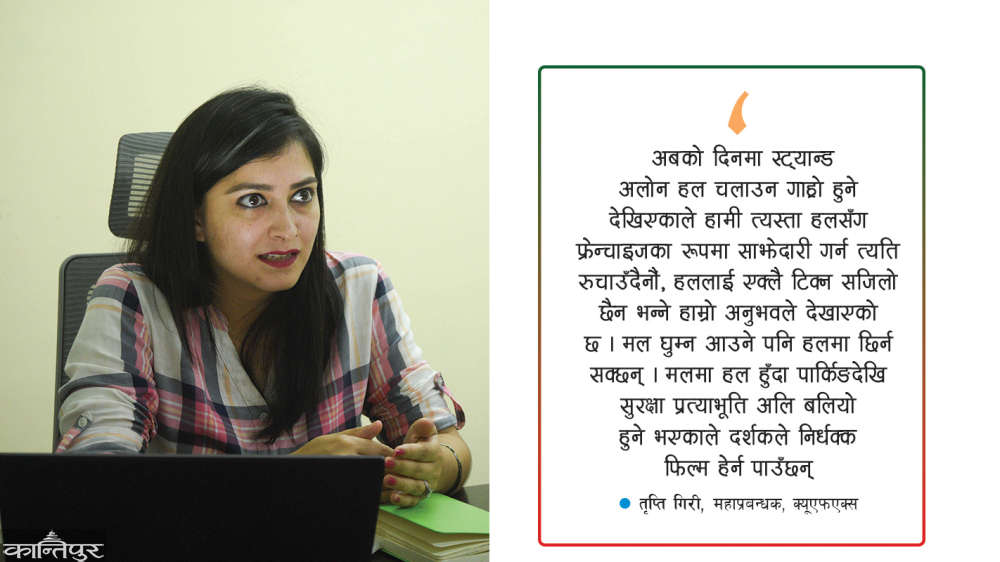 Incidentally, even within the largest multiplex chain, QFX, the number of female employees is more than male. Tripti Giri holds the highest management position in 'Team Quest' as General Manager. The managers of 'QFX' Bageshwari in Nepalgunj and Darbar Cinemax in Kathmandu are also women. I am the Head of Marketing and Business System, Head of Business Development and now General Manager.
I feel that my work is important,' says Tripti, 'I took the initiative to advance the partnership program of Pocket Wallet, Worldlink, Coca-Cola with QFX. I also got to join and work on the plan of how to operate QFX strongly after Covid.'
Business expansion
A new hall was recently added to the 'QFX chain'. Two weeks ago, actors Deepakraj Giri, Ramesh Upreti, Jitu Nepal, singer Prakash Saput, actress Neeti Shah and others inaugurated the hall of 'QFX' at City Square Mall in Samakhusi, Kathmandu. Team Quest has added four halls in the last quarter. 'Pokhara Cine Plex, Chitwan Cine Plex, Rising Mall and City Square' are the added halls.
All of these except City Square are already running halls. They have now come to join the 'QFX Brand' as a 'Franchise' managed by 'Team Quest'. Currently, 'QFX' halls are operating in 17 locations across the country. There are 7 locations within the Kathmandu Valley and 10 locations outside the city. There are only two 'QFX' halls in Chitwan. A total of 40 screens are showing Nepali and foreign films. QFX's annual average income is more than 2 billion rupees.
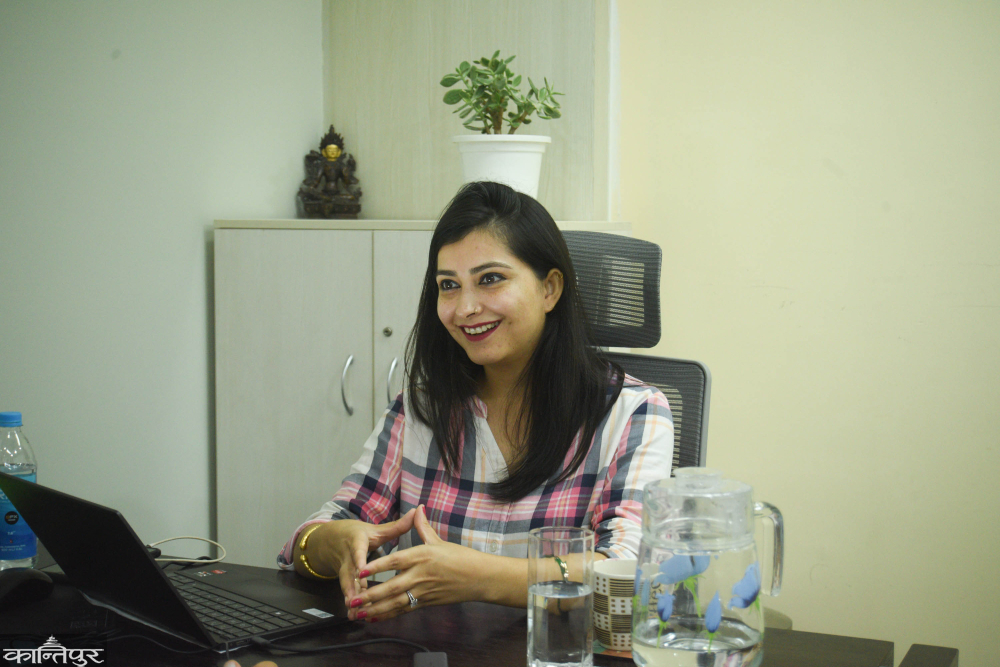
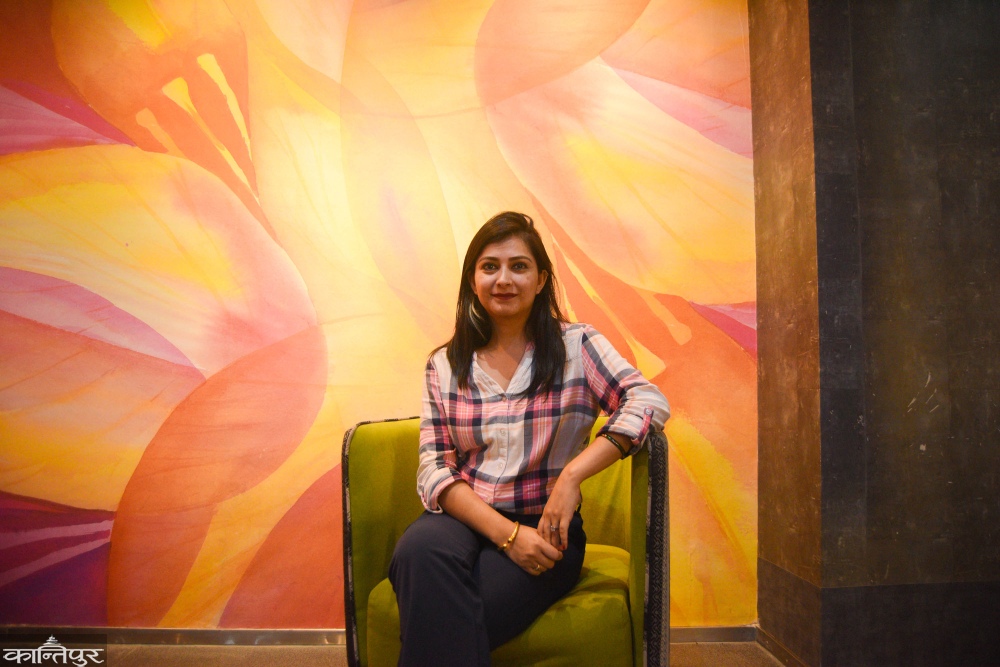 QFX General Manager Satisfied giri . Photo: Safalprakash Shrestha
As many halls as 'QFX Brand' have, all of them are run on the 'franchise' model. The business methods and services specified by Team Quest as the 'Franchisor' are implemented in accordance with the agreement with the 'Franchisee' (Related Hall). QFX Brand Hall is managed by Team Quest. 'QFX' is not a company in itself but a brand owned by Team Quest. More than 350 people have got employment under 'QFX brand' across the country. Adding the number of office assistants and security guards to be outsourced will increase the satisfaction, she says. Team Quest has 31 employees.
When expanding a new hall, Team Quest takes a one-time fee for providing the "QFX brand name" and a monthly fee of 5 to 9 percent according to the income of the hall from the "franchise". Halls earn income from movie ticket sales, advertising, food, branding etc. The proceeds from the ticket sales are shared by the halls with the film distributors. Regarding Nepali films, only a few months ago, it was decided to share 50/50 percent shares between the hall and the distributor. In the case of
foreign films, 50 percent in the first week, 42.5 percent in the second week, 37.5 percent in the third week and 30 percent after the fourth week, Trupti said. "The longer a foreign film runs, the more shares the hall gets," she said, "However, 36 percent tax has to be paid on foreign films." Nepali is 20 percent. Since the tax is low, if Nepali films run more, the hall will benefit more.'
 There has been opposition from time to time saying that the government has imposed many kinds of unreasonable taxes on film halls such as film development fees, VAT and local taxes. Last year, the Nepal Film Association stopped films across the country with the demand of canceling such taxes. "This year there is talk of tax increase again, this is not good," says Trupti, "and the other is that the local government has said that the data of our software should be synced." Internal Revenue Department and Film Development Board are in sync. All our data is transparent. How many agencies should we open the software to when government agencies are involved? It is feared that it will cause discomfort in the business network.'
Brand journey
Bhaskar Dhungana, who returned from America, Nakim Uddin and Rajesh Siddi, who came to Nepal after studying in Taiwan and engaged in various businesses, started 'QFX' in the year 2000. After extensive upgrading of Jai Nepal Hall, they started the 'QFX Brand' by arranging to show films through digital technology.
At that time Manakamana, Vishwajyoti, Hiraratna, Gopi were all doing well, we were just a startup. People used to say that when they tried to run the hall by increasing the ticket price from the current price of Rs.50 to Rs.175, they would drown," recalls Bhaskar, "but the halls at that time were only serving one group of customers, there was no hall for those looking for convenience. There was fear that the ventilation was not good and dirty toilets would spread the disease. In Jai Nepal, we have provided security arrangements such as fire extinguishers and exit passages, and the hall was packed when we showed Spider-Man.'
Nakim said in Sanjay Silwal's 'On Air Podcast' that QFX was conducted by showing only English in the beginning and later Nepali films were added through Hindi. He also remembers that they produced 'Kagbeni' and 'Sano Sansar' when the Nepali film 'QFX' was shown in Nepali film 'QFX', which was made by exact imitation of Hindi film.
 'We started looking for a film because we had to play a Nepali film after we were heavily criticized for only showing foreign films and did not encourage Nepalis,' he says, 'There was a film, celebrated for 50 days, a very successful film, made by our friend, who was saying to play it. was We were going to show that film in Jai Nepal. However, none of them worked. We made the film ourselves because multiplexes needed a different and topical film.'
Released in 2007, directed by Bhushan Dahal, Kagbeni is credited with introducing a new narrative style and visual language in Nepali films. This is Nepal's first film made through digital technology. After 'Sano Sansar' directed by Alok Nembang in 2008, the trend of making films using digital technology increased. At that time, Ch Ojha, a popular producer, announced that he would make a film using digital technology, and others also opted for digital technology. Digitization has made it easier to screen films in theaters across Nepal. Nakim explains this as a 'turning point' in the Nepali film industry. At the same time in 2010, after the hall opened in Civil Mall, the fame of 'QFX' also increased. Established as a well-known brand in the Nepali entertainment sector.
Meanwhile, 'Loot', 'Chakkapanja', 'Kabaddi', and 'Jari' have become trend-setting films in the Nepali film industry. Halls have also started showing films through analogue, cellolog, Tukey, Fokey and now laser projectors. Tripti says that 'QFX' is always adapting itself to the latest technology and improving the 'Film Watching Experience'. According to him, laser projector QFX, which has been used in the world for the last few years, has already been installed in Jalma Hall in Chitwan and Bageshwari Hall in Nepalgunj last year. "The quality of the video and the lighting are high," she said. A sound system called Aromax has been installed for the first time in Nepal in the hall of Samakhusi.'
According to Triptika, Nepali and Hindi films 'QFX' play more in Civil Mall. English films play a lot in Chhaya and Labim. Butwal is an exception even though most of the theaters outside Kathmandu do not show so many English films. Nepali is spoken more in Damauli. There is an experience of satisfaction that started moving after 'QFX' went to Birtamode, where English films were not shown before. But according to him, the audience of English films has decreased drastically since the trend of the young generation going abroad. She said that this is a matter of concern and a big challenge for them.
Rising above the scourge of covid
One of the areas most affected by the covid epidemic is the film hall business. During the lockdown, the halls were the first to close and the last to open. While the market of OTT platforms such as Netflix, Amazon Prime, and Disney is growing, some of them even started to argue that the era of the hall is over. At that time, many halls in Nepal were closed forever. As far as 'QFX' is concerned, from where it was started, the same hall had to be closed first.
 Jai Nepal Hall is currently unused. Kumari Hall has been purchased by Islington College and used for its own educational purposes. "We had an emotional connection with Jai Nepal and Kumari because that's where we started," says Bhaskar. It had to be closed because there was no possibility of improvement, but why were we not so emotional? Even though the hall is not alive, the idea of starting Jai Nepal is still alive. And, we are thinking of expanding it further.' Bhaskar says that the initial 'idea' that the audience should be given good facilities in the
hall, only if the hall is good, they will come to watch the film and this will increase the overall industry. He also said that 'QFX' has spread outside of Kathmandu and now they are thinking of gradually bringing it to the villages. According to him, even though the single screen halls with less facilities have been closed after Covid, the number of halls with facilities is increasing. Currently there are only two 'stand alone' theaters namely Jalma and Bageshwari under 'QFX'.
'Since it seems that it will be difficult to run a stand-alone hall in the future, we do not prefer to partner with such halls as a franchise,' Trupti said, 'Our experience has shown that it is not easy to sustain a hall alone. Halls and malls complement each other when running a shopping mall. Mall visitors can also enter the hall. When the hall is in the mall, the security guarantee from parking is a little stronger, so the audience can watch the film confidently.'
Bhaskar said that although the hall's business has shrunk due to Covid, now there are signs of improvement. According to him, "QFX" itself is doing well commercially. Tripti says that when everything came to a standstill during the time of Covid, they improved the process of data analysis, documentation, digitization, from updating the standard operating procedure (SOP) to be followed while running the hall. "When we opened the hall after the lockdown, we opened it as QFX 2.0," she says, "We made a new way of working, upgraded the software. We are focused on making the experience of going to the theater and watching the movie pleasant and comfortable.'
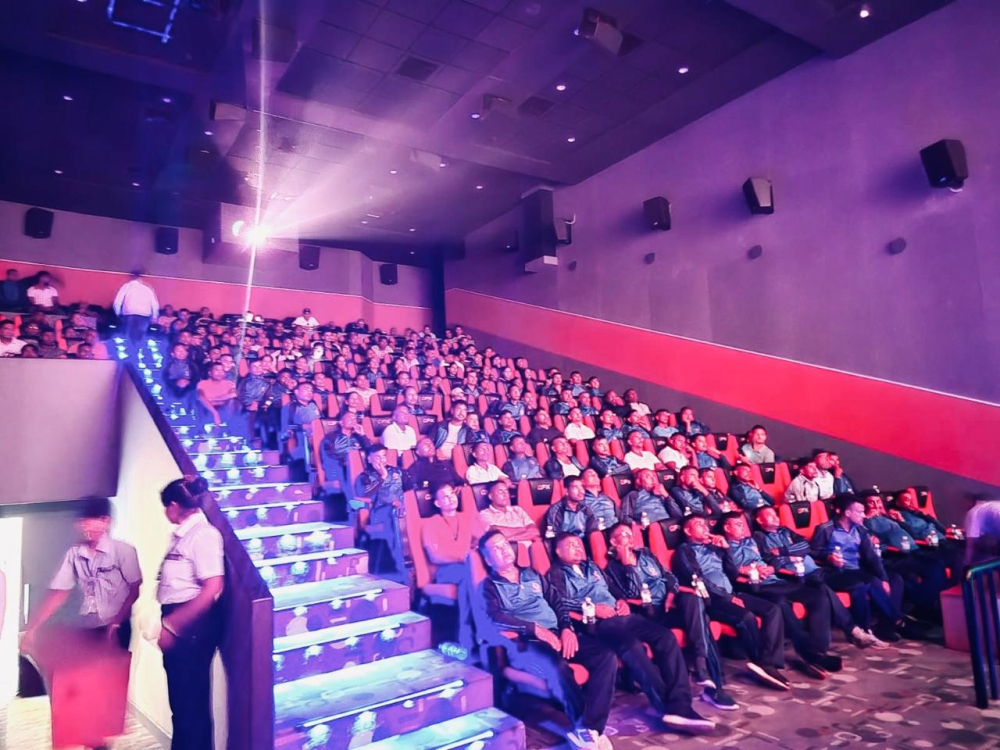 What is another coincidence, most of the key members of the 'QFX team' who succeeded in bringing newness to both the field of making and showing films in Nepal have returned after receiving higher education abroad. 'QFX', started by Bhaskar, Nakim and Rajesh, who came to Nepal after studying in countries like America, Taiwan, Hong Kong and doing good work there, has now become the biggest entertainment company in Nepal. Tripti, who leads the organization professionally, has also returned home with work experience after completing her studies in America. This group is now taking initiatives to modernize the company's 'corporate culture', to maintain a balance between the work and family life of employees, and to make the office inclusive.
Along with commercial success, the main message given by 'QFX Team' is how Nepalis can turn their studies and experience abroad into exemplary work at home. At a time when the number of Nepalis going abroad for study and work is increasing, the zeal of 'QFX Team' has exposed the issue that there is an opportunity in Nepal as well.