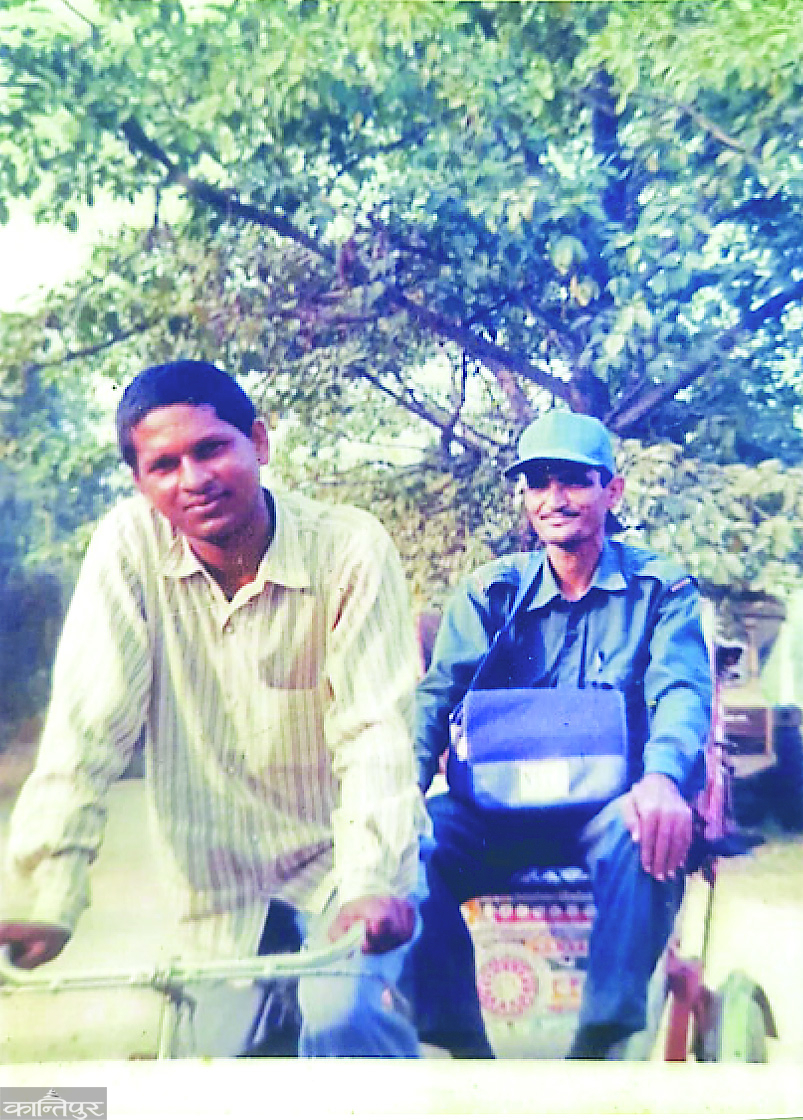
Chhatra Bahadur, who arrived in Lumbini 35 years ago from Bayarwan in Morang, has had to live in daily begging for the past one and a half years. Why did Chhatra Bahadur, who retired after working as a security guard for about 30 years in the Lumbini Development Fund, become a monk? Is it his desire or destiny to live in poverty? To understand this, you have to listen to the ups and downs of his entire life.
We use Google Cloud Translation Services. Google requires we provide the following disclaimer relating to use of this service:
This service may contain translations powered by Google. Google disclaims all warranties related to the translations, expressed or implied, including any warranties of accuracy, reliability, and any implied warranties of merchantability, fitness for a particular purpose, and noninfringement.
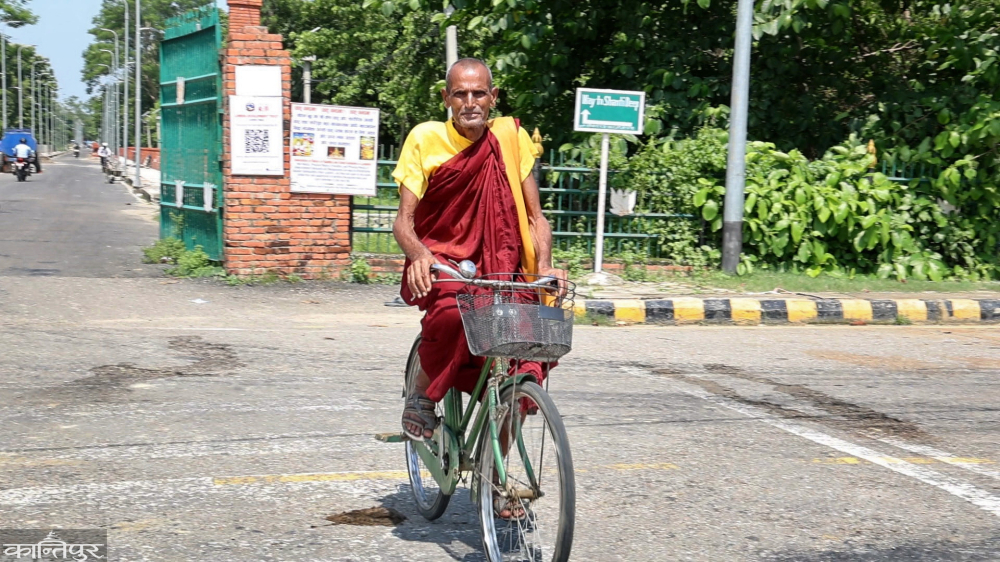
Every day before 7 in the morning, 64-year-old Chhatra Bahadur Karki leaves his house in Parsa Bazaar wearing a chewer on an old bicycle. Even after covering a distance of three kilometers which can be covered in one go, he is exhausted by the scorching heat from early morning. At one end of the Mayadevi temple complex, he mingles with a wave of dozens of other monks. He sits quietly with an alms bowl in his hand. His stay lasts till 10 o'clock.
Chhatra Bahadur, who arrived in Lumbini 35 years ago from Bayarwan in Morang, starts his daily life in this way for the last one and a half years. Why did Chhatra Bahadur, who retired after working as a security guard for about 30 years in the Lumbini Development Fund, become a monk? Is it his desire or destiny to live in daily begging? To understand this, you have to listen to the ups and downs of his entire life.
Chhatra Bahadur never thought until a year and a half ago, that the vehicle of a well-run life would break down like this and he would have to live for begging. He thought that he could live peacefully in his old age by remembering the struggle he had fought till he reached his old age. But it was not what Chhatra expected. So many unexpected things are happening repeatedly in Chhatra's life.
When Chhatra came to Lumbini after being distraught from Byarwan in Morang, he had no idea how his future life would go. After the food business boat that he started with his friends suddenly sank, he had a debt of 1.8 lakhs in Thaplo. And after paying off all the real estate debts, leaving his wife, minor son and daughter with his in-laws in Damak, Jhapa, he rushed to Lumbini in search of peace. Chhatra narrated, "At that time, I had no idea where to go or what to do." Where to go, how to stay, what to do, he only had a pile of unanswered questions.
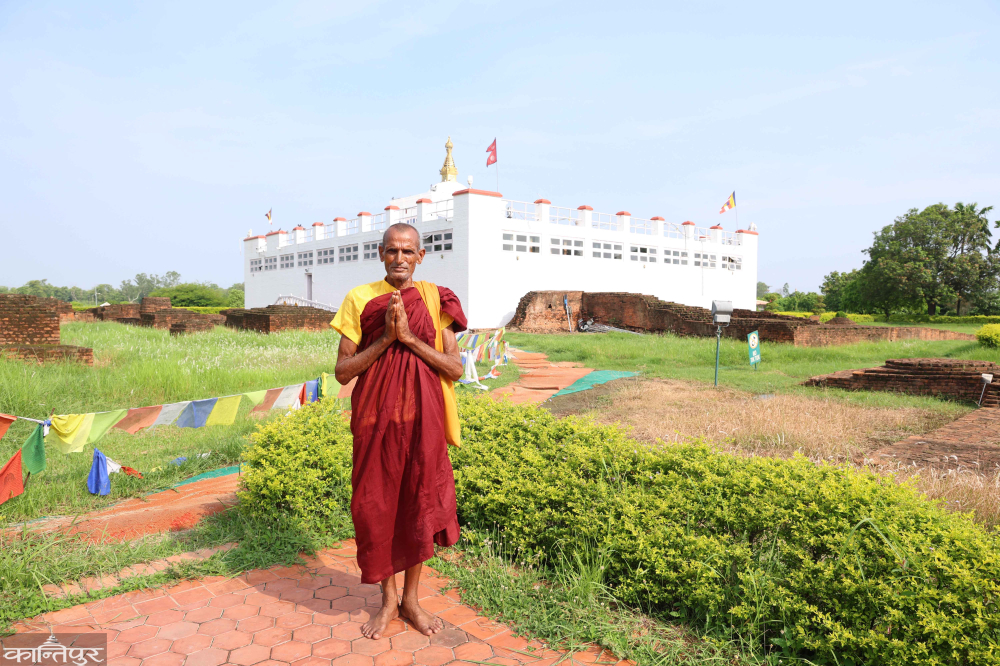
Nowadays, Chhatra's name has also changed like Dainiki. He became a monk from Chhatra. The Lumbini Development Fund has allocated a place for begging at the south end of the Mayadevi temple. Where beggars from nearby villages stay for begging. In this place you can sit for begging from 7 am to 10 am and from 3 pm to 6 pm.
Pilgrims who come to Lumbini wave and give donations to the monks who sit for begging. Such a donation will also add something to the alms bowl of Bhanteshoka. Calmly closing his eyes, he sits in a meditative posture for hours.
The memories of his past and present keep repeating in his mind. After the morning almsgiving, the other monks go home. But he reaches the rest house in Shantideep Chhevai towards the north from Mayadevi temple. They live on the east side of this house. And they satiate their hunger by eating bread and vegetables packed in plastic bags.
After meals he worships, recites Tripitaka. People who see him sitting peacefully accept donations if they give them. At 3 pm he again reaches the same place as in the morning. And joins the crowd of monks who are sitting in a crowd.
Chhatra Bahadur's life is enough to understand that life does not run only on the journey of thoughts and memories. Because when he came to Lumbini three and a half decades ago, he did not think that life would come to the present day. With three and a half hundred rupees, which was not enough with him, he rented a wheelbarrow in Lumbini's padaria at a monthly payment of rupees 50. He ran a pan shop there for a year.
While working at a paan shop, he got acquainted with Gaj Bahadur Gurung, the security guard of the nearby Mayadevi temple. Gaj Bahadur was the head of the security guard at that time. It was these yards that got him recruited as a security guard. Thus the pan shop became a security guard under the Chhatra Bahadur Lumbini Development Fund. Chhatra recounted the memory of that time, "For the first six months, I received 5 kg of wheat, 150 grams of lentil, 150 grams of soybean oil and 5 rupees in cash per day."
The initial struggles of the working life are indelible in Chhatra Bahadur's memory. That's why he said, 'On 4th July 2046, he got a temporary appointment as a security guard. After working for five years, he was appointed permanently on July 1, 2051. After working as a security guard, Chhatra Bahadur did not have to look back much. In the meantime, he brought his son, daughter and wife with him, who had left him with his in-laws. All the motions of life went smoothly.
He had completed the responsibility of getting his daughter married. Grown up son Gopal also started his own vegetable business. Chhatra spent 1.5 million rupees and bought a pick-up vehicle for his son who was working to bring vegetables from Butwal to Lumbini and Kapilvastu. And he bought two motorbikes for his son and grandson to get around easily. Chhatra had almost forgotten the old stories of struggle.
Chhatra started having breathing problems due to his advancing age. However, such a problem was not over. He said, "One day, my son told me to leave, and I resigned following my son's advice." When he resigned in August 2076, his monthly salary including ration reached 23 thousand rupees.
Chhatra thought that he would spend his old age peacefully, happily living with his sons and grandsons. But, where is it as expected? One day son Gopal fell ill. The pain in the neck and back was getting worse every day. Over time, the situation became such that the son was unable to walk. He said, "From February 2079, my son fell ill." He had some savings. He believed that after treatment, his son would recover and start his business again. However, it did not happen as he expected. The doctors told the son that the problem started after the spinal cord was torn. He did not rush anywhere for the treatment of his son. From the hospital in Gorakhpur, India, to all the hospitals in Ginechune, Kathmandu, he carried his sick son. After months of running and spending at the hospital, not only did his savings run out, he ended up having to take out a loan to treat his son.
In the meantime, Chhatra did not only treat his son. He sold the pick-up vehicle bought for Rs. 15 lakhs for Rs. 7 lakhs. Sold both motorcycles. 6 took a loan of 33 lakh rupees from a commercial bank by mortgaging the house built in Dhur.
In the eighth month of his son's illness, he operated on his son in a private hospital in Kathmandu. Doctors called for a follow-up after some time. However, the situation was such that, due to lack of money, he could not even go for follow-up. 42-year-old son Gopal said that although he underwent therapy for three months in a hospital in Butwal recently, he could not do more therapy due to lack of money.
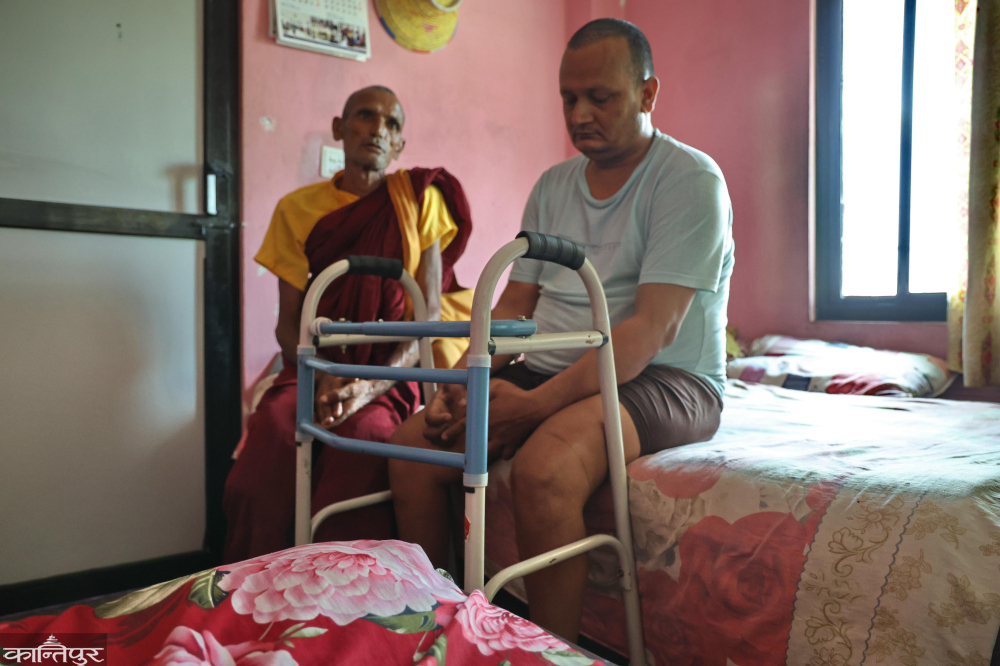
Today, Gopal's health has worsened. He has reached the point where he cannot even get out of bed on his own. As he has a problem with shaking his body, shaking his legs and shivering, his family sometimes keeps him tied up.
Today Chhatra is afraid of increasing bank interest and deteriorating son's health and his falling age. He told that the bank installment which was initially 33 thousand rupees per month has now increased to 42 thousand rupees. After being scared by the bank's increasing interest and burning loans, Chhatra did house counseling one day, selling real estate.
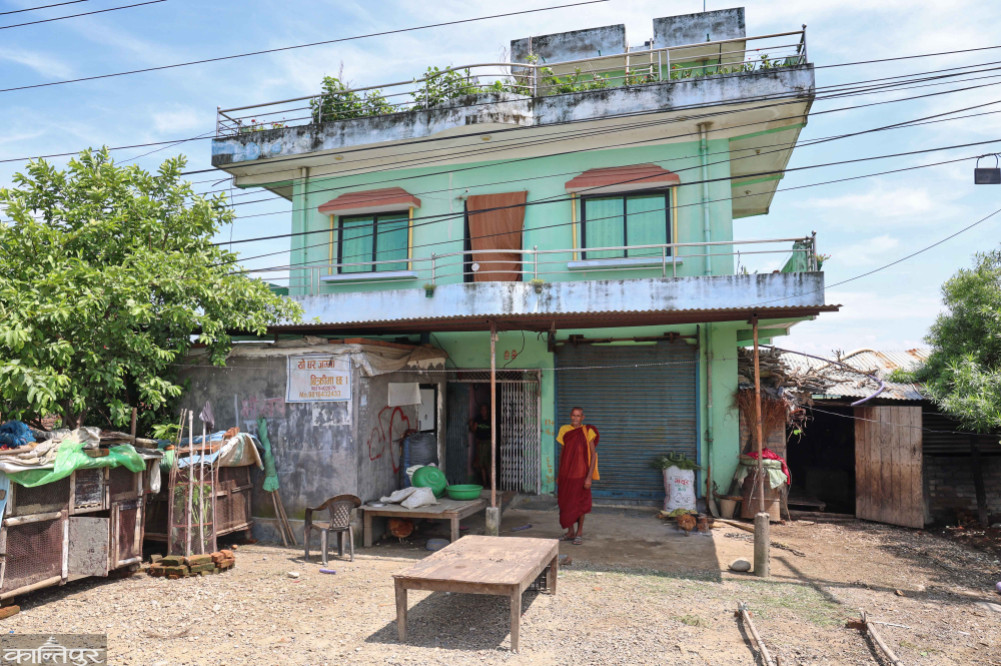
Now he has pasted a notice on the wall of the house. On which it is written, the house is for sale. Even though there is an economic recession all over, the concern that real estate is not being sold has started to bother Chhatra more and more.
Chhatra is involuntarily reminded of the old days when he is sitting near the temple of Mayadevi with alms bowl. Even after starting the job of security guard, Chhatra did not remain silent. In his spare time he was engaged in agricultural enterprises. Jersey cows and Murra breed buffaloes were imported from India and were not reared, fish reared, chickens and goats were not reared.
He was always looking for ways to earn income. Today, when you see a barn with only one cow, you are reminded of the time when there were 45 mow Jersey cows and 10 mow Murra buffaloes in the shed. And tiring.
Chhatra had always imbibed the mantra that life is based on actions. That is why he was engaged in agricultural production in addition to security guard work and animal husbandry. On the other side of the Bhairahawa-Lumbini road, a man from Kathmandu is earning and eating a one and a half bigha field. Chhatra said, 'The family is gathering food by growing in the same field. I didn't have to buy grain.'
Chhatra is also worried about the increasing interest of the bank on top of her son's deteriorating health. At the same time, he is worried that the bank will auction the house if he cannot repay the loan by selling the property. "There is no option to go under the tree with the family on the day the bank auctions the house," he said in a soft voice, "I came here with my children from Morang, now it is like going on the road again." He said in a soft voice.