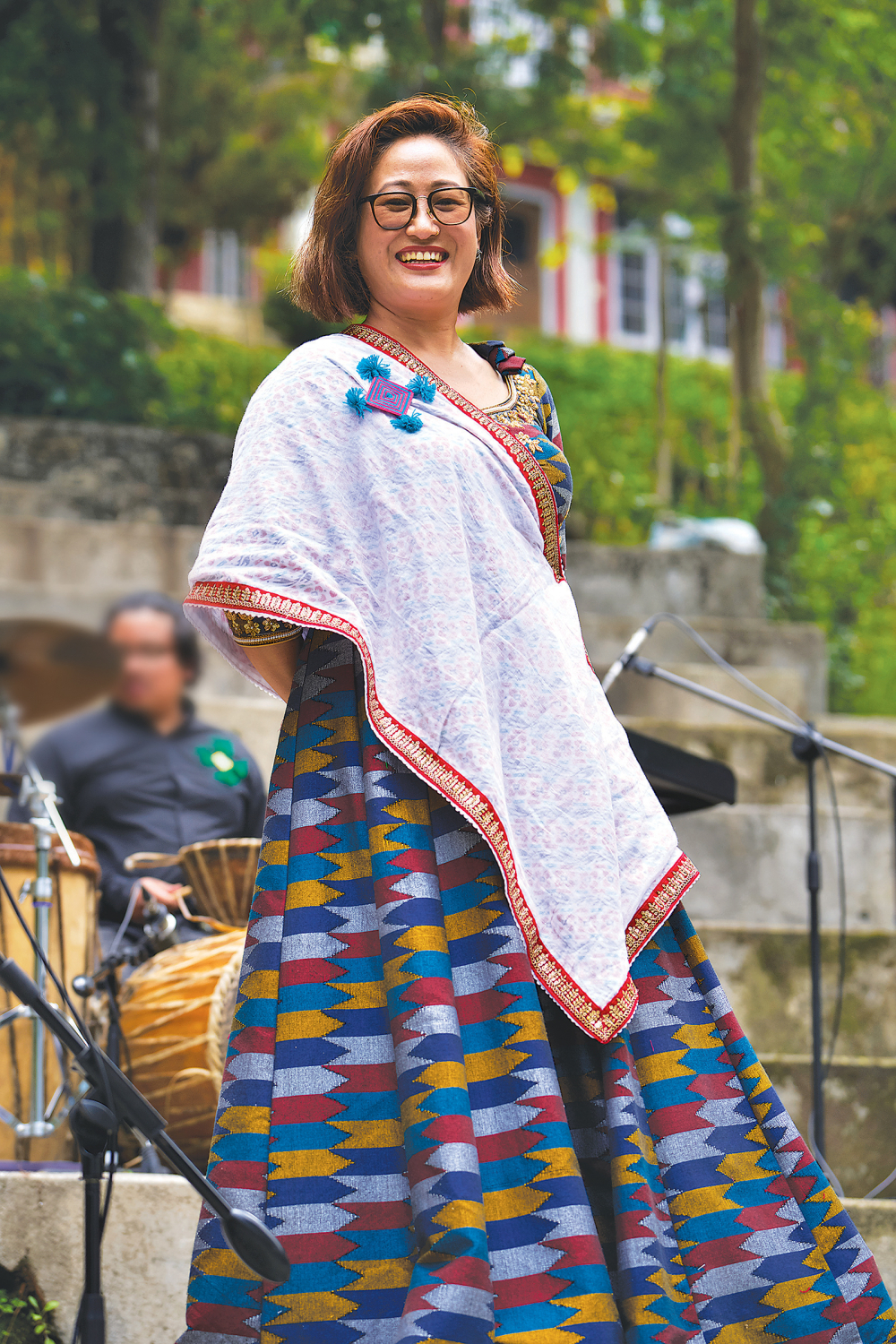
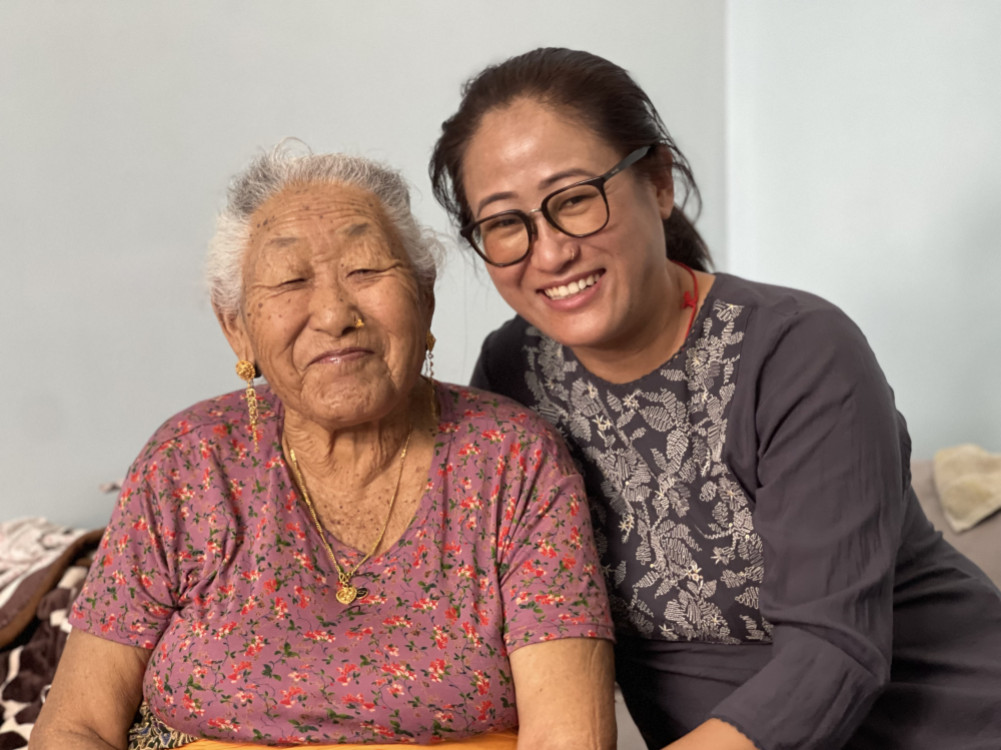
Jhuma Limbu is introducing other Raithane songs of Limbuwan including 'Hakpare' through her singing. But the Raithane music sung by Jhuma has no small influence from his mother. Therefore, Jhuma thinks that mother is also a teacher of music.
We use Google Cloud Translation Services. Google requires we provide the following disclaimer relating to use of this service:
This service may contain translations powered by Google. Google disclaims all warranties related to the translations, expressed or implied, including any warranties of accuracy, reliability, and any implied warranties of merchantability, fitness for a particular purpose, and noninfringement.
The Yakthung Limbu community's scripture 'Mundhum' contains narratives in poetic style. The practice of expressing those narratives through singing is called 'Hakpare' in Limbuwan. Jhuma Limbu is introducing the same 'Hakpare' and other Raithane songs of Limbuwan through her singing.
In a way, Raithane Sangeet and Jhuma Limbu are established as synonyms. However, there is no small sadhana behind this establishment. And his mother has no small influence on the music Raithane is singing. That's why Jhuma feels that his mother is also a music guru.
Non-Limbu may think, how did Hakpare become the oldest music of Limbu? After falling down in Fung Tianna, when Ixa Khambek (universe) stopped beating, people started singing Hakpare, mixing 'ho' with 'ho' to wake up the creation again. Bhir, Pahara, rocks and rivers were affected by it and Hakpare started,” says Jhuma. Hakpare starts by saying 'E' and ends by saying 'Orillo'. Jhuma also starts her mother's story by saying ``E.'' It seems that one of the gurus of Raithane Sangeetalaya is singing to her ancient Guru in rhythmic words.
Jhuma's mother remembers the changing seasons of the village and the rural fragrance in Kathmandu, where the monsoons are coming. When the memory of her village is Ektamasa, her memories keep coming back - the old lapsi plant standing in front of the house, the birds flying around sitting on that plant. In Tamorkhola Shir (Phaktanglung) of Taplejung, the birth-village of Jhuma's mother Lakshimaya Limbu (81), many stories-myths of Mundhum were heard. The stories of Mundhum are no less than the Tilsmi stories of any literature. In order to make the earth beautiful, God placed stars in the sky, created mountains, mountains, birds and animals. Planted colorful flowers, made tamor, maiva and many streams. How many stories are rich in imagination, in Mundhum.
Watching the cattle in the barn, going down to the river in the evening, cutting Duwali and fishing were his Tamorkhola daily routines. The road to and from Kanchenjunga Himal is Phattanglung village. In winter, when the Goras ascended Kanchenjunga, girls from all over the village would gather to see them, including Lakshimaya. Now she tells Jhuma her memoirs, 'Foreign blondes who came in winter used to look at her, and when they came back from the mountains, they would break their cheeks with their horns.' Fedangmas, Sambas and Yebas recite stories from the banks of the Tamor River while reciting Mundhum in karjes. Mundhum says that the origin of the Limbu tribe is near the Tamor river in Taplejung. Jhuma's mother, who grew up listening to the talisman stories along with the rhythm of the river, used to tell her daughter the story of the origin of Tamor river and Mundhum myths, which she heard from Babubaje. She keeps telling Jhuma - I am a person who has drunk the water of Tamor's root. People should think longer than Tamor, people don't know how long they live. The longer you think about it, the longer your life will be.
The Tamor river where he was born is the same, only the seasons change and the people who continue to travel that way. Lakshimaya also remembers the story of leaving Tamor and getting married to a distant village. Born in Nikkhur Limbu village, his mother got married and went to Dhungesanghu-Maivakhola in Taplejung, a village of Bahuns three days away from home, at the age of 15. Only after marrying her 9-year-old husband Man Bahadur Limbu, she saw him for the first time. Having never heard/spoke Nepali language, she slowly got used to that language.
•
• • Jhuma thinks that the village mothers are Tumyanghang. Tumyanghangs have all the knowledge of Mundhum. If Fedangma said/didn't say Mundhum correctly, it's up to Tumyanghang to check. Lakshimaaya keeps talking about yams and bamboo when discussing about household, marriage and lifestyle. According to Mundhum, a person's life begins and ends with bamboo. The first house in Mundhum was made of bamboo,'' Jhuma enters Mundhumi Darshan, 'Mother probably doesn't know what I am saying. But, he moves according to the world.
Their lifestyle is mundane. Mothers take Mundhumi song-music as their soul, I take it as a profession.'
Growing up in a community-culture where no work is done without music, Lakshimaya used to sing Hakpare in the village. In Limbu culture, music should be used to lift every task, music should beat the beat.
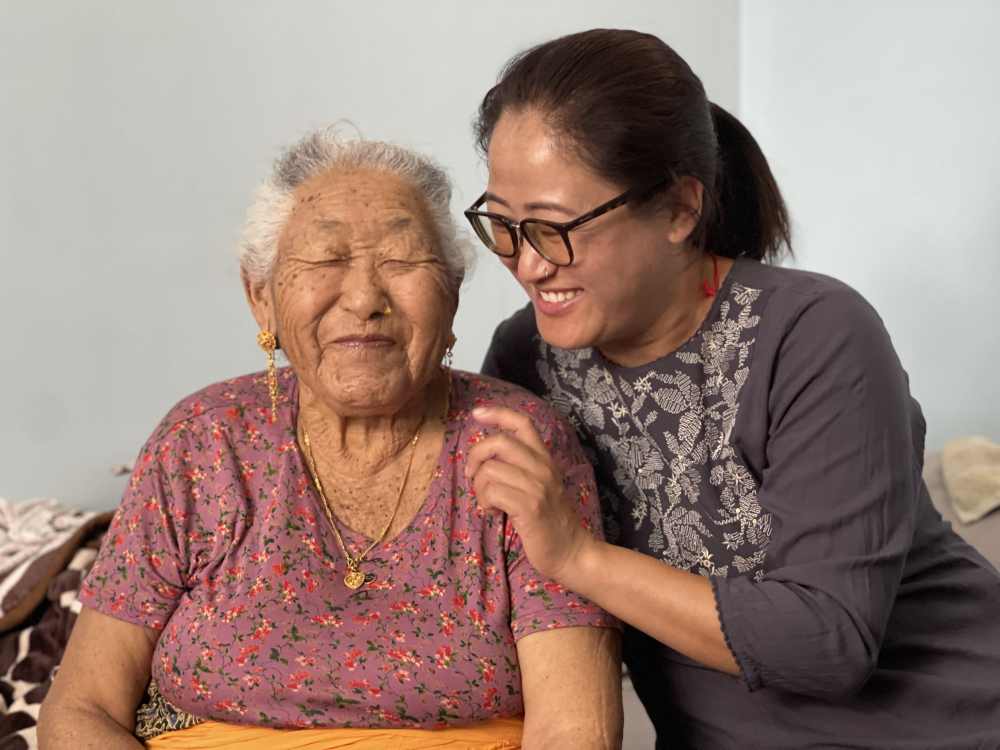
Jhuma still remembers the lullaby sung by the mother rocking the nanny after the birth of her elder brother's daughter. Little Jhuma heard a song sung by her mother for the first time - a song to lull the child to sleep. He didn't know, mother sings too. I know how to move my mother's neck but I can't sing, that knowledge is limited to mothers. When mother was shepherding, she used to sing and play. Even if I didn't understand it, I felt great joy when I heard my mother sing,” says Jhuma. There was a time when Jhuma felt like 'My mother sings a beautiful song' - after hearing the hakpare she sang at the village wedding. Mother sang all night long. At that time, the women of the whole village were crying. I don't understand the song, but I always remember that mother's voice.''
•
• • At a time when there are accusations that Nepali mainstream music is more influenced by 'Ravindra Sangeet', Jhuma has given preference to music-singers who spread the fragrance of their soil around them, their civilization and culture. . Even Jhuma herself had ventured into the folk modern song market. However, she somehow returned to Raithane Marg. And started looking for herself. Raithane found herself and her community in Dhun. His work is original, elegant and beautiful. The great diversity within Nepali music is reflected in this warmth.
Another introduction to Jhuma has been added to singing-sadhana - research and preservation of endangered cultural traditions, bazagaza, music. Staying in a village in eastern Nepal for 4 months, she made 23 instruments including 8 thari and a total of 23 instruments using khamari wood and cow skin. Jhuma has also produced a musical documentary 'Samsogha Mundhum' on Mundhum, where there is a dialogue between a living person and a soul. 'A Sayla', 'Khassam', 'Sounds of Mundhum', 'Amber Sangeet' are his other albums. Through Hakpare, Palam, Jhuma continues to tell this city – the story of Mundhum. Hakpare talks about girls, sex and flowers.
•
• • Jhumaki's mother's life-story has not only songs and fun, but also moments of pain and sorrow. How much pain and suffering? No accounting. Many flowers of desire in him fell to Oi. She witnessed the death of her sons. Loneliness tormented him. And, even though at one time I felt that everything is dead, I am also dead. The experience of such pain made him realize that 'to live life is to walk on a colorless journey'.
After the wedding, Lakshimaya was left alone in Maiwakhola, the British Lahure husband Man Bahadur Limbu walked to Paltan (Hong Kong), after getting married when he came to the country on vacation. Even when her husband came home from vacation after a long time, Lakshimaaya was too shy to speak. For 5/6 years, there was no conversation, no effort. It was only after a long time that we started talking,'' mother told Jhuma a childhood story. Man Bahadur took Lakshimaya to Hong Kong. When he returned to the country after 3 years, he had a son and a daughter in his arms. Lakshimaya had 8 children – 5 sons, 3 daughters. Jhuma is the youngest, 15/16 years older than her siblings. After the British retired from Lahore, Man Bahadur fell very ill. Dhami-Jhankri drums were played regularly in the house. He was also treated in Dharan's Ghopa camp for months. In the treatment of her husband, Lakshimaya's Taplejung-Dharan continued to increase.
When Jhuma was born, a high mountain of poverty and misery had already fallen in that well-to-do Lahure home. After her husband fell ill for years, mother Lakshimaaya was too strong to bear that practical burden. On her way back from Lahore, she went home with 50 to 60 tolas of gold and 18 to 20 porters. When Jhuma found out that her mother had only 2/3 tola of gold left, she sold it for household purposes. Instead, the Limbus sell land and land, they do not sell gold immediately, selling gold is considered to be a disgrace to the house.
Man Bahadur finally breathed his last in the winter of 049, at the age of 59. Jhuma was 9 years old at that time. In Jhuma's memory-sleep, the day his father's breath went away keeps coming back and forth. In the corner of the courtyard, Dhami was playing with the old lapsi plant. That year more than 30 people died in the village due to fever and diarrhea. Jhuma does not know what the disease is, but she remembers Jhuma fainting in the courtyard, crying and crying loudly. Then everyone's loud bang was heard.
After the death of her husband, Lakshimaya spent 4/5 months crying, she did not even eat food. According to Jhumka, she also fell ill after that. "Khskinuvo, the white mother's face began to get wrinkled, the weight of her children was on her," says Jhuma. Little by little the children also spread their wings, Lakshimaya became more and more lonely. And she started getting sick. Lakshimaya's life is not only separated from her husband, but also a series of separations.
Just one year ago, Lakshimaya's 54-year-old son went on a never-to-be-returned journey due to dengue. No one dared to tell the news of her son's death in the hospital, but she asked Jhuma in a soft voice trembling and sighing at that time - does your brother speak or not? But, in the end, the news had to be given. After the death of her son, the mother could not support herself. She became unconscious, her brain was in a state of non-functioning. She kept asking her daughters - 'Where am I?' and 'Who are you?'
She was unconscious for four months. She was rambling as if her mind was not working. She kept saying - the soil I stood on collapsed. The separation caused him great stress. A doctor was kept at home. Now she is tense, she seems to laugh a little. Even before that, two of his sons had passed away – the younger one in 036 at the age of 6 and the younger son in 042 at the age of 13. Jhuma is shocked every now and then - How did the mother survive after the grief of the short life of her sons?
This is how his 3 sons passed away. However, she says "I am happy" with her grandchildren. She narrates stories to her grandchildren, of her time. Jhuma has seen that many women in the village became addicted to tobacco and alcohol after the death of their husbands and children. However, this was not the case with his mother, she did not earn a living - she kept herself busy with her children and farming. Childhood mother - the picture in Jhuma's mind is like this - mother sitting in the west corner cooking rice on the stove and next to her sick father or mother pulling tonga from time to time.
When Jhuma was born, her sister-in-law had already entered the house. Lakshimaya used to say, 'Pregnant women should eat dahro'. And she used to make her daughter-in-law eat meat with jand-tongba-marmasala. When the daughter-in-law was pregnant, worship was performed at home - Sapok Chomen. After knowing that she was pregnant, Lakshimaya used to cook the egg - add spices, put it in a ghyampo, cover it with mud and bury it in the ground. Only after the birth of the child, the gyampo was opened and the mother was fed. Nowadays, Lakshimaaya is very proud of the grandchildren she has raised - "My 14 grandchildren are well educated and healthy." She often spends time with her sons.
Now she is in Kathmandu with Jhuma. Back patient is bedridden.
•
• • The village of Jhuma was a cultural mix of many races. The house was Mastir - Tamang village, where marriages took place between strong boys in Batul. 'Paddy dance' became a common practice. Growing up in such an environment, Jhuma used to sing and dance in school. She used to say 'I sing' to her mother. Mother would burst out laughing. She used to say - your voice is not good, how do you sing? Instead, work to get a job, Nani. Your brother studied and became the headmaster! However, Jhuma felt that 'the voice is made by doing sadhana'. After SLC she moved from village to Dharan, joined 11th class in Mahendra Multipurpose Campus, also Saramag Sangeet School. After some time she recorded the album - 'Maya Daunthari'.
Mother didn't let me go to Kathmandu. She pretended to walk away saying 'I will return after taking the voice test'. And, she started studying - at the music school 'Doremi'. Later she studied classical music with music guru Chandan Kumar Shrestha for 10 years, modern music with Amber Gurung and studied musicology at Kathmandu University. Jhuma feels that there is some coincidence between his 'music career' and 'mother's life'. There is a reason for that. In 1960, when Jhuma recorded the album 'A Saila' with a loan of one lakh, his mother fell ill, and she stayed on a ventilator in the Ghopa camp. Mother's leg was broken during the recording of 'Khassam' album. Jhuma reached London to record 'Sounds of Mundhum', at that time her mother became extremely ill - she had to be brought to Kathmandu by helicopter from Dharan. When the recording of 'Amber Sangeet' started, the mother was suffering from cirrhosis of the liver. And, while making the 'Samsogha Mundhum' documentary, Maila's brother passed away. However, despite the stress, all his albums were successful. 'When every song of mine is recorded, mother is intu na chintu,' says Jhuma with a sigh, 'I am not superstitious, but sometimes I feel that my music career has harmed my family?' break •
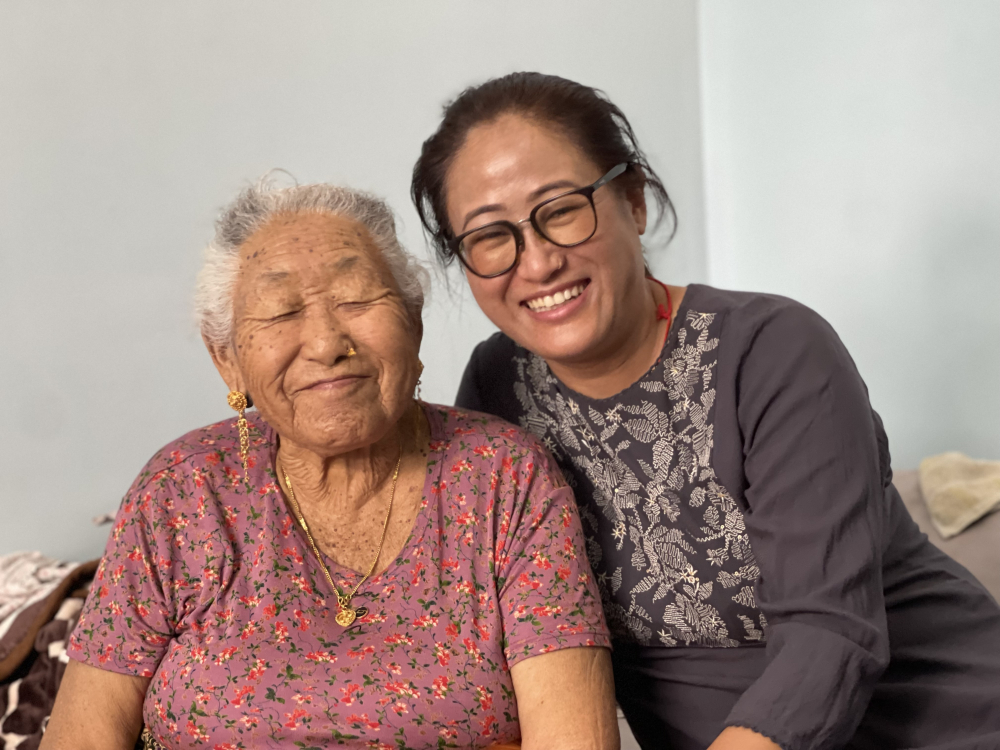
In Jhuma's understanding, mothers in Nepal are burdened by sorrows, but she also has the courage to put them all aside, just like her mother. She says, 'My mother is a responsible mother. Even after going through such stress, he lived.' An important aspect he learned from his mother is tolerance. The first audience of Jhuma's song is his mother. However, even after listening to the song, he does not respond.
When Jhuma is not around, Ray says to her friends or relatives - 'My daughter sang such a song.' Even when Jhuma got divorced, Lakshimaaya was not worried. She asked - 'What will you do now, Nani? Will you get married again?' Again she said to herself, 'Don't, marriage only binds the feet. Make it a habit to live a sorrow, a pleasure, you don't have to be raised by anyone, children are children, they just get bored.' Lakshimaya wants her daughters to 'live independently'.