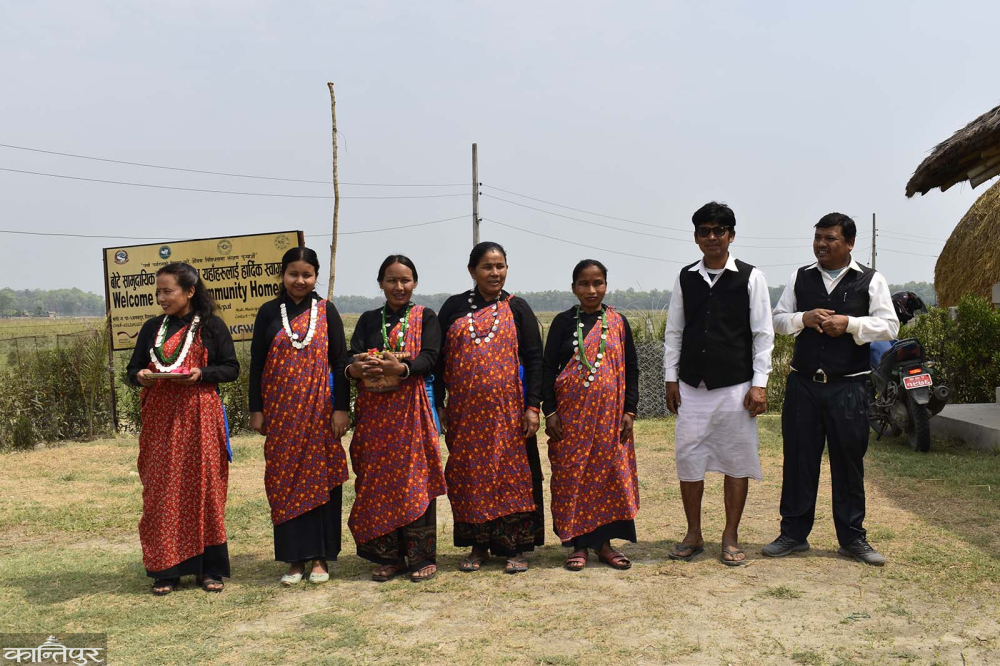
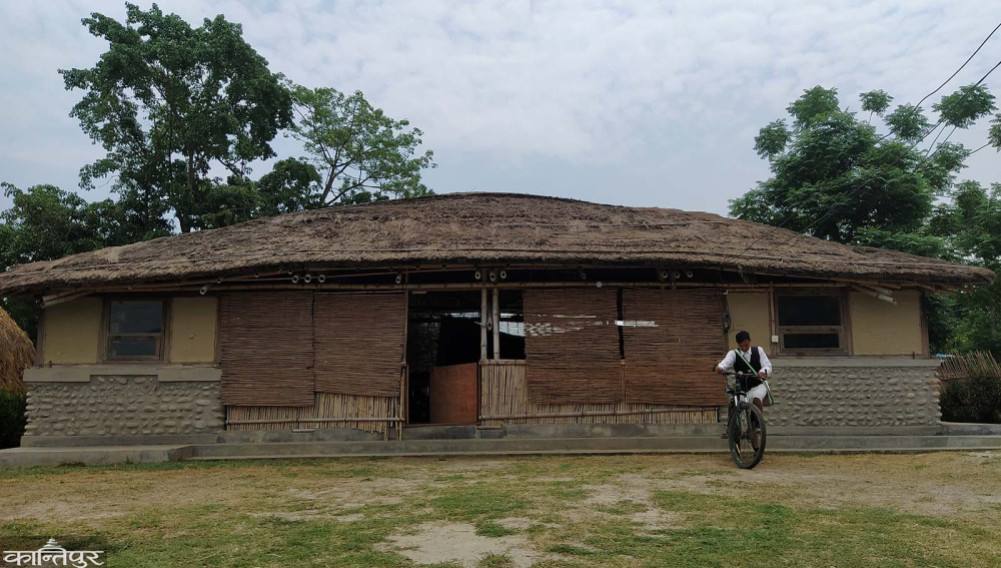
Even those who were displaced by the flood are now back in the village and are busy operating homestays
We use Google Cloud Translation Services. Google requires we provide the following disclaimer relating to use of this service:
This service may contain translations powered by Google. Google disclaims all warranties related to the translations, expressed or implied, including any warranties of accuracy, reliability, and any implied warranties of merchantability, fitness for a particular purpose, and noninfringement.
Sommaya Punmagar of Shivdwar in the eastern part of Madi municipality spent more than four decades of her life in Trasaitras. The Baje generation who migrated from Myagdi to Chitwan settled in Riukhola Adai near the forest here. Five decades ago, the government declared the forest they were enjoying as Chitwan National Park. She was very afraid of wild animals near her home during her childhood.
For the tribal community of the middle class, whose main occupation is raising livestock and farming, daily life did not go without going to the park . They had to go to the forest every day to graze, cut grass and cut grass. Tigers and bears attacked the locals who were cutting grass on their own. Elephants and rhinoceros used to give pain. "It seems that Dhanna lives in fear of when she will be attacked," said 50-year-old Sommaya in a recent meeting. After the government declared it a park, it became a legal provision to bear the attack of wild animals.
The wild animals were afraid because of the flood of Riunkhola, which spread to 300 houses and caused the rise and fall of the crocodiles here . Most of them left the settlement after all the farming fields were cut. Despite the wild animals and floods, some of the villagers including Sommaya in Shivdwar tried to slowly resettle .
Meanwhile, flood victims including Sommaya were helped by the Terai Geo-Perimeter Program (Tal) implemented by the government with the financial and technical support of World Wildlife Fund (WWF) Nepal . This program, implemented since 2001, initially aimed to protect large wild animals such as tigers, elephants, and rhinoceroses which are in danger. For a decade now, the lake has been providing support in alternative income-earning activities for the livelihood of the local residents of Madhya Pradesh to reduce human-wildlife conflict. In the year 2072, the Ayodhyapuri Intermediate Consumer Committee of Madi Municipality-8 Shivdwar took some people including Sommaya to see the home stay at Amaltari in Nawalparasi. After returning from there, 10 families started Ayodhyapuri intermediate community homestay .
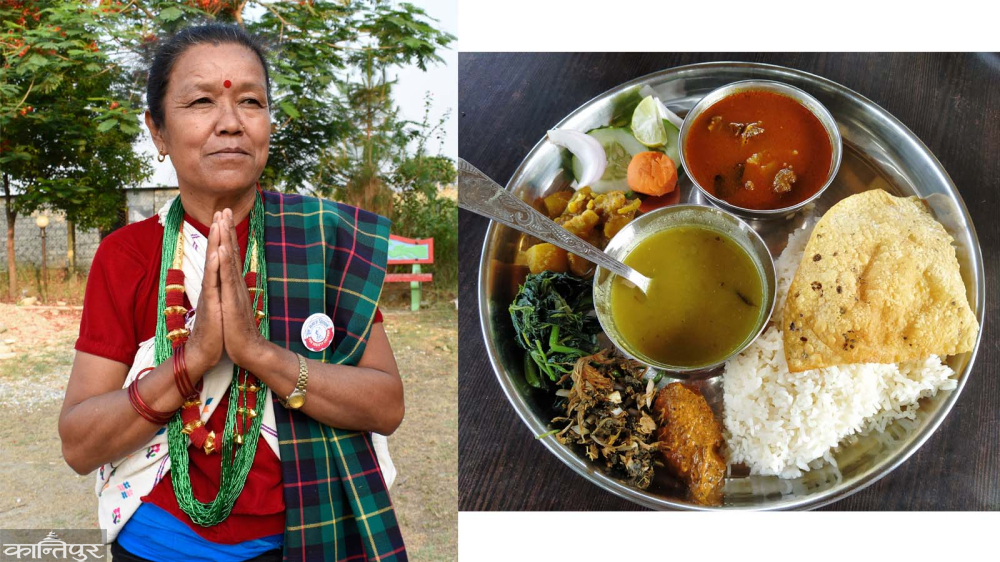
They depended on the forest and are now making a living by welcoming guests to the homestay. Sommaya said that she started getting information about her original customs, culture and costumes, which she never learned about. 'Our parents didn't teach us, after that, we didn't know what our culture was, what was our costume,' she said Leaders in the age group of 60 to 72 years from West Chitwan were invited and had the opportunity to learn about Madal, Maruni, Sorthi and other customs and culture at the community level for 10 days. Also went to observe the homestays of other places . They show the Punamgar art culture learned from others and entertain the guests who come to the homestay . They have built a community house here again. He has also thought of going to the mountains and looking for the old art and culture of Punmagar and making a museum. In Shivdwar, 10 Punamgars, two Newar communities, 14 families each from Thapamagar and Rai are running homestays in Shivdwar.
Even those who were displaced by the flood are now returning to their villages and operating homestays. Guests keep coming to the homestay here every week . Income is earned by hospitality. There is no compulsion to go to the forest like before. 'It's not that there is no risk of wild animals, it's less because we don't have to go to the forest,' said Sommaya, 'It's okay, before it was enough to eat by farming, now we girls are earning two pennies by staying at home.' break Established in 2030, Chitwan National Park is Nepal's first national park. It has a total area of 952.63 square km, extending to Chitwan, Makwanpur, Nawalparasi East and Parsa. The area of 729.37 square km around the park was declared as intermediate zone in 2053.
Chitwan's Madi municipality is surrounded by parks. As in Ayodhyapuri, 72 families from the tribal communities Punmagar, Bote, Tharu, Dura, Darai and Khasarya are operating homestays at 6 places in Madi. Gandharva community homestay is under construction .
Prem Paudel, the 'cluster in charge' of Chitwan-based Tal said that every homestay here has around 7,000 to 10,000 guests. According to him, who is also a resident of Padampur in Chitwan, the participation of women in the homestay business, which is flourishing as an alternative profession, has made them self-sufficient, while the human damage caused by wild animal attacks has also decreased. "Since women are directly involved in seasonal/non-seasonal vegetable farming, starting from welcoming guests, hospitality, serving food in homestays, positive thoughts have also started to come to the park," said Poudel, "Earlier, it was difficult for us to go to the middle school and talk about the park, not even now, but The thinking is slowly changing, this is a matter of happiness.'
Rewa Intermediate Consumer Committee in the southern part of Madi has also started operating a homestay, the women here who are limited to Chulachowka and grass shepherds have started earning income at home. Having had the opportunity to observe the Tharu Homestay in Kanchanpur 10 years ago, after returning from the observation tour, they dared to run Madi View Community Homestay themselves. "We saw that old mothers cooked and fed food there, let them stay, and saw that they were earning, so we started here after returning from there to see if we can do the same," said Prem Kumari Regmi, one of the homestay operators. Starting with five houses, now there are seven families running homestays. Three more houses are also being prepared for homestay.
Prem Kumari has allocated two rooms of the house for homestay. He plans to expand further with grant support. "I kept the space free so that I didn't have to send guests back if I could expand the room," she said. Not a day goes by without a guest . Homestay gave women skills . He has made himself independent by earning. "We used to go to the forest in the morning and evening to collect grass and firewood, now we have income from the homestay, guests are coming," said Belkumari Prasarin, another homestay owner who has homestays.
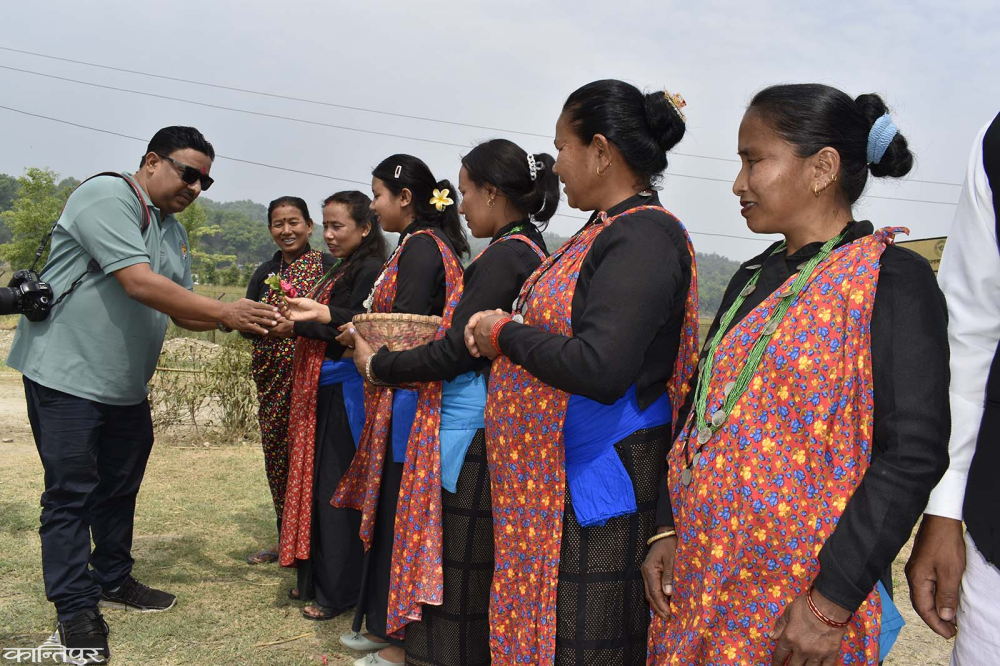
Before running a homestay, every house here used to have 10/15 commodity prices . When the grass of the field was not enough, he had to go to the forest . At that time, there was a risk of being attacked by wild animals. After starting to earn from the home stay, the price of goods was reduced. "Earlier, we used to go to the forest to raise cows, buffaloes and goats and earn two to four rupees, now we are getting good income from the homestay, we don't have to go to the forest, there is no risk," Belkumari said. Previously, we had to wait for 6 months to pay off the expenses by rearing goats . There was no place to raise buffaloes and sell milk. Honey should be poured into the malkhad. Now they keep one/two cows and buffaloes . The grass planted in the garden is enough, you don't have to go to the forest . Milk, curd, honey, ghee are served to the guests . "Even the latte greens that were plowed before are being used as vegetables," said Regmi, "We are very happy to forget about this." Riukhola and Marathkhola Dobhanner have 110 houses of Bote community families . Among the four intermediate community consumer committees of Madi, this settlement, which is the most vulnerable from the point of view of human-wildlife conflict, has been operating Bote Community Homestay for the last three years. Five Pandavas went on a study observation tour after undergoing homestay training under the Intermediate Consumer Committee. The construction of the homestay started from 2075 and it was put into operation from 10th of January 2077. 13 The Bote family runs the homestay . This homestay is also the only community homestay in Nepal run by Bote community.
Botes who have been living on the banks of the river for centuries have negligible land ownership. They were working as agricultural laborers, fishing in the river, mining gold, and picking blackberries in the forest for their livelihood. In this way, when the park began to tighten up because of the increase in the attacks of wild animals when they went to the forest, the plants lost access to these traditional practices . They were focused on homestay and fish farming as alternative occupations. "Since we are next to the river and the forest, we are in the grip of all wild animals like elephants and tiger bears. All of them have been killed by elephants and attacked by tiger bears," said Jagnarayan Bote, the treasurer of Bote Community Homestay. After getting something, it will be easier.' For a salary of 800 rupees, he had to grind bones all day long . "Now we earn 800/900 in two hours sitting at home, we sisters meet at home, we are self-employed, we don't have to be dependent on others," said Lakshmi Bote, one of the homestay owners. She said that since the number of guests coming to the homestay is increasing, they have to turn away the guests who have come more than the capacity. Homestay operation has also helped to revive the disappearing language and culture. "Because of the homestay, now we can also show our language and culture, Boteni dance, Jaghya dance, Machuwari dance, festival dance, Maruni dance," said Jagnarayan. Although alternative occupations are leading to ease of livelihood, he expressed concern that the traditional occupations of the Bote community such as fishing, ghat building, and gold mining are almost in crisis .