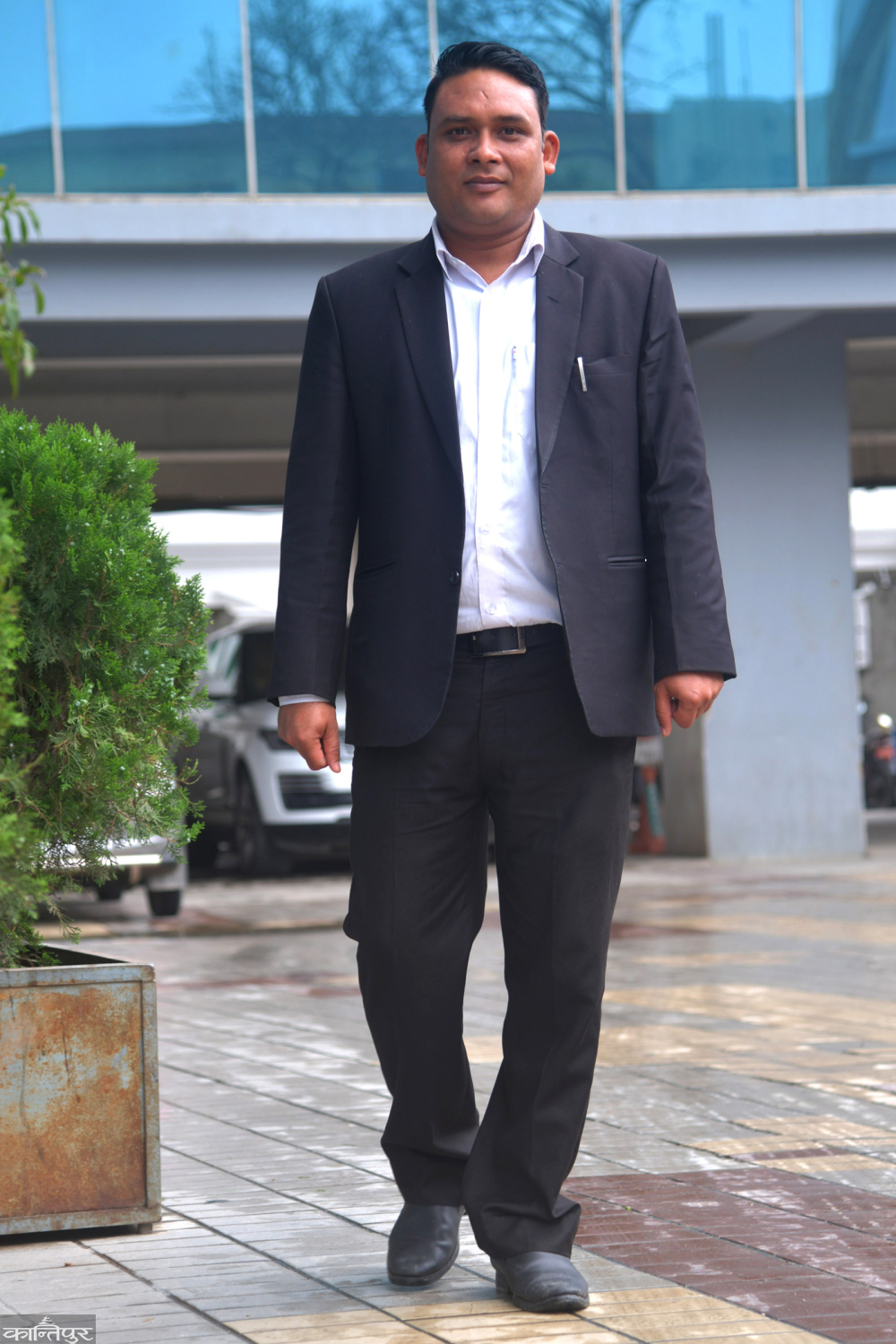
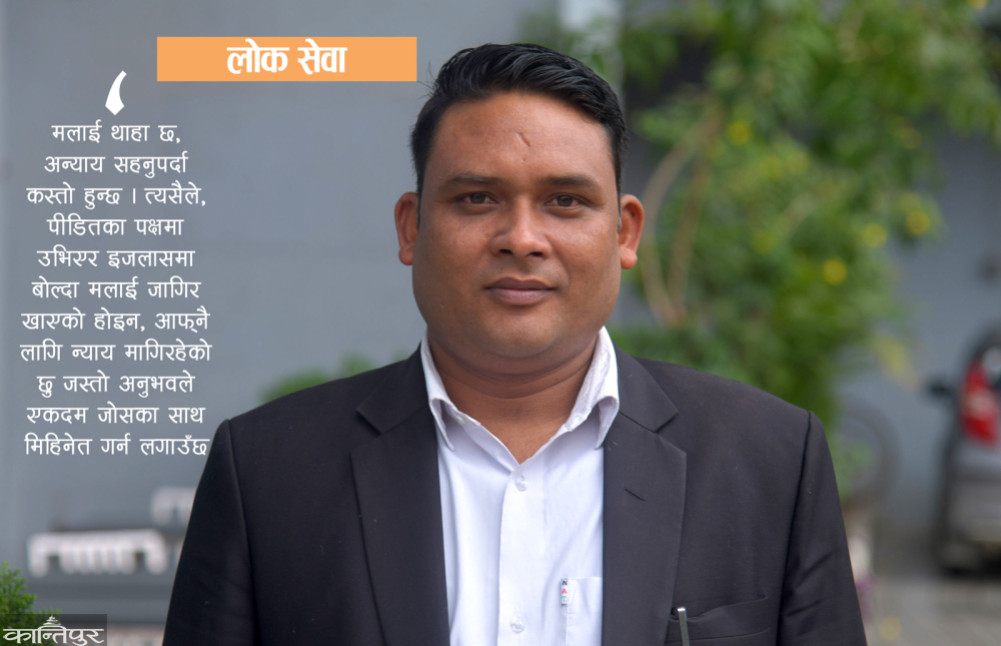
Sur Bahadur Pariyar feels as excited as he speaks for himself when he speaks for the victims. Growing up with the experience of his community always being oppressed and unjust, his job as a government lawyer established him in the role of bringing justice to others.
We use Google Cloud Translation Services. Google requires we provide the following disclaimer relating to use of this service:
This service may contain translations powered by Google. Google disclaims all warranties related to the translations, expressed or implied, including any warranties of accuracy, reliability, and any implied warranties of merchantability, fitness for a particular purpose, and noninfringement.
The job of a public prosecutor, also known as a public prosecutor, is to fight for justice for crime victims on behalf of the state. It includes the process from instructing the police in the investigation of the case to prosecuting and pleading the case. The question of who will be the first public prosecutor of the Dalit community from Karnali province in the public prosecution work with such an important responsibility is now being asked by students preparing for public service as a common knowledge.
If this question is asked in the exam, whoever writes Sur Bahadur Periyar in the answer will get the number.
Sabik Nathpu-4 Jawaldhara in Mugu still has not reached the road, electricity does not work. The then Prime Minister Baburam Bhattarai arrived to inaugurate the 2069 route for the first time at Gamgarhi, the headquarters of Mugu. However, no one can say in which prime minister's time the road will reach Jawaldhara, which can be reached by walking from Gamgarhi in two days. Such a remote village was even more remote 36 years ago. Sur Bahadur, who was born in this village, faced many obstacles in his life, such as poverty, geography, caste discrimination. The journey he sets out to overcome all of them and bring himself to the role of public prosecutor is nothing short of exciting.
Currently, he is an Assistant District Attorney at the District Public Prosecutor's Office Kathmandu. On a daily basis, his work is the same - filing cases in court against criminal offenders, arguing on behalf of the victims, and making depositions of the victims and government witnesses, etc. In Karnali, where there is more caste discrimination compared to other states, the lives of Navaraj Vikas are wasted. Sur Bahadur, who has seen such discrimination step by step, was the first from his community when he was nominated for public service as a government lawyer exactly 6 years ago, and there is still no one who is second after him.
"Dalits have more inclusive participation in politics, not in the bureaucracy," says Sur Bahadur, "Moreover, they will not be in the justice service." Sur Bahadur, who argued on behalf of the government lawyer from the Bhutanese refugee case and the latest Sun scandal to the case of Sandeep Lamichhane, used to work in Kailali before coming to Kathmandu. He felt that even though untouchability is a punishable crime by law, this crime is being committed all over the country, but the case is not being prosecuted. When he went to Kailali as a government lawyer, he found the same situation there. "And I registered a case against the crime of untouchability and argued against it in the district court," Sur Bahadur says. Sur Bahadur of Muhar feels that even small coincidences in life have a great meaning. As if his illiterate mother Avala Periyar had not become ill a few months after his birth, Sur Bahadur would probably not have been able to read like many other villagers. "Mother is in agony and everyone has given up on her," Sur Bahadur told what he heard when he was younger, "Father thought that he would save his life by taking her to the hospital, and after taking a loan, he migrated and carried her to the desert."
His father Karma Pariyar In addition to his wife, among the six children, he took two others with him - the boy Sur Bahadur and his sister Hazura. "My father hired my sister, who could not see the front of the school, to help her in the cooking," says Sur Bahadur, "as I was a lap child, I could not leave and came." A thousand rupees have been spent on tickets, which at that time was an unheard of expense for a Dalit family in Karnali. "It's not just about paying money, the airport manager reprimanded my father as to where he would be able to board four people from Damai on a 16-person plane," Sur Bahadur sighed as he recounted the discriminatory treatment of his father and the compulsion he suffered, saying, "It's his father's turn." , saved the boss from canceling the ticket bought by giving 10 hats he sewed and 50 rupees in cash.' Sur Bahadur's father had reached the village of Baisakhi in search of the settlement of the same Shahi Thakuri who discriminated against him and who had descended from the Terai like him, like a ghost caste closer than a distant deity. When he came to Rajapur Katase during the haat before the Terai falls, Karma learned the skill of sewing from Muslim Kaligarh. Sur Bahadur was able to go to school because he did not need to buy salt and oil due to his father's skill. Sur Bahadur, who was sometimes first and sometimes second in studies, also received a 'Jehendar student scholarship', which helped him to study even more. 'There was untouchability in the plains as in the mountains,' Sur Bahadur recalls, 'I was not allowed to enter anyone's house in the toll neighborhood, so I had no choice but to study at home.' As a result, he became the first young person to complete a bachelor's degree in three subjects and a master's degree in two subjects. Until then, office assistants in government offices in Mugu were district residents, subba-khardars were from Jumla and bosses were from Karnali. The development workers working towards Karnali suggested to Sur Bahadur that he would make a name if he graduated in education, law and humanities and had a master's degree in rural development and peace and conflict. Sur Bahadur himself also reached Mugu as a Santino development activist. His villagers used to tell Sur Bahadur that even after studying so much, he would not be able to get a fast-paced job. Sur Bahadur, who was inspired more by the comments of his neighbors than by the suggestions of the development workers, examined the public service in 2070. He passed in objective but failed in subject. "It's not that I didn't know the question asked at that time," Sur Bahadur says about the reason for the failure, "I didn't know the style of public service." Sur Bahadur checked that too. He lived in Mugu, he had to come to Kathmandu for examination. He had never been to the capital city before and came to Kathmandu for the examination. His name appeared in the examination but as an alternate candidate. Seeing that, Sur Bahadur couldn't help but cry. 'People are not as sad when they fail in life as they are when they choose public service,' Sur Bahadur lamented, 'I felt as if someone had snatched the straw from my mouth when I saw the results.' . Perhaps from the fatigue of the long journey, he felt a sore throat and headache. The next day was the exam. He has taken some medicine on the advice of a medical practitioner to make his life better. Even though he was cured, the medicine reacted to him. "Suddenly I wanted to jump from the third floor of the hotel and fly and I screamed," Sur Bahadur says about the moment he became unconscious, "thankfully the hotel staff heard and took me to the hospital." Will give and send. At night he had a fitful sleep. Even when he went for the examination, he took the same medicine. In the examination hall, he was given an answer sheet along with the question paper, in which he had to write his name. "I couldn't even remember what my name is," Sur Bahadur laughed remembering his own predicament, "When I thought about it, I suddenly realized - my name is definitely on the admit card." He laughed seeing that Sur had some work in Besur as well. Everyone in the hall laughed at him. Thus his preparation was wasted that time.
Successive failures had hit Sur Bahadur's ego. He said that wherever the name came out in the alternative, he would leave as an official, waiting for the announcement of the opening of the Human Rights Commission next time. Needless to say, after two years, the Public Service Commission of 2075 failed to select the name in the examination conducted for the National Human Rights Commission.
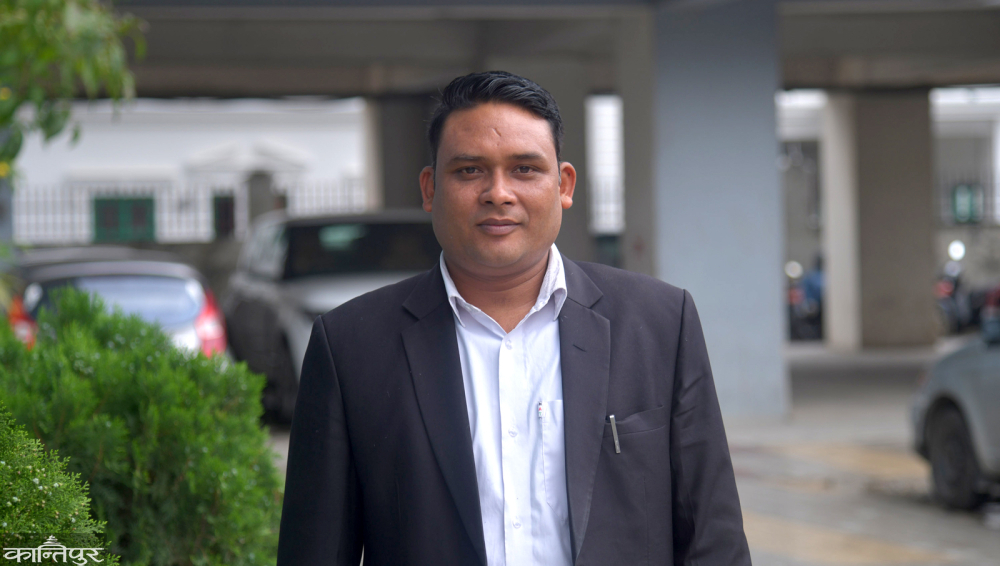
As a human rights officer, he reached Jumla and told this news to Babu Karma. "Father didn't understand what human rights officer is," Sur Bahadur rolled his eyes, "He didn't show any happiness, it made me angry." Sur Bahadur would have checked that too. He had to go to Surkhet to take the exam on February 15, 2075. That was the day Tourism Minister Rabindra Adhikari died in a helicopter crash. It snowed until it fell on Jumla. According to Sur Bahadur, there was the most snowfall in three decades on that day. All the paths leading down to Surkhet were covered with snow. Regardless, he hurriedly left the camp carrying his bag as he wished. By the time he reached the Jumla bus park, his body was completely covered in snow. There is a jeep. "Are you going to Surkhet?" he asked the driver, staring at the snow. 'Are you going to die?' The driver ignored him without any interest.
He sat there with folded hands wondering if there would be any solution. 'Four passengers came again after 6 o'clock, they persuaded the jeep driver,' Sur Bahadur says, 'The jeep continued to slide on the snow all along the way, they were not afraid that they were going to die.' . And he got to take the exam in the afternoon. After the name came out, he came to Kathmandu for interview and computer test. "Thus, after completing all the stages of the examination, I returned to Jumla," says Sur Bahadur, "On June 3, 2076, at 12 o'clock in the night, the mobile phone rang, it was a message that I had been selected in the government lawyer group."
Hearing this, this time his father jumped with joy. "The old man has got a job in Qaeda, he danced that my son is now a court judge," says Sur Bahadur, "Anyway, seeing him happy made me even more happy." The record of being the first government lawyer from all castes in Mugu and from the Dalit community in Pura Karnali has gone to his name. While walking in the rough Karnali, there was no time to sit and study in one place as the days passed by without going from one place to another. He used to record the notes he read and prepared in his mobile phone and listened to it while walking. There was nothing that he would not be happy with the 'extra large size' after the preparation made by such hard work gave sweet results.
Sur Bahadur, who grew up with the experience that he and his community were always oppressed and subjected to injustice due to caste system and caste discrimination, found himself in the role of bringing justice to others with the job of a government lawyer. "I know what it's like to suffer injustice," says Sur Bahadur, "so, when I stand up for the victim and speak in the courtroom, the experience makes me work very hard as if I'm not getting a job, but asking for justice for myself." However, she has a special interest in issues related to women and children. Because, like Dalits, women and children are also oppressed by the social elites. Sur Bahadur says that he is happy to provide legal assistance for them.
It wasn't long before he started working as a government lawyer in Kailali. He saw a woman with a sad face painted around the court every day. Sur Bahadur called and asked what happened. The woman said while crying that the information about the court's decision to pay compensation to her husband who died in the accident in Sabari did not reach the district administration office which is 500 meters away even after two years. "I immediately coordinated with the court staff and had them send the file to CDOCO on the same day and she got the compensation amount," says Sur Bahadur, "There are many people like her who have been stuck in our local court for years with small work." He thinks that this problem has arisen because it is not there. In addition, the state of criminal justice is deteriorating due to increasing political influence in the courts and partisanship in the appointment of judges affecting the process from sentencing to prosecution and investigation. In such a situation, Sur Bahadur continues to experience that the job of getting justice is very shocking. And also, he continues to passionately advocate and advocate for victims as long as he can.
There are certain duties that the state must perform for the citizens. Judgment is one of them. In any case of crime, the perpetrator is believed to be stronger than the victim. Here is the recognition of jurisprudence that because of weakness, someone has become a victim and because of weakness, someone has become a victim. In this case, the victim himself is not capable of justice. The state provides legal assistance for that. He feels that the government lawyer is the position of the same thing, and it tells us to stay for the future of his conscience. "I am not happy about fighting for the victim's judgment," says, 'she has found my happiness.'