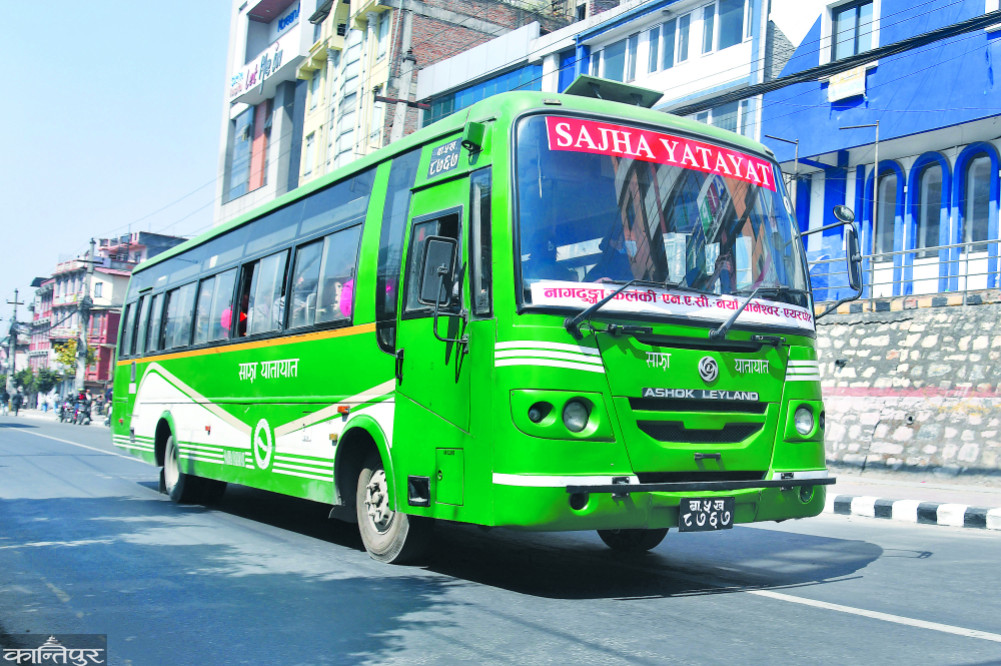
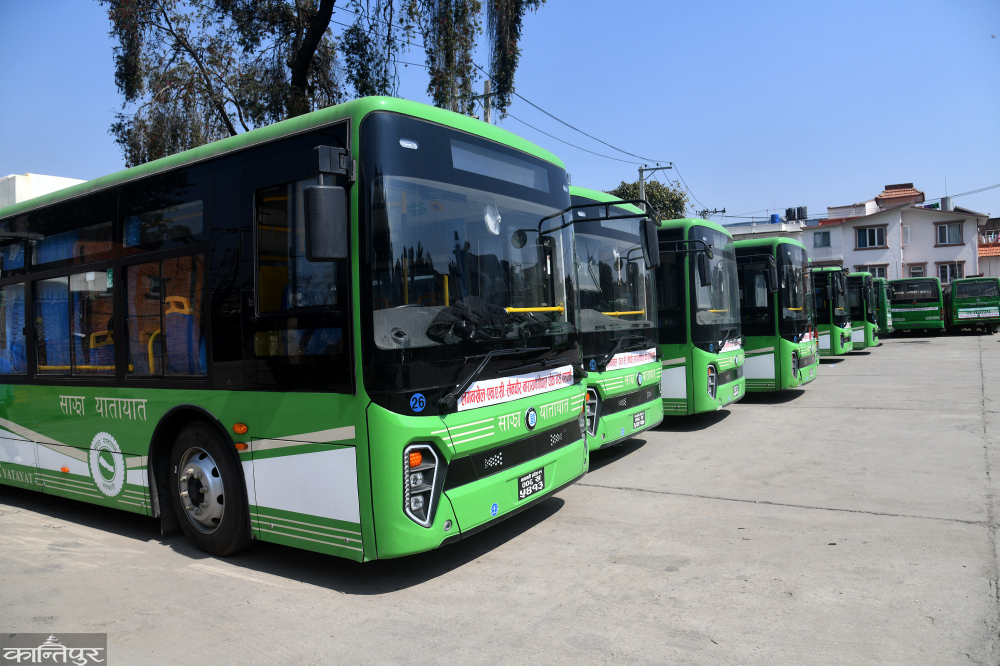
Sazha, which started its service with 6 buses 6 decades ago, had to suffer a lot of decline in the middle, now 111 buses are serving 71 diesel and 40 electric buses.
We use Google Cloud Translation Services. Google requires we provide the following disclaimer relating to use of this service:
This service may contain translations powered by Google. Google disclaims all warranties related to the translations, expressed or implied, including any warranties of accuracy, reliability, and any implied warranties of merchantability, fitness for a particular purpose, and noninfringement.
Anyone who rides in a shared busCalendar cuts Rs.2 ticket...This is a song composed and sung by artist Harivansh Acharya himself for the movie 'Film' around 055. He did not like this song, his childhood is connected with the song. When I was a child, there were only shared buses running in Kathmandu Valley as public buses. At that time, he was living in Garidhara and he used to sit in the bus for hours. After getting on the bus, it was almost impossible to get off.
As a child, he used to pay 25 paise to ride a shared bus, and by the time he composed the song, the fare had risen to two rupees. Now you have to pay 20 rupees when you board the bus. "When I was young, I used to enjoy traveling by bus, there were many cyclists in Kathmandu apart from the bus," he remembers the old days, "Sajha was like my childhood friend, even though he was inanimate, Sajha seemed like a living creature to me." Tried to show through film. Even the rich people of our village used to meet in common, even ordinary people. Women, children and senior citizens had a shared means of reaching their destination, he said. He shot most of the scenes of the 'film' inside the bus and told that even now the common is being shared by everyone.
As Acharya remembers Sajha in his childhood, its history is as old. Founded 6 decades ago as a common transport cooperative. It had to go through a lot of ups and downs during its operation as it became a 'shared' brand in the common tongue of the general public. It was established on 28th January 2018 as a common transport cooperative. From July 1, 2019, Saha will be in the valley The service started with 6 buses. At that time, according to the Cooperative Act 2016, the service was started by investing shares in it under the leadership of the then King Mahendra Shah. Kanakamani Dixit, Chairman of the Board of Directors of the Common Transport Cooperative, says that the first credit for the common being common to all goes to its founders.
This is a service, not a commodity. The credit of Made in Nepal in common transportation goes to its founders,' he says, 'the then King Mahendra Shah is also among the founders, after observing the cooperative in Israel, it was decided to move it forward with his associates, for that Bishwabandhu Thapa went ahead.'' tells At that time, Thapa Vikas was the Education Minister. He invested 2000 shares in common, he also became the chairman of the cooperative.
 Photos : Deepak KC/Kantipur
The then queen Jagdamba Kumaridevi did the work of getting the land where the common transport is now. "I got involved in it later, I was inspired by the work of my father Kamalmani Dixit," he said, "we are continuing the cooperative which was closed for some time with the help of some friends." Kamalmani Dixit was later elected as a member from the annual general meeting of the cooperative. He was of great help in getting the land for common.
"My father became a board member of the cooperative and got involved in the work of getting land for Sahagar," he said, "Sahagar has set a standard in the field of public transportation." The stage of struggle was almost over. Whether inside Kathmandu valley or outer district. Everyone chose common for the journey. Everyone believed that sharing a ride would lead to faster and safer journeys.
"But in between, due to various reasons, they fell into a common gap," says Kanakamani. Why is sharing closed? Most of them spread rumors that the 'driver-conductor' ate money, built a palace and closed it. 'Yes, there was some weakness (leakage) in the vehicle, there is still some,' he says, 'but this is not the reason for the closure of Sajhar, the Japanese government gave the bus to the Nepal government as a subsidy, from which the government worked to clear the debt to Sajhar, after that the government's share in Sajhar was increased. It happened, after the secretary of the government agency was made the president, it was gradually turned into a recruitment center.''
 Finally, the government made a decision from the cabinet meeting on 15th of December 2058 saying that sharing cannot be done. Common was closed from January 11 of the same year. At the initiative of the employees, some shareholders filed a petition in the then Appellate Court Patan with a demand to overturn the government's decision. One of the petitioners was Mahendraraj Pandey. He is the general manager of Sajha. After the government's decision was canceled by the court on January 15, 2059, the institution was restored. "On the outside, we set up an informal organization called friends of Sajha, in which the late judge Bharatraj Upreti, writer Sarubhakta, journalist Rajendra Dahal, Madankrishna Shrestha, Harivansh Acharya, and myself were involved," said Dixit, "we created an atmosphere to monitor Sajha and in the end, after winning the case, Sajha We managed to wake up.' The same was politicized when
was awakened. Kanakamani says that when Dineshhari Adhikari was the secretary of the government, the arrangement that the chairman of the common cooperative was made up of ordinary members was approved. "Until that time, five government employees and two from our side were kept on the board, this was reversed and five ordinary members and two government employees were made to remain ex-officio," he said. Two ex-officio members will be the registrar of the co-operative registrar (cooperative department) office and the director general of the transport management department.
He says that there is no organized public transport monitoring body in Nepal. There is a Ministry of Physical Infrastructure and Transport, the focus is on building infrastructure. The Department of Transport Management is entangled in the trap of distribution of licences. He suggested that the Kathmandu Valley Public Transport Authority should be made operational. "The joint should try to do good work and show the way for others," he said. , managerial agility has not yet been reached.
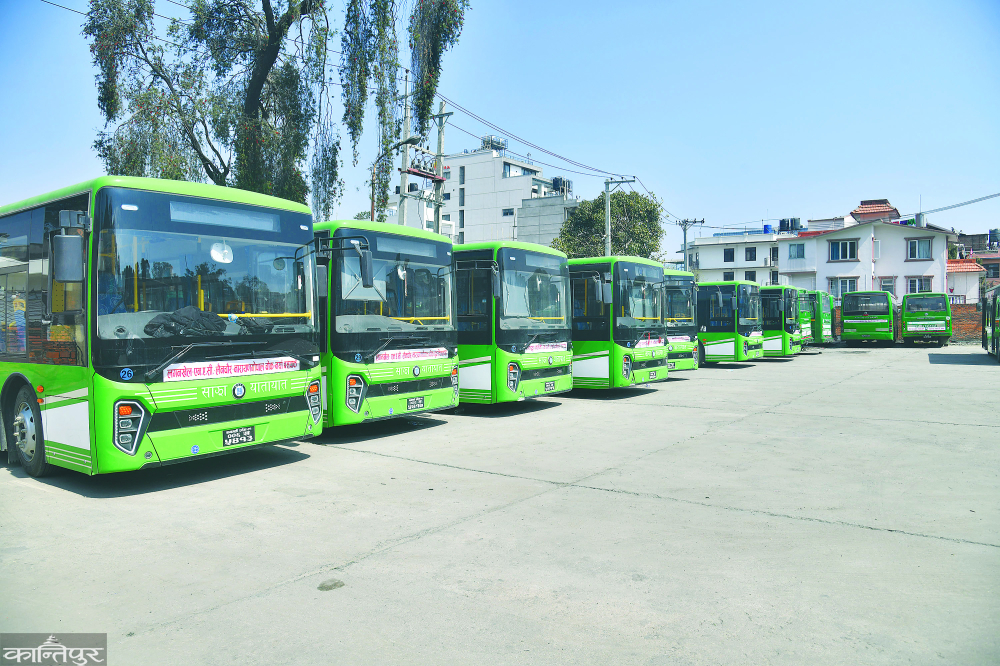
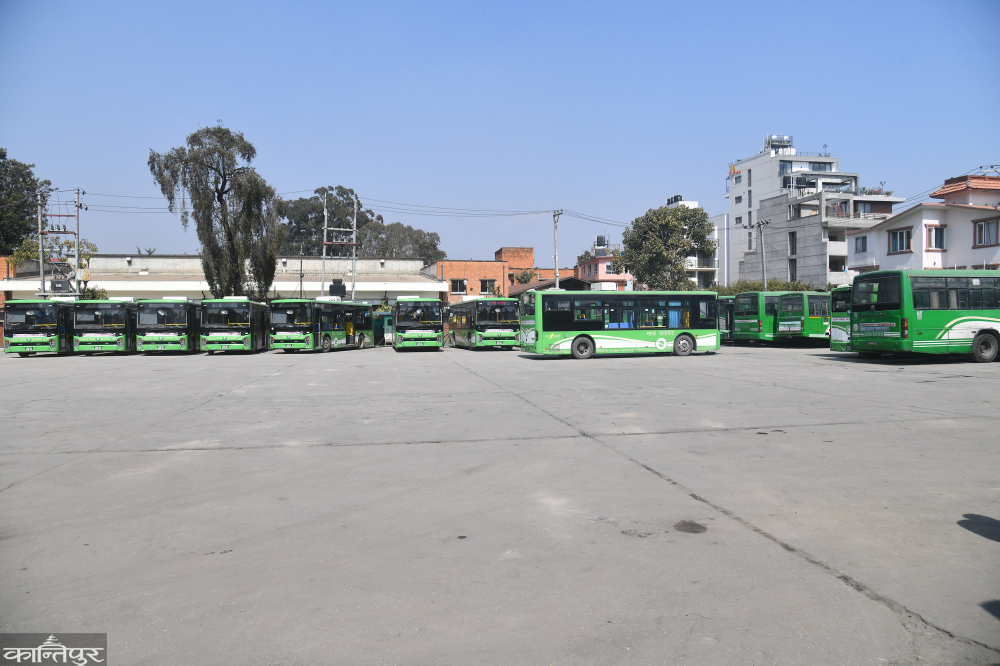 The government has given 3 billion rupees to Sajha as a subsidy. The amount was withheld for one and a half years. "Later the decision was made by the Council of Ministers, until this time we were delayed by one and a half years," he said. "Initially, we bought 40 buses, even if all the buses did not run on time because there were no charging stations, we are making final preparations for operation by making charging stations," he said. He says that the government has been able to buy electric buses with support.
'Now the private sector is not able to bring such buses, the government should also support the private sector,' he says, 'but electric buses are not 8 and a half meters long, but 12 meters long to carry passengers.' meters. Electric buses are only eight and a half meters long. Now there is a plan to bring only 12 meters. Sahaj's plan is to make people who ride private cars and motorcycles ride buses. "Everything may not be good in Shajha, but to a certain extent Shajha runs at the same time and stops at the same place," he says. He says that he is careful not to have an accident. Common is investigating whether an electric bus can be run for long distances. He says that the infrastructure is not good enough to run electric buses outside the valley.
He suggests that public buses should go for 'digital payment'. "First we tried with Nepal Bank, but it was not successful. Now we are looking at who to collaborate with,' he says, 'If we implement card payment, the financial leakage will be reduced.' It should be implemented in mass public transport, we can take the lead in this.''Sajha has implemented a separate 'app' to see where the bus has arrived. Since the 40 buses brought from China have different software, work is being done to put it in the app. CC cameras are being prepared to be placed in all buses.
'We are also accused of taking the government's interest, but the interest has not gone into private pockets, it has been invested in common,' he says, 'now where it is necessary to run buses together with the union and state governments, there should be super deluxe buses. We are thinking.''There is a plan to run it even if it is a diesel bus even if it cannot be electric. The process of bringing 60 to 80 12-meter long electric buses is underway. Common has decided to open a research body related to public transport. According to Pandey, the general manager of
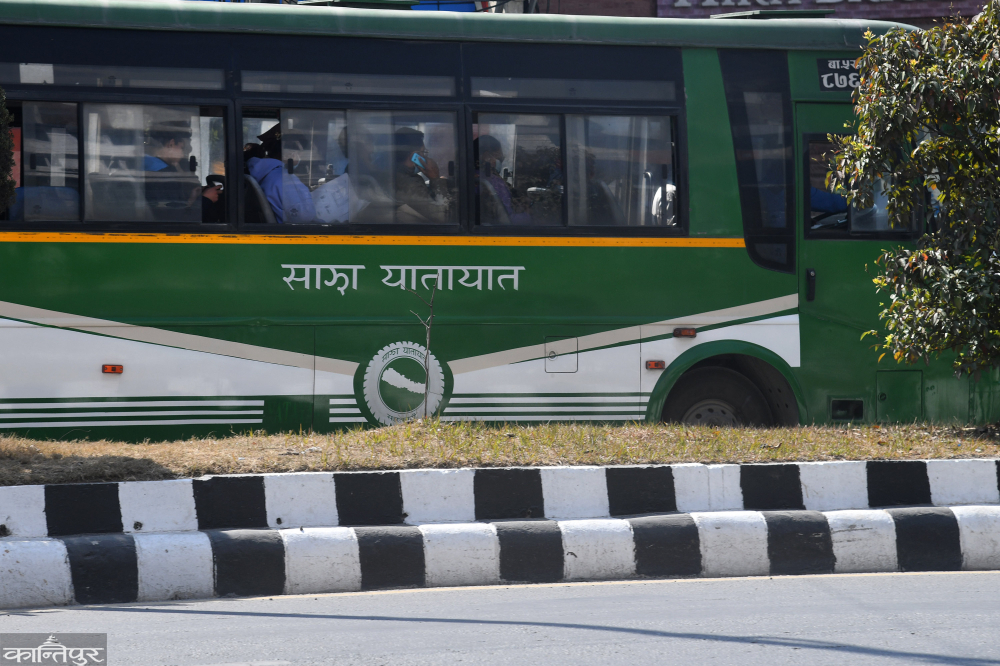
Sajha, which started with 6, Sajha has now reached 111. Of which 71 are diesel and 40 are electric. "Earlier, it used to run not only in the common valley but also in Kathmandu and Pokhara as a long distance," he says. Sometime in the year 2026, the common closed again. From the year 2037/038, Japanese Mitsubishi buses entered. In 2050/51, 35 Tata Deluxes were added under Japanese subsidy. "Those buses started running in the outer districts," he says, "which were donated by Japan to the Government of Nepal." When the bus started, its color was green. Later Japan gave blue colored buses. Again from 2070, green color was brought into common operation. "We have brought green colored buses into operation when the weather is suitable," he said.
 When the Japanese bus arrived, the number of shares was more than 150. Share members were made by deducting Rs 5 and Rs 10 from the salary of employees working in common. After 2051, regular buses were started outside the valley. After 2046 Saha vandalized the bus to win the movement, so Saha was targeted by the agitators. "During the conflict, the Maoists also targeted Sajha as a government bus, but even though Sajha has government employees on its board, Sajha is not a government bus," he said.
At that time, daytime services were common in many cities including Biratnagar, Birganj, Jaleshwar, Janakpur, Malangwa, Nepalgunj, Bhairahawa, Palpa, Baglung, Walling, Pokhara, Tandi and others. But from 2023 to 2061, there was no general meeting of common. After the joint restructuring, it has become regular. From 2058 to 059 March, the common was closed. 2060 Baisakh 1 was brought into operation. After the court order, the staff and office were restored. At that time there were only 728 permanent employees. Now there are 228 share members in common. In which 63 government bodies, 4 local bodies and 161 other organizations and individuals are share members. Likewise, the shares of members of the royal family, including former king Gyanendra Shah, are still intact. By the end of October 2068, all employees were removed by giving the facility to get
. "Until this time, we repaired some vehicles and some private vehicles with the banner of Sajha," he says. done Godavari and Mahalakshmi Municipalities are also among the shareholders.
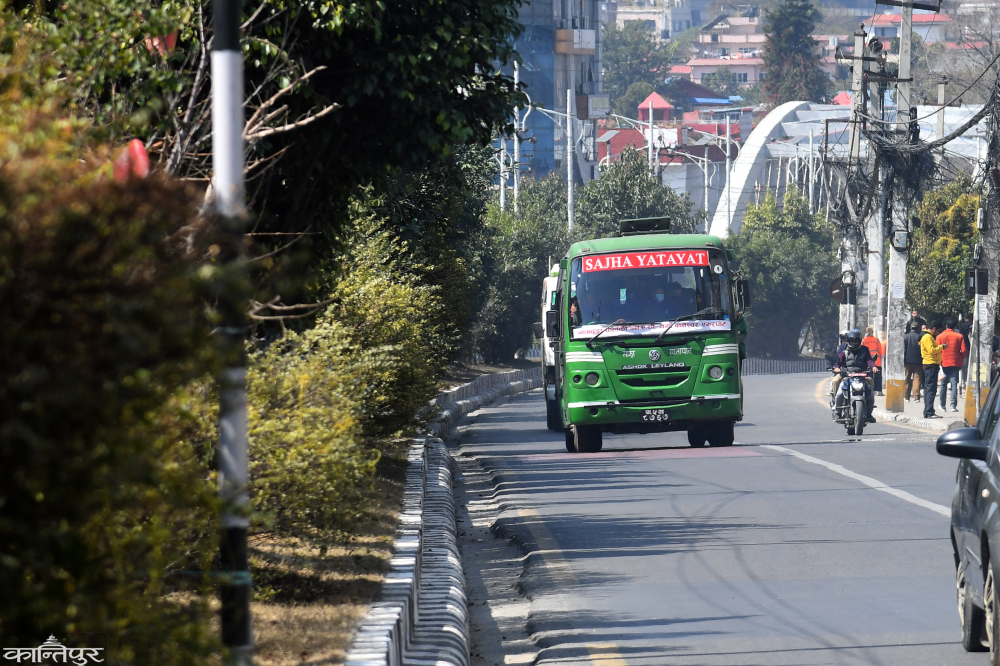 is currently running on 7 routes in the shared Kathmandu valley and Baglung and Bhairahawa routes outside the valley. 16 permanent and 18 contract employees are employed. Drivers, co-drivers, security guards are supplied by Navadurga Security Guard Supply Services Pvt. There are 129 drivers, 129 co-drivers, and 3 security guards. In which there is one female bus driver and six female co-drivers. 20 people have been working in the cleaning. An average of 30,000 passengers are being served daily. In the proposal of the Kathmandu Metropolitan City, senior citizens who have reached the age of 70 years, children under 5 years of age, persons with disability ID cards of 'A' and 'B' categories have been provided with free travel on shared buses operating within the valley.
A charging station has been constructed on 22 ropani land in Pulchok to be able to charge 22 electric buses at a time. The bus that leaves Pulchok at 5:30 in the morning and stops here again after 8:00 in the evening. Electric buses are running on the same route as diesel buses. Electric buses are not running on Lele and Ratnapark routes due to road conditions. Only 6 electric buses ply on the Lamatar route. After the commissioning of 20 more electric bus charging stations, diesel vehicles will be operated on the same route.