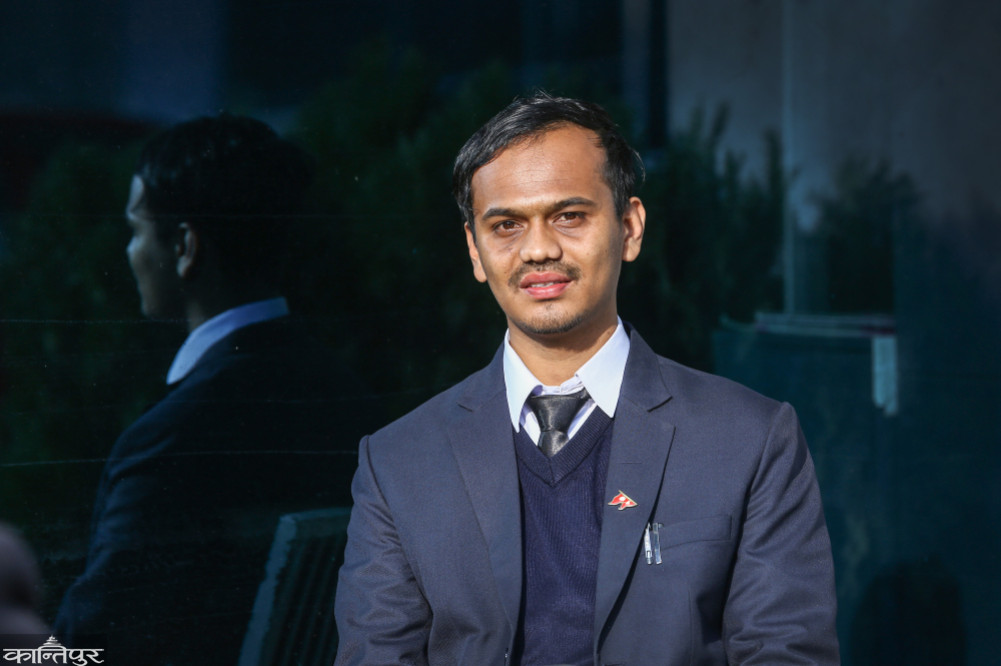
Time management is the most important strategy during exams. For this, Urbin practiced solving every question asked in the written test in 16 minutes.
We use Google Cloud Translation Services. Google requires we provide the following disclaimer relating to use of this service:
This service may contain translations powered by Google. Google disclaims all warranties related to the translations, expressed or implied, including any warranties of accuracy, reliability, and any implied warranties of merchantability, fitness for a particular purpose, and noninfringement.
There are certain dates that change the course of life. For Urbin Ranabhat, the first day of February turned out to be one such memorable date, due to which his path and direction changed.
"What will I do if I don't get the name?" He was sitting for the public service exam, and a question kept bothering him every now and then, "Going abroad or staying in the country?" He had left his job as a student last October and started preparing for the public service. Whether it was when he was studying day and night or during the days when he was waiting for the results of the exam, the same question kept bothering him. Most of them had already reached America, Europe and Australia. He didn't bother to go too often. After his friends suddenly left the country saying that 'there is no future in Nepal', Urbin also stopped feeling that there was anything that would bind him here.
His father Arjun Ranabhat, who retired last year from the police superintendent, reminded Arbin, "You can't say there is nothing here without trying?" He could not interrupt his father's words. He thinks that he can prepare for public service by taking a job. Therefore, Wagmati temporarily left his job as an officer (7th level) in the Ministry of Economic Affairs and Planning for a year. I was scared to leave my job in a country where I couldn't find a job no matter how hard I searched. Moreover, after 16,000 applications were received for 18 posts, Urbin was not hopeful.
'With so many people competing for so few posts, I didn't expect to be named,' says 26-year-old Urbin, 'So, the question of what to do next was very overwhelming for me.' As if 16 thousand people were running for 18 plates of food. In this way, no matter how fast he could run, his legs would tremble. Urbin spent about a year in such dilemma and doubt. As soon as the Public Service Commission recommended Arbin's name as one of the 16,000 candidates to be screened for branch officers on February 1, all his doubts ended.
Urbin couldn't believe it for a moment when he got the result that he never imagined. As surprise and disbelief startled him, 'Congratulations, Urbin. His schoolmates called and texted from America and Australia saying, "Congratulations." The number of congratulatory posts on social media was the same. Even those who have forgotten are remembered. Relatives served sweets. The happiness of the parents knew no bounds. Orbin was more surprised than delighted, in an indistinguishable excess.
'It was the most emotional moment of my life,' Arbin, who is still congratulating, smiled. Training is given for 6 months beforehand. Arbin has been undergoing the same training since last week. Everyone congratulated them saying that there was also a topper. The teachers also addressed him with more interest. And finally Urbin is starting to believe, 'I am the topper of this year.' The first stage exam is preliminary. In it, questions are objectively asked about general knowledge related to history and geography of the country and abroad. Urbin joined Lusukk in the pool of 16,000 students in the last exam held last June.
'Because I had general knowledge, I did well in it and passed,' says Urbin, 'After a while, the results came, 10,000 failed, and my name was in the remaining 6,000, which gave me the motivation to move forward.' A written examination is conducted on three subjects namely system, contemporary and service delivery. "This exam is the most important and difficult to name," Urbin says, "because it determines the real intelligence and knowledge of the examinee." Four thousand names were chosen in this exam. Urbin fell in that too.
The 'Union Public Service Commission' (UPSC) exam is conducted in India like the Public Service of Nepal. It is considered as one of the toughest exams in the world as lakhs of youngsters compete here for some posts. Director Vidu Vinod Chopra recently made a movie about that exam of the Federal Public Service Commission of India, 'Twelfth Fail.' Arbin did not have a difficult life like the main character Manoj as shown in the movie, but he worked hard. After going through all the stages of the
exam, it was time to go for the interview. He was interviewed by a group of experts, unknown to Urbin, along with members of the Public Service Commission Bir Bahadur Rai and Dinesh Silwal, who selected 18 people out of 320 who scored the highest marks out of 4,000. It was as if it was a final knock on the door of his future. It was in the hands of these three to open the door or not. Urbin faced the questions, suppressing his glands of excitement, whatever the outcome.
Arbin, who is doing his MSc in Agriculture from Rampur Campus, asked him at the beginning why he chose the career of an administrator. He was not surprised by this unexpected question. Because, it had to do with a deliberate decision he made. "I have not left agriculture, I will not leave it," he gave a brief but firm answer, "I have only chosen a different character of service because the knowledge of agriculture is useful here too." Gossiped about the same, common interests, etc.
'Well, one question was a little troublesome,' Urbin's eyes, who looked a bit tired after training all day at the staff college, rolled as if he remembered something, 'It was with the ongoing problems of cooperatives.' How to solve it? In this too, Urbin has given a short and effective solution like a mantra - these institutions did not run according to the principle of cooperation, that's why this situation happened. The constitution has empowered all three levels of government to regulate cooperatives. The solution is not to allow the cooperative to move beyond the leak by using it.
His answer must have satisfied the questioners. How could Urbin's name be number one in their recommendation on February 1st? "No matter how many times you pass, the dilemma remains until the interview results," says Urbin, "because no one can tell what will happen." Born in Chundi Ramgha, Tanahun, Urbin appeared for the SLC exam eleven years ago along with 93 of his classmates. All of them passed, most of them went abroad, but he was probably the only one out of the whole group to take the public service examination.
Like Babu Arjun, his teacher's mother Vimala also used to give instructions to Urbin to do something in this country. So after suppressing the urge to go abroad many times, Arbin, who graduated from the Institute of Agricultural and Animal Science Studies, Lamjung, worked for some time as a contract employee in Ratuwamai Municipality of Morang as an authorized sixth position. A few months later, he worked as a temporary officer in Wagmati Province. During a period of one year, he gathered brief experience in local and state civil service administration. Prior to that, he worked as an agricultural instructor at Barpak Multi-Technical School of Technical Education and Vocational Training Council for about a year. All these experiences both inspired and helped him enter the federal service.
He gave 4 exams of the State Public Service and Public Service Commission at the same time in the same year. All of them passed the exam. In the branch officer examination, he became known everywhere and passed in first place. "Preparing for the Public Service Commission is a stressful time and after getting authorized, you feel relieved from that stress," says Urbin, "After studying, you don't know if you have completed the preparation, and the situation is becoming more difficult as there are many competitors." Similarly, after trying in the country. He also remembers his father's advice that he should think about foreign countries. "It is wrong to say that there is nothing in Nepal without trying here, my father proved to be right," he said.
Friends and acquaintances often ask him if there is a different style of reading to get better. He has a precise answer in this matter. "In my opinion, the effort to top is the same as the effort to get the name, the difference between getting the name and getting the top is luck," he says, "so instead of reading that you will top, I advise you to refine your preparation by covering all the topics." He believes that not only knowledge is needed, but art that can express it is also needed. He himself had followed the suggestion for months that the practice of writing answers within the stipulated time should also be continuous along with the studies. To cope with anxiety and pressure during
preparations, he used to watch motivational videos on the Internet and listen to the experiences of elders. The common problem of not remembering what was read or not being able to analyze or being lazy to read is not absent from him. He made a schedule and divided the goal into small parts so that he could do it in a certain time and kept trying to win. "I used to feel lazy to study in the evening," he says, "then I used to go out with my brother, sometimes I would talk to my friends on the phone and try to maintain my love for studying." But the result was good. Now the most difficult part of the exam was the written test. He gave a lot of time to prepare for it. Joined the practice exams of various institutes and observed what are your weaknesses. After dividing the various topics of the course, they started reading by keeping similar and related topics together. In that process, he deeply saw and meditated on one fact – time management is the most important strategy during exams. For this, he practiced solving every question asked in the written exam in 16 minutes. "Despite a lot of effort for time management, there is a lack of time for the last question in the exam," says Urbin, "so I used to do the difficult question at the end." There are many things to understand, remember and grasp. "While reading everything, one feels that the fog has disappeared like paper," he says, "Even though you know a lot, there is a situation as if nothing has come, even if you work hard, the result does not come as you want, that situation is very challenging." One of the exams. An important part is also to be updated about current events and related news. For that he mainly used social networks. He would also make notes on important current affairs arising from it and later memorize it.
Now all these days of his toil and worry are over. After the results came out, he was very happy. However, Bhinkhale is surrounded by obstacles and challenges. He thinks about how he can make a difference in his behavior and work as an employee. "The big challenge of the public service sector is to provide citizen-friendly modern services," he said about the bureaucracy, "the public service sector must be able to provide services according to the times." However, even for the smallest work, the citizens are in a situation where the staff is running in a situation where they have to be bothered. mechanism. Arbin knows that the real test of those selected from the public service lies in their inability to replace it. "Entering the service is not the only real test," calm-natured Urbin concluded briefly, "the real test is our work, which is about to begin."