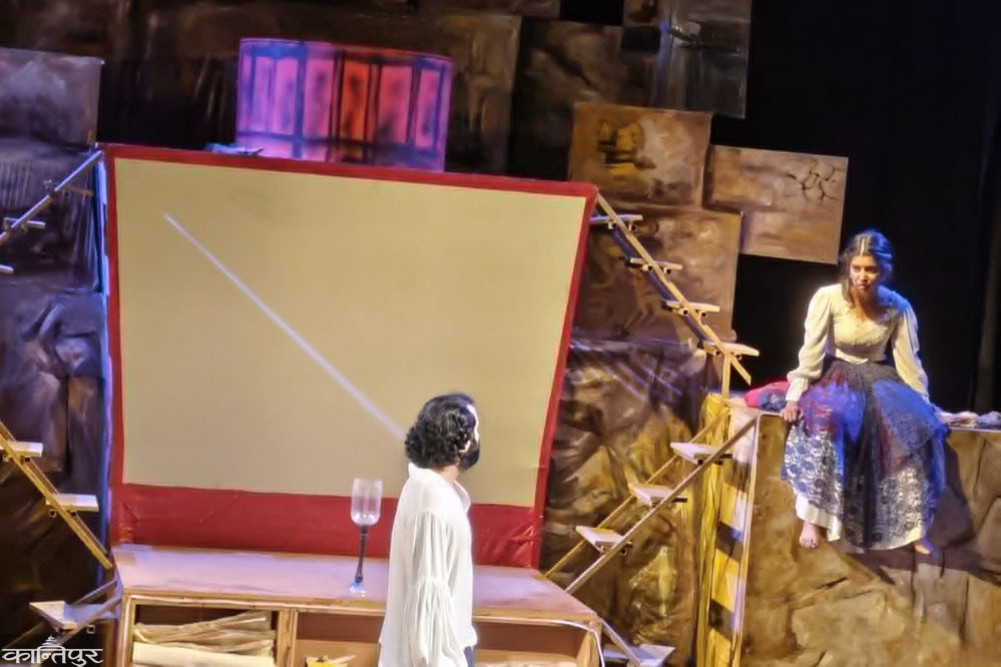
The play 'First Draft' takes us to a world beyond imagination, where we can feel the pain of a writer through his characters.
We use Google Cloud Translation Services. Google requires we provide the following disclaimer relating to use of this service:
This service may contain translations powered by Google. Google disclaims all warranties related to the translations, expressed or implied, including any warranties of accuracy, reliability, and any implied warranties of merchantability, fitness for a particular purpose, and noninfringement.
"This play should be watched especially by the creators," said actor Ashant Sharma as he left the first show of the play 'First Draft'.
Like Ashanta, I was also thinking about all the writers while watching the play. How do writers write, how do they think? What kind of stories are born from the creative friction in their minds?
What do the characters who live the lives of those stories look like? If they came out of the letters they weaved and came face to face with the writer, what kind of dialogue would they have? Would they be satisfied with their character or would they complain about their incomplete life? The play ‘First Draft’ takes us to a world beyond imagination, where we can feel the pain of a writer through his character.
This play, which is being staged at the Oscar International College Theater, has been written and directed by Kanchan Sangraula. Kanchan, who lives the life of Meera for 1 hour and 40 minutes on stage, has been seen as excellent in all three genres. Whatever Kanchan wrote, whatever she imagined, she herself became a part of the world. She has performed different challenging tasks naturally.
The writer and the artist Abhay Baral, who stood on stage as the writer's character, has squeezed out the character within himself. The glow that his character Hira gives to the story is very interesting.
How do the two artists patiently hold the audience in the hall? The most important thing for this is the story. The story is woven in the surrealist style. The characters born from the alliance of the subconscious mind and his imagination get a special place in the story.
A theater artist Mira who asks herself - who am I?
She did not answer it the way her friends who came to learn drama in the theater initially gave her. She searched for an identity within the shell. The character in the story who is talking to him asks him the same question over and over again – who am I?
He wants to know why the author created him? He wants to read what is written about him. But Meera can neither give him the first draft nor tell him the purpose of creating it. The story progresses amidst this conflict and internal conflict. The ‘twists’ in the story can make the audience fall into the trap of confusion and truth.
The play has delicious dialogues. When we listen to some dialogues, it feels like we are composing within ourselves. Just as Meera has no answers to some things, we ourselves have no answers to some of the things we have done. The dialogue about names in the story seems meaningful. From the dialogues like ‘Where is the name kept for so long’ to ‘What is there in the name’, these questions lead us towards thinking about existence. The dialogues of the play teach us to search deeply for existence and identity.
The set, light and sound used in the play do justice to the story. This set, woven in an abstract style, taught us to think in two ways. The upper level represents the creative world of the writer's mind. The lower level gives us a sense of the physical world.
The set also indicates the relationship between the writer and the character and the ideological ups and downs of the writer. The blocks also indicate the stage the writer is in and the mood he is going through. The characters' 'entry' and 'exit' in the set are beautifully crafted.
When they drink red and blue ink, it feels like an image of a powerful poem written by a poet.
Ink is the most powerful weapon to express thoughts and feelings. The creators quench their hunger with the nib of the pen. Perhaps this is what the author is trying to express? The sound that comes with the ink indicates the thoughts and consciousness that have been added to them.
In the play, the lighting and music have done justice to the author and the characters, their state of mind and the graph of the story. At times, the story seems to be ‘on hold’. Some contexts seem to be repeated. However, before the audience can get restless, the scenes and the story pick up speed again.
Writer and director Kanchan and his team have tried to break the traditional style in the story, set and light from the ‘first draft’. With their sincere efforts, the time invested by the audience can be beneficial.