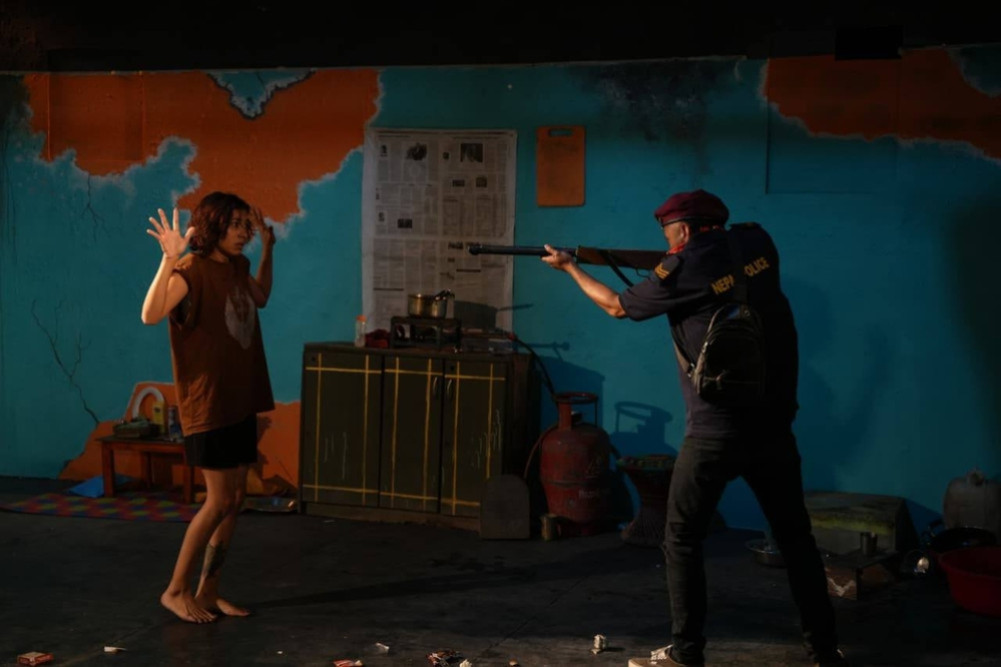
This play, which has long been embroiled in controversy, satirizes those who become Lucifers through the 'mania of power'.
We use Google Cloud Translation Services. Google requires we provide the following disclaimer relating to use of this service:
This service may contain translations powered by Google. Google disclaims all warranties related to the translations, expressed or implied, including any warranties of accuracy, reliability, and any implied warranties of merchantability, fitness for a particular purpose, and noninfringement.
Let's start the occupation
and the fun will come
Let's start the occupation
and the fun will come
The play 'Lucifer Rising' begins with this rap of 'Kabja' sung by rapper Sakar. As the rap says, the play shows the time of occupation - that too is the Gen-G rebellion! The occupation of power, strength and time . At the beginning of the rap, Sakar raises questions about the unrest and corruption in the country - Sakar's government....Let's start the occupation and the fun will come!
What is interesting is that in this play, director Sahlesh has beautifully depicted the events of the Gen-G rebellion in the story. For example, a policeman who is chased away by protesters and is mistreated takes refuge in a room to save himself . The male character of the room himself becomes active in the Gen-G rebellion . They rob shopping malls, abuse the police, and steal money. And they say, 'The whole city has been taken over by the Gen-G, you understand. All cops are out, now the rule of the Gen-G will be in force.'
Now think about it, how will the policemen who have been bloodied by the protesters and the protesters who have seized power and authority stand in front of each other? On top of that, the protesters have guns in their hands. The policeman is innocent, helpless, unarmed! This play, staged in a theater, brings the situation, anger, and destruction of the Gen-G rebellion to the stage. The director puts on stage a class of people who are disappointed with power and authority, hopeless, whose actions and expressions you identify with and sympathize with. Apart from a few scenes and dialogues, there are not many interesting aspects in this play.
First, let's look at the plot - Although this story is about the rebellion of a young man angry with the state, the director has brought two characters on stage with special importance. First - Elisha. She spends most of her time disappearing inside her room. She is tormented by some invisible force, which she calls Satan (Lucifer). And she prays to the Lord Jesus to save her from that shadow and torment.
At other times, she seems to disappear after taking drugs. Her lover Pratap is also addicted to drugs. However, Pratap is more overwhelmed by the power he has received than by the drugs - when there is a Gen-G rebellion in the country. Pratap vandalizes the shopping mall that he did not allow her to enter yesterday, saying 'tape'. They have broken into the police station and exposed the police. They have stolen a lot of goods and money from the shopping mall. But, more than that, they have gained the pride and honor of carrying a gun. Even if it is for a moment, Pratap has gained power. He knows that Singha Durbar was burned - now the country has its own government. The gun has filled him with a kind of power frenzy.
How does power make a person feel, and how long does the energy it gives last? After all, why does a person have ego after reaching power? The play shows it through the character of Pratap. What happens when power takes over? Pratap is also an example. The story of Elisha, Pratap and the other characters (2 prisoners) brought into their room by the Gen-G rebellion is included in 'Lucifer King'.
This play is new in terms of its subject matter. It tells the story of a community angry at power and authority, which no one has ever seen with a humane eye. For example, Elisa was not allowed to enter the shopping mall because she was a tapee. When power came to her, Pratap took revenge. 'What did you say yesterday, the shopping mall didn't let you enter because you were a tapee, didn't you? I came after burning it. Now we will take revenge on each other,' Pratap, who caused havoc during the rebellion, tells Elisha. This play is the story of a person who has neither the attention of the state nor that of society. The play shows the anger that the same group and character, who are ignored despite being a part of society, express towards the state and administration. Pratap and Elisha have seen the abuse and contempt that is meted out to drug users by society. They have endured abuse called thieves. In anger at such abuse, Pratap picks up a gun. And then he shoots at those who doubt and disrespect them unnecessarily. Why are the people angry with the state and the administration? The experiences of these two are found in their anger. But, does anger always lead to chaos? The question is seeking an answer.
This play has captured the language of the class and group whose story it covers. For example, when the characters express their anger, they only use the word 'obscene'. Most of the time, the characters speak obscene dialogues. That dialogue brings the audience closer to the characters and their situation. Now, are the dialogues in the play that bring the characters and the situation closer to reality, pornographic or obscene?
However, when telling the story of a character in a poor slum (slum dweller, unorganized slum), the commentary that only presents crime and obscenity seems traditional. The story of this play could have been carried forward without the rape scene. However, the ideology of showing the characters in the slum as criminals is repeated in this scene as well. However, the acting of the actors covers up such weaknesses of the play. Tara, who plays Elisha, and Anoj Pandey, who plays Pratap, have presented that 'adrenal juice' within the character in a melodious manner. The acting of other actors Buddhiram Chaudhary, Milan Bahadur Khadka, Subrataraj Silwal and Aden Bati has also made the play strong.
This play, which has been embroiled in controversy for a long time, satirizes those who become 'Lucifers due to the frenzy of power'. According to the Bible, Lucifer is a character who was once an angel close to 'God'. But, as soon as the ego of power enters him, that same pride leads him to his downfall.
The play questions the tendency to become 'Lucifer' through the faith that people of this religion have been believing in by making a Christian character. After all, what would happen if you had an ego like Lucifer's while controlling power? The play strongly satirizes the frenzied tendency of this power. As the saying goes in the rap of Sakar, you can control power, but what if power controls you? What will be the result? The play raises the question.