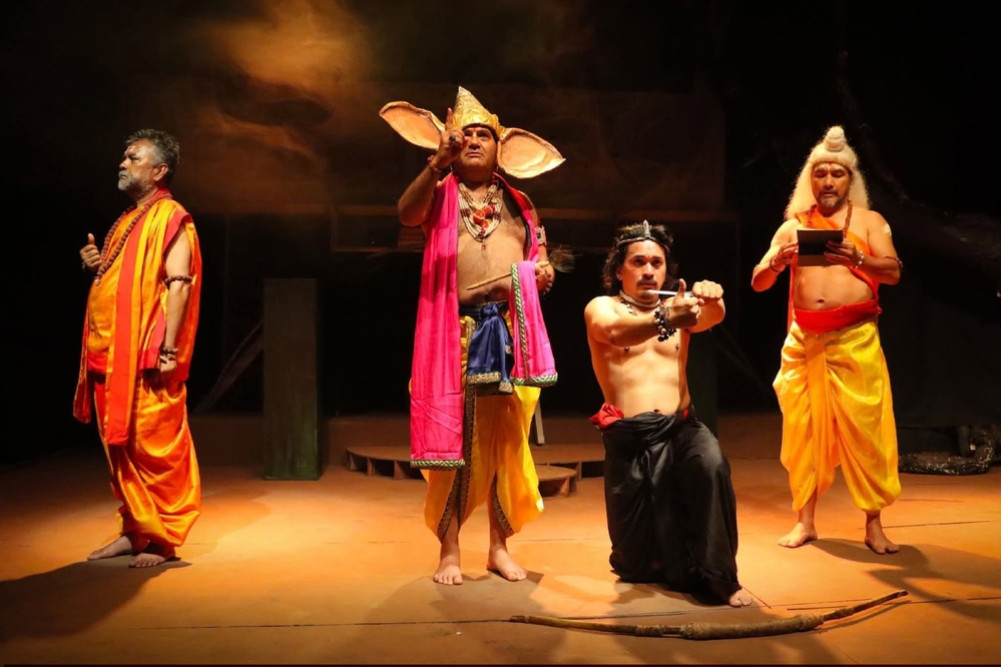
The play stands for a society, issues, and dialogue where caste discrimination no longer has to be tolerated, neither in books nor in society. The play is a unique satire on those who cling to orthodox traditions that hold onto mythological ideas.
We use Google Cloud Translation Services. Google requires we provide the following disclaimer relating to use of this service:
This service may contain translations powered by Google. Google disclaims all warranties related to the translations, expressed or implied, including any warranties of accuracy, reliability, and any implied warranties of merchantability, fitness for a particular purpose, and noninfringement.
What does it look like when the characters in the book suddenly come to talk to the author? What do you think? What does the dialogue between the author and the characters sound like at that time? What do you think? Can the characters in the book suddenly come out and argue with the author?
A similar situation arises in the play 'Mahabharata' being staged at Kantipur Theater. Maharishi Vyas (Suvarna Thapa) goes on narrating the story of Mahabharata, Ganesh ji (Manoj Gajurel) goes on writing. The plot of Eklavya (Sandeep Shrestha) on stage starts flowing at a fast pace. And in the latter half of the play, Eklavya suddenly comes to ask questions. Ganesh also disagrees with the portrayal of Eklavya's character and starts questioning Maharishi Vyas. The dispute between the characters reaches its peak on stage. Ganesh himself consults Eklavya about his character and argues with Vyas.
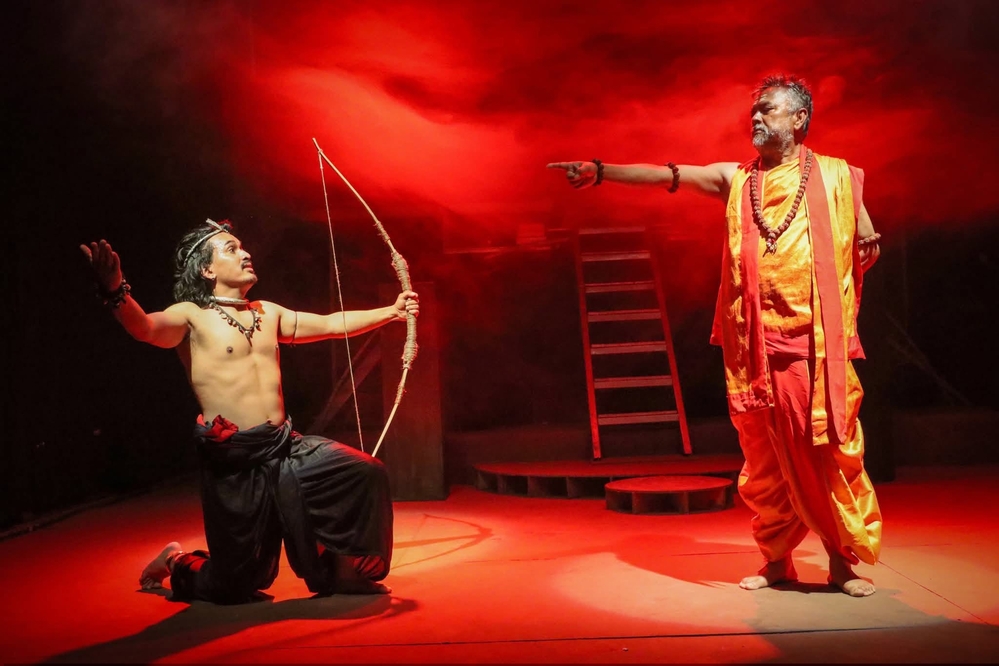
Anyway, on stage these characters seem familiar with each other . The author of the story and its characters become so intertwined in the story that which story is real ? Which actor is in which character ? At some point, the audience has to get confused. The strong point of the story telling of the play 'Mahabharata' is that it also mixes the story within the story .
For example, Ganesh knows that towards the end of the story, Eklavya has to cut off his thumb. So on the one hand, he keeps arguing with Maharishi Vyas to develop this story in a new way . Eklavya requests Vyas to advance his scene through a story where the thumb does not have to be cut off, what should be called a request? The argument breaks out . On the other hand, Eklavya, who is aware of the end of the story where the thumb has to be cut off, also disagrees with Ganesh. Maharishi Vyas is the storyteller Now how will he take the story forward?
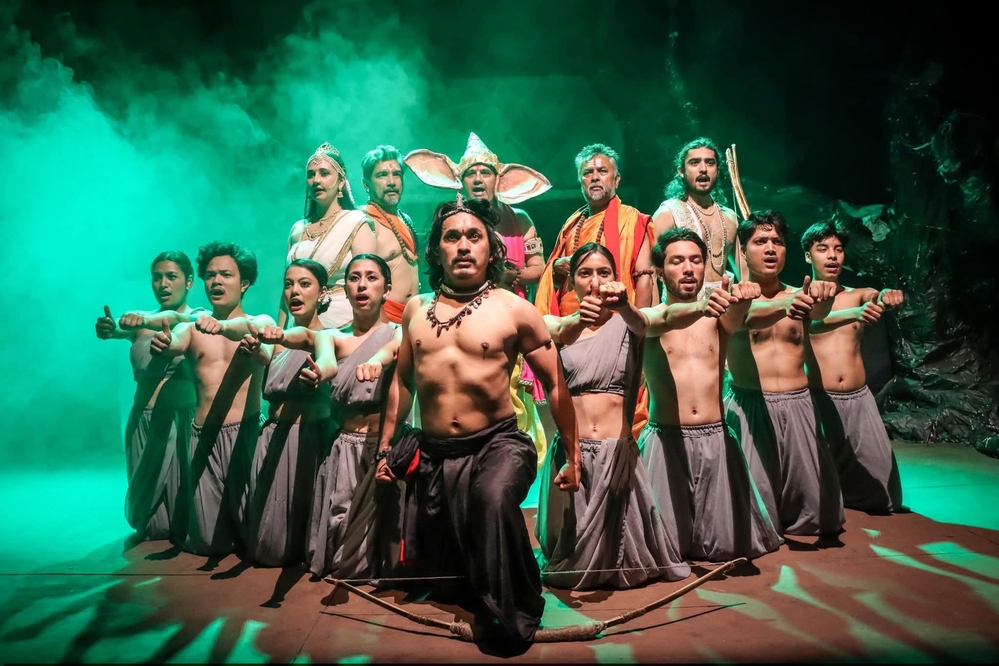
Although the play 'Mahabharata' focuses on the famous character of Mahabharata, Eklavya, it is not a mythological story. Here, the person who tells and writes the story of Eklavya himself appears on stage as a character. And the characters of the story come to meet the narrator and the writer from within the story.
'Mahabharata', which breaks the structure and message of the mythological story, is also a new play in that sense.
Eklavya from the tribal community wants to learn archery from Guru Dronacharya (Ramesh Budhathoki). However, Dronacharya, who dreams of becoming the best guru by teaching archery to the regionals (Prince Arjun), does not accept Eklavya as his disciple, citing his alleged low caste.
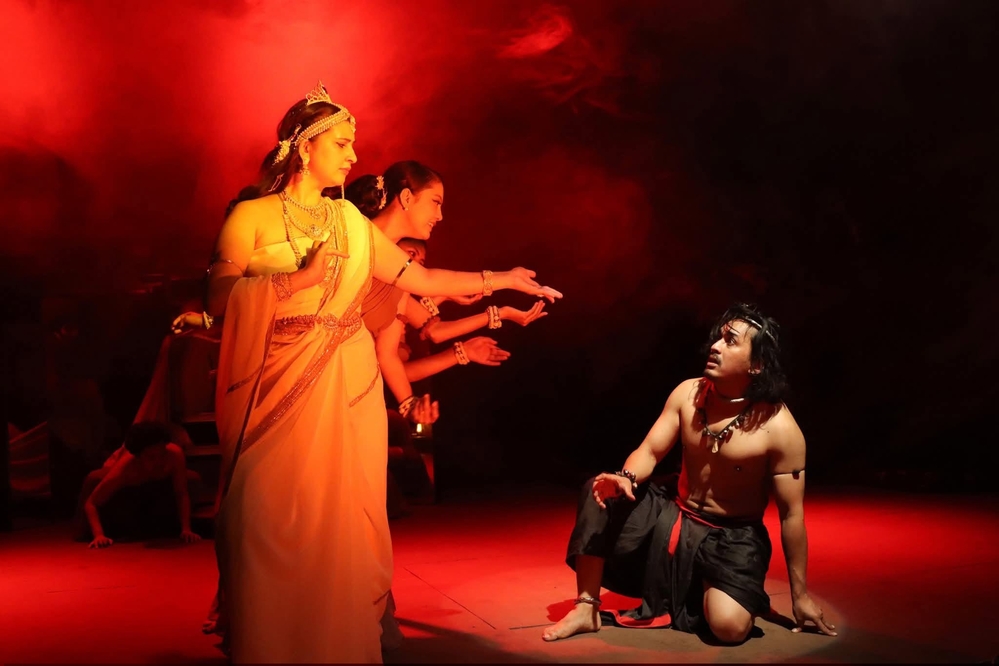
However, even after making a statue of his guru, Eklavya completes the rigorous practice of archery and proves himself to be the best archer. Finally, Guru Dronacharya asks for his right thumb as Gurudakshina. We all know that Eklavya cut off his finger in the mythological story. But what will happen in the play 'Mahabharata'? The interesting part of the play lies in this.
Guru Drona's intention to cut off Eklavya's finger and create a situation where a tribal cannot use a bow and arrow is debated on the stage as oppression, exploitation and discrimination against the so-called lower caste. It is after this scenario that the finger has to be cut off that the play takes on its real form (meta theater). As the character in the story, Eklavya, is trying to cut off his finger, the character who has become Ganesh leaves his seat and goes to him saying 'Pakh Eklavya'.
Opening a prop with big ears that look like an elephant, he starts advocating for Eklavya not to cut off his hand. And in his real language he says- ‘I will not act in such a play in my life, as long as the minds of both the performer and the viewer remain asleep!’ This dialogue and scene have the power to shock the audience.
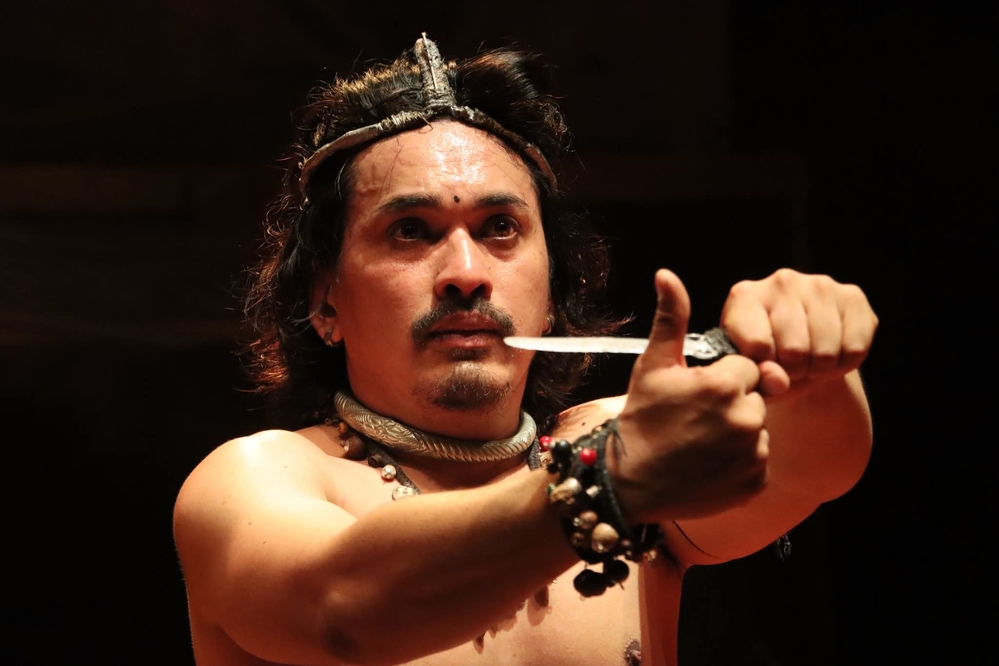
Before Ganesh alias Manoj can finish his words, Maharshi Vyas also turns to his real identity Suvarna and shouts angrily- ‘Oh Baba, then you yourself direct and wake up those sleeping minds!’ As in the story, these two start fighting on stage again. Reminding the two, Ramesh, coming out of Drona’s character, adds, ‘Manoj Babu, what is your problem, do you look at everything through the lens of an ideal? That is your problem. You have never been able to become practical!
This scene shows the theoretical ground on which the play stands. The real characters of this play, which stands on the constructionist theory of philosopher Jacques Derrida, now start discussing with each other the discrimination caused by the caste system. They start arguing, saying that even though Eklavya had to cut off his finger because of caste in the mythological period, such discrimination should not happen in the present day.
Some argue in favor of Eklavya's finger being cut off, while others are against it. Those who speak against it, connecting the story with the current situation, speak for the end of untouchability and discrimination based on caste. Artist Sandeep Shrestha, who plays Eklavya, also argues that no one should be humiliated, ignored, or oppressed because of caste, '... caste should not be hidden, it should be told.' So the point is that Sir, now Eklavya does not cut his thumb.'
Embracing Derrida's constructionist theory, this play directed by Navin Bhatt questions the portrayal of Eklavya in the mythological story and the message it gives, making this character think differently. The play stands in favor of a society, questions and dialogue where Eklavyas no longer have to endure caste discrimination, neither in books nor in society. The play makes a unique satire on those who hold onto orthodox traditions that have embraced mythological ideas.
The sound and light presented on stage also convey the same commentary that 'Mahabharata' is trying to spread. On top of that, the refined acting of artists like Ramesh Budhathoki, the mature portrayal of Manoj Gajurel and Suvarna Thapa. Sandeep, who plays Eklavya, makes the characters of the mythological story come alive on stage.
Moreover, this debate on the caste system created by their characters seems to be truly essential for today's society. But, if these oppressed voices, communities, and characters were brought to the stage in this way, would this debate have reached greater heights if the same community had been involved in the production of the play?