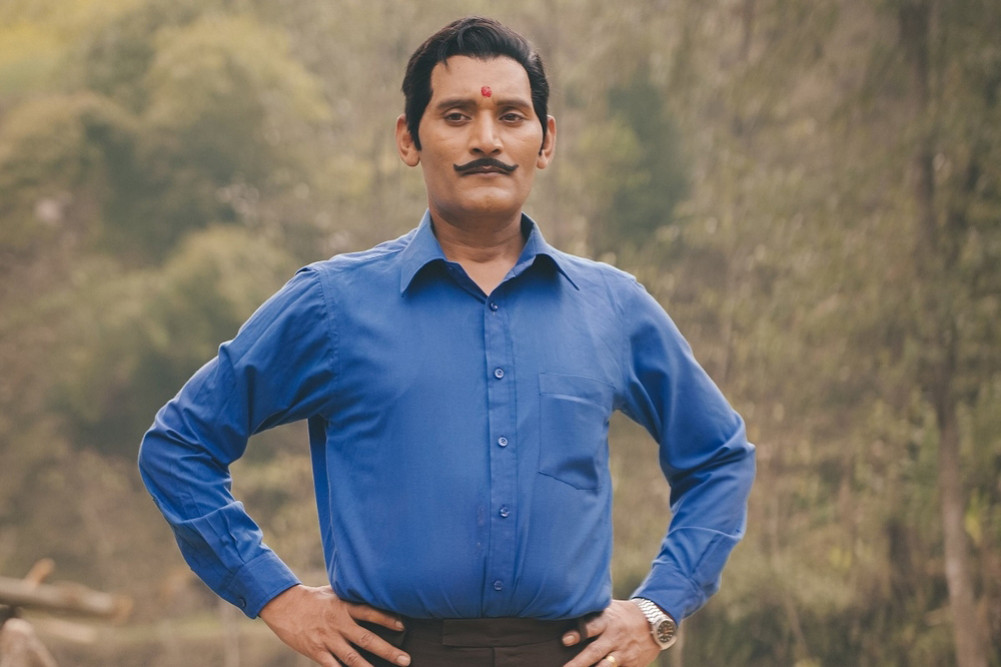
In the film 'Kazi', Bipin Karki plays the role of a married man whose love for his wife matches real life.
We use Google Cloud Translation Services. Google requires we provide the following disclaimer relating to use of this service:
This service may contain translations powered by Google. Google disclaims all warranties related to the translations, expressed or implied, including any warranties of accuracy, reliability, and any implied warranties of merchantability, fitness for a particular purpose, and noninfringement.
Actor Bipin Karki remained a household name in the hearts of the audience throughout 2082. While sharing the warmth of the film 'Wool Sweater' directed by Navin Chauhan, he spread not only within Nepal but also to various cities in India.
A year after Dharanidhar Kafle's deep love was reflected on screen, Bipin has taken on a new incarnation of love. In the years when Kafle's love was far from life, he was lonely. But in the film 'Kazi', which was released on 8th Jestha, Bipin plays the role of a married man who loves his life partner deeply.
'The way I love my life partner, the same love Kazi loves his wife,' Bipin compares Kazi's love with his own feelings. How can a 'celebrity' get angry easily? Forced to hide her true feelings from the scrutiny of millions of eyes, she is a life partner who understands herself carefully. 'Sometimes I get angry with him immediately, and then I cheat on him immediately.' Kazi also teaches me in the film, says Bipin.
He has lived the character of a couple from the young Kafle in ‘Wool Sweater’ to the old Jayanarayan Sharma in ‘Phulbari’. But Kazi seems like a different lover to him. In his childhood, Vipin’s eyes would be drawn to the sight of middle-aged couples in the village always walking hand in hand. Characters who loved their wives were called ‘Joitingre’. ‘No matter what anyone said, their love was so sweet and beautiful, it kept pulling me,’ says Vipin.
Vipin has filled the souls of the same lovers he saw in Kazi. In every film Vipin has done, he often comes across ‘gray’ characters. But Kazi is a ‘white’ character to him. ‘He is an ideal man, who does not make any mistakes.’ He gets the sympathy of the audience,’ says Vipin.
While watching the film ‘Kazi’, it seems that this is a story seen through religious eyes. The film, which focuses on patriarchy, tries to make the male character more pure. However, the love between Kazi and his cousin in the film is interesting and fair. ‘The main philosophy of the Kazi character is how far a person can go and what kind of sacrifices he can make to save a relationship and love,’ says Vipin.
Where was this story told to Vipin in the beginning? In Vipin’s memory, the character of the story that was first told was a ‘don boy’ of the city. Who spends his time in pleasure. The film was not finished even after signing for a long time. ‘When the director came to me after two years, the story had completely changed,’ says Vipin. After hearing the changed story, Vipin told director Laxman Rijal, ‘I will not do this film, I will return your money.’ But gradually, the story began to bind Vipin. Then he agreed.
Vipin does not want to speak the dialogues written in the script exactly on the set. Instead, he adapts the dialogues in his own style. ‘The writer and director understand the overall story, but the depth and detailing of the character is done by the actor,’ he says, ‘Even while doing Qazi, we improvised a lot until the very end.’
In the film, Vipin has a screen share with his one-and-a-half-year-old daughter. A child was needed in the dream sequence that Qazi sees. The child of the age that Vipin needed was his own daughter. But because of the fake moustache he wore during the shooting, Vipin was not recognized by his daughter. ‘She came to my arms only after I was fooled,’ says Bipin.
As Bipin does more films, new characters are born. How much does he love his characters? He told the story of his house walls decorated with sketches of his own characters. After the release of every film, some audience members give Bipin a sketch of his character as a gift. Now, Raja and Kazi have been added to the wave of those sketches.
The character of Raja is the most beautiful character that director Tulsi Ghimire has written in the film ‘Pahaad’. ‘Pahaad’ suffered a disaster not only in reviews but also in business. However, the discussion of ‘Raja’, which remains etched in the memories of the audience who return after watching the film, continues to be held in awe. Bipin told the story of when he wore Raja in ‘Pahaad’. He had a great desire to work with Tulsi Ghimire in a film. ‘If it weren’t for her, how would Nepali film have come this far,’ Bipin wonders.
When he was little, the memory of sitting on his mother’s lap and riding a tractor from the village to Biratnagar to watch Ghimire’s film ‘Lahure’ kept running through his mind. ‘Who wouldn’t want to work with someone whose films I grew up watching,’ says Bipin. One day, Tulsi jokingly told Bipin, ‘You are a person who can carry 50 kilos, but you are only being carried 25 kilos. I am carrying 50 kilos for you.’ Bipin had also jokingly said, ‘Brother, I am ready to carry a quintal, but I need someone to carry it.’
After a long time of hinting at work like this, one day in 081, Tulsi came to Bipin with an offer. At that time, his mother had passed away. ‘I had just left the orphanage. I was not mentally in a position to go anywhere for shooting.’ But Tulsi Dai himself came to my apartment with the agreement paper and the story,’ says Bipin Sadrishya.
While narrating the story, Tulsi thought, ‘My character is definitely Raja’.’ He felt that the pain of that character and the emptiness of Bipin’s life at that time were intertwined. At that moment, he said to himself, ‘I gave Gurudakshina to Tulsi Dai.’
There is a reason why the character of ‘Raja’ is special to Bipin. He kept thinking of his mother throughout the shooting. Raja, who grew up in Mumbai, is a character who lost his mother. His mother’s dream was to go to Nepal and see the mountains. Bipin's mother also had a wish, 'To buy a washing machine, wear gold jewelry and go abroad once.'
She always told Bipin, 'Other people's children are abroad, I also want to see them.' Bipin would say, 'I will take you to Thailand, I will arrange the time, don't wait.'
But when Bipin's time came, his mother was not with him. 'I could not fulfill your dream, mother,' he says in a pitiful voice from his throat that had been blocked for a long time.
In the film 'Pahaad', the king's mother's dream is also unfulfilled. When the king reaches the mountain, he gets emotional thinking about his mother. 'I wanted to stand at that height of the mountain and communicate with my own mother. I had my own mother's face in my mind. Whatever I said there, those were things that were made up in my own mind,' he remembers. It took Vipin three days to do that scene without opening the mountain. At that time, he thought, ‘Maybe mother is still angry with me.’
In Bipin’s own words, he is an artist who mixes 50 percent ‘Vipintva’ in his character. ‘Whatever I cry, that is my own tears. Whatever I laugh, that is my own happiness,’ he says.
She calls him Jeevan Sangini, ‘Others have colorful things on Facebook, but only black letters and poems always come to yours.’ That is why Vipin also follows poetry and poetry pages on Facebook and reads them at his own pace. ‘I love Hindi and Urdu literature very much. Sometimes, when I come across a good poem while scrolling through Facebook, I stop and start reciting it,’ says Vipin.
Vipin also draws poetry. Sometimes, even the walls of the house are not empty . ‘That’s why I don’t stop my daughter from painting on the walls .’
Be it Bipin’s ‘Bhasme Don’ by Pashupati Prasad or ‘Phanindra’ by Jatra . With each different character in the film, it seems that the artist within him is always maturing . ‘Sometimes I feel that these characters are like my children . Be it Bhasme Don or Phanindra, they are alive in my mind even though they are not physically present . I am living for their love,’ he says lovingly, ‘As much as a painter loves his painting, as much as a mother loves her son, I also love my characters as much .’
That’s why he is carrying those characters around every day, every moment . Even though he carries many characters with him, he never shirks his responsibility as Vipin . ‘I take care of the household responsibilities equally . Taking my daughter to school, buying vegetables, buying meat, and going to receive guests are all my daily chores,’ says Vipin .
He always worries, ‘That my daughter never says, ‘Baba doesn’t give me time .’
Like the trust of his family, he never wants the trust of the audience to be shaken . Remembering the huge crowd that loves him, he expresses his commitment, ‘I will never let the ‘blind’ trust they have in me break .’