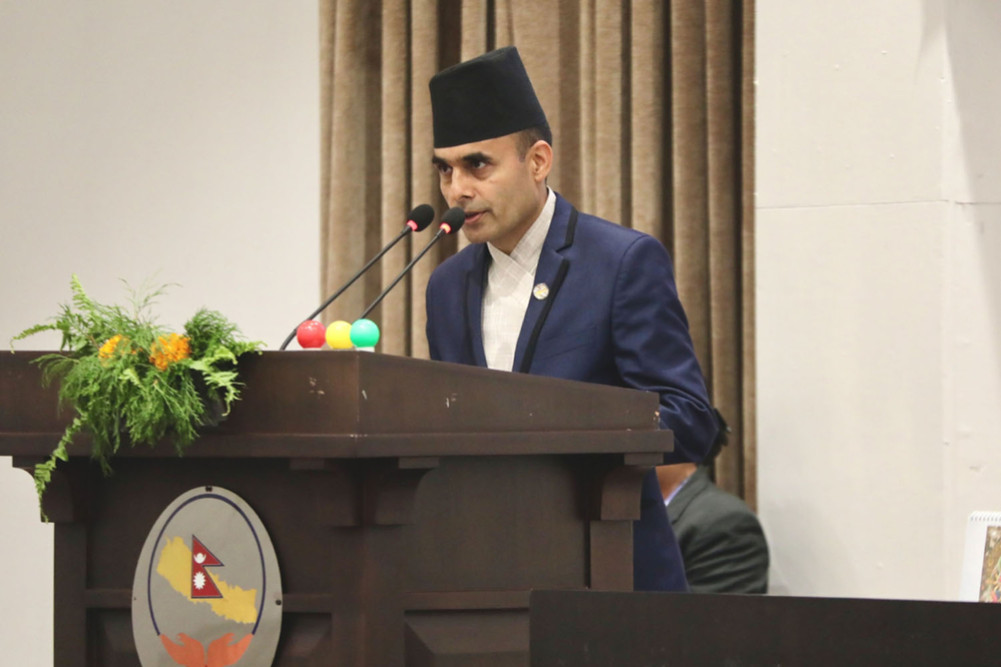
Expressing his views on the 'Film Bill 2082' presented by Minister of Information and Communications Bikram Timalsina, MP Jagdish Kharel demanded the removal of pre-censorship of films.
We use Google Cloud Translation Services. Google requires we provide the following disclaimer relating to use of this service:
This service may contain translations powered by Google. Google disclaims all warranties related to the translations, expressed or implied, including any warranties of accuracy, reliability, and any implied warranties of merchantability, fitness for a particular purpose, and noninfringement.
Rashtriya Swayamsevak Sangh (RSS) MP Jagadish Kharel has said that the film sector should be kept under the Ministry of Information and Communications. In a meeting of the House of Representatives, while considering the 'Film Bill 2082' presented by Minister for Communications Vikram Timalsina, Kharel demanded that pre-censorship of films be removed.
'The most pressing issue in the film sector is censorship. Pre-censorship should be removed,' he said. Stating that it took 57 years for the Film Bill to become an act, Kharel said that the 'Censor Board' should be made a film certification committee.
Even as the Minister of Communications, Kharel had been saying that films should be kept under the Ministry of Communications in the Legislative Management Committee during the discussion on the bill. However, since there was interference in the process of keeping films under the Ministry of Communications, most people had been demanding that it be kept under Culture and Tourism. 'We have discussed this bill that originated in the National Assembly intensively. The bill presented to the House of Representatives has also included it,' Kharel said, 'That should be continued. If all the work from pre-production to post-production of the film is done under the Ministry of Communications, it would be appropriate if it is kept under the Ministry of Communications.'
Kharel also said that the film sector should be recognized as an industry. 'I should be able to move forward even by taking a loan rather than making a film,' he said. He also raised the issue of making the Film Development Board autonomous and empowered during the meeting.
Another MP, Ashok Kumar Chaudhary, suggested that since film is not only a medium of entertainment but also a powerful medium of social change, it would be appropriate to send it to the Legislative Management Committee with detailed discussions to make it mature, practical and free from controversy. He also felt that although the proposal to make the Film Development Board autonomous is positive, its structure, powers and responsibilities should be clarified. He said that a serious discussion is also needed on the structure and powers of the Censor Board. 'The state should also be sensitive to the issue of freedom of expression not being stifled while exercising the powers given to the Film Censorship Committee,' he said. MP Chaudhary felt that although regulation is necessary, creativity should not be regulated in the name of regulation but should be encouraged.
He said that films are not only entertainment but also a means of social change. 'Films create awareness in society. Preserve culture and establish national identity. Present the image of the country to the world. This bill has attempted to establish the film sector as a social, cultural and entertainment industry, which is welcome,' Chaudhary said. 'The idea of making films a medium to promote Nepal as an international tourism destination seems far-sighted.'
MP Saraswati Lama said that this sector should not only be regulated but should also be seen as a national economy, employment and cultural identity. 'Even after completing a journey of more than 6 decades, the Nepali film sector has not been able to develop, expand and build its expected international competitiveness.' The main reason for this is the state's apathy, policy ambiguity, lack of necessary protection and encouragement,' she said. Lama opined that some provisions of the bill show a mentality of controlling films more than encouraging them, so the state should cooperate, protect and encourage them rather than controlling them. She said that if such provisions are not amended, the development of the Nepali film sector will be seriously affected. 'The development of the film sector is not through orders and control. It is possible through trust, cooperation and encouragement,' Lama said.
MP Bharat Giri stressed that a law should be passed giving special priority to domestic films. He also said that the Film Inquiry Commission should be formed in the presence of film professionals with 8/10 years of experience. 'Here, it was said that it should be done under the leadership of the Deputy Secretary. This should be considered,' Rai said.
Padmakumari Aryal said that the film should be viewed from the perspective of cultural and national existence rather than from a commercial perspective.