In East Asian and Iranian cinema, sequels are used not just for commercial gain, but rather for storytelling depth and ideological continuity.
We use Google Cloud Translation Services. Google requires we provide the following disclaimer relating to use of this service:
This service may contain translations powered by Google. Google disclaims all warranties related to the translations, expressed or implied, including any warranties of accuracy, reliability, and any implied warranties of merchantability, fitness for a particular purpose, and noninfringement.
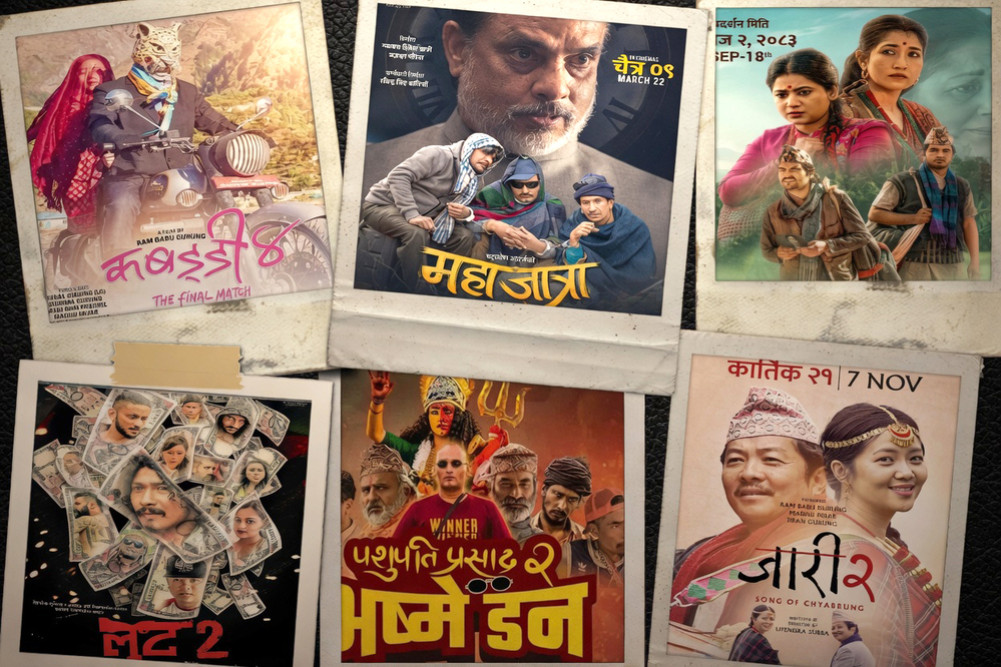
Four years ago, until the release of the film ‘Kabaddi 4: The Final Match’ directed by Rambabu Gurung, thousands of viewers were curious, ‘Will Birkaji (Dayahang Rai) get married this time?’
After the film was released on 3 Jestha 2079, a huge crowd of viewers reached the theaters. This film, which had a business of over 22 crores, was the fourth sequel to ‘Kabaddi’. ‘Kabaddi’, released on 12 Baisakh 2071, was highly liked by the audience due to its original and unique storytelling. At that time, this film did a business of over 7 crores.
The audience felt refreshed when they saw the love between Kazi and Maiya on screen in the setting of the Himalayan village of Mustang. At that time, the writer and director of ‘Kabaddi’, Gurung, felt, ‘This story of Himalayan life should be told to the audience again.’ This alone did not fill the stomachs of the audience. And he conceived, the sequel to 'Kabaddi' 'Kabaddi Kabaddi'.
And he brought new player Saugat Malla into the ring to play 'Kabaddi' with Dayahang. After that, not only did the film receive favorable reviews but also a boom in business. Even after 12 years of the release of 'Kabaddi', its series has not ended. Whereas four years ago, director Gurung had brought 'Kabaddi 4' calling it the 'final match'. But just a few months ago, he shot the fifth sequel and is now preparing for post-production. To please the audience, Sipalu Gurung has brought Maiya (Rishma Gurung) back into the story this time.
Before doing 'Kabaddi', Rambabu brought 'Simala' and 'Kabaddi Kabaddi' within four years after 'Purano Dunga', 'Mr. Jhole' and 'Saili'. But those films did not give Gurung the name or the money as much as the 'Kabaddi' series did. Then 'Kabaddi Kabaddi Kabaddi' revived him. But the film 'Sentivirus' that came after that made 'Senti'. And after throwing the final match of 'Kabaddi' to the audience, Rambabu became more busy with production than directing. In these four years, when 'Phoolbari' and 'Degree Maila' came under his direction, four films came as a producer. But it would have been impossible if the film 'Kabaddi' series had become the one that sustained and introduced Rambabu.
The trend of making sequels in Nepal has increased rapidly in recent times with commercial success. The film ‘Jhingedau’ directed by Gyanendra Deuja, released in 2079, achieved commercial success at that time. After that, Gyanendra, who was excited, announced ‘Jhingedau 2’ at that time. His ‘Jhingedau-2’ is being released in the upcoming Asoj. ‘The main reason for making Jhingedau-2 is the commercial aspect,’ Deuja says frankly, ‘There is a trend of making sequels all over the world after the first part is a hit, I also made a sequel to ‘cash’ the previous success.’
Deuja’s ‘Jhingedau’ is a film based on Bhimanidhi Tiwari’s story ‘Jhingedau’. The previous film was completed after the distribution of Dajubhai’s shares. ‘But the second part is not based on the book, rather it is based on characters and situations.’ In which the relationship between mother and child is shown,' says Deuja.
Earlier, in Falgun 2080, Deuja directed the film 'Uphaar'. The film was neither critically nor commercially successful. 'To make up for that loss and to be commercially successful, I started working on 'Jhinge Dau 2'. But the story is equally strong in it,' he claims.
The Biraj Bhatt-directed film '12 Gaun', released in Dashain 2081, revived the action genre that had been almost non-existent in Nepali films for a long time. After the film did business of over 19 crores, Biraj did not waste any time in announcing the production of '12 Gaun 2' as its sequel. Currently, he is busy shooting the sequel, targeting a release in the upcoming Dashain.
Director Pradeep Bhattarai never thought that he would have to stretch the story further until the release of the film ‘Jatra’ in 2073. After the audience liked ‘Jatra’, it achieved significant commercial success. ‘When I made Jatra, I did not think that I would make a sequel or a series of it,’ says Pradeep, ‘but we ended the film with an ‘open ending’. Not much was clear about the future of its three main characters. But seeing the love and demand of the audience, we decided to make ‘Jatrai Jatra’.’
Pradeep remembers that after that, he took the story forward by holding onto a small formula. When it came to the film ‘Mahajatra’ released in 2080, Pradeep understands that the commercial success gave him the energy to make a new sequel. ‘If the audience has rejected the first part or the film is in losses, then there is no point in making a sequel.’ Making a sequel is only possible after getting the love of the audience. This is the practice all over the world, says Pradeep.
Is it easy to make a sequel? Pradeep says it will be very challenging. ‘There is no creative freedom in a sequel like when writing a new and fresh film. Because the characters are already established and the previous story has drawn a boundary. Since you have to write within that boundary, there is very little room to play and it is very difficult to write,’ he adds, ‘Despite so many challenges, we are winning the love of the audience by saving the characters.’
The film ‘Loot’ directed by Nischal Basnet, released on 29 Poush 2068, changed the traditional trend of Nepali films. ‘Loot’, which brought about a huge upheaval not only in the narrative style of the film but also in the acting style of the actors and their approach to the story, did a business of over 50 million at the time. This business was unexpected in the film industry at that time. Five years after ‘Loot’, Nischal brought ‘Loot 2’. The film did business of over 100 million, but it was considered weak in terms of reviews. At that time, critics alleged, ‘This is a film made for the needs of the market rather than the needs of the story.’
Although the sequels of successful films have been successful in terms of business, they have been seen as weak in terms of reviews compared to the previous film. Some sequels have not been able to achieve commercial success or critical success. Examples of this are ‘Jari 2’, ‘Pashupati Prasad 2’ and ‘Prasad 2’.
The film ‘Jari’ directed by Upendra Subba, released in 2080, had presented the original story of the Limbu community in a delicious way. After this film, new stories of different communities also started being told. ‘Jari’ had done a business of 170 million at the box office. After 'Jaari', director Subba's 'Manasara' came in 2081. In 2082, he made a sequel to 'Jaari'. But 'Jaari 2' proved to be weaker in both business and reviews compared to the first series. The film did a business of only Rs 60 million at the box office.
The film 'Pashupati Prasad' directed by Dipendra Kumar Khanal, released in 2073, has remained in the minds of many viewers. The story of the film, shot on a narrow canvas within the Pashupati complex, was very broad. Actor Neer Shah, while speaking at various events, had called 'Pashupati Prasad' the 'best film of the century'. The film did a business of Rs 5.5 million at that time. It was a successful business at that time. In 2080, the sequel to 'Pashupati Prasad', 'Pashupati Prasad 2: Bhashme Don', was released. But the film's business was neither encouraging, nor the reviews were positive.
Why was a sequel born? Director Khanal says, 'At the end of the film, the character 'Bhashme' was left in a state of transformation. We started with the intention of making that character complete.'
They were also greedy about whether it would be commercially profitable as soon as the name of 'Pashupati Prasad' was added. But Khanal claims that that greed was not the main thing.
'If it was just to make money, we could have made this film in 2-3 years. We wanted to complete the story that was left and show what happened to Bhashme and that area a decade ago,' he adds. But while making the sequel, he was afraid from the beginning. 'I was very afraid of what the audience would say and think about the sequel to such a big film.' That fear is destroying the soul of the film,' he said.
The film 'Prasad' directed by Dinesh Raut, released in 2075, was also successful from a commercial and critical perspective. But its sequel 'Prasad 2' (2079) directed by Sudarshan Thapa could not maintain its previous reputation.
After a story is liked in a film, not only is there a trend of making a new sequel to the same story, but also the trend of making brand sequels in the name of a famous film is growing in the Nepali film industry. For example, Deepak Raj Giri and Deepashree Niraula's 'Chhakka Panja' series. Even though the story is different, they are making a new film with the same name.
Currently, the film 'Chha Maya Chhapakkai 2' directed by Dipendra Lama is also in the process of shooting. 'It is not that we have not thought of telling the story under other names. But as soon as we go beyond these names, distributors and hall operators do not want to take risks. That is why we are forced,' says Giri.
'Ae Mero Hajur', 'Nain Nabhannu La' or 'Chhadke', among many other films, there is a trend of showing the audience the greed of 'sequels' by just singing the name and telling a different story. Director Dipendra Kumar Khanal, who directed 'Ke Ghar Ke Dera' after 'Ke Ghar Ke Dera: Ghar No. 2', adds, 'This is not a sequel, it is a series. Where even though the name is the same, the story is different. Makers are greedy for the brand name of the previous film and keep it.'
There is a trend of sequels all over the world. And the business of most such sequels is even more remarkable. In Hollywood, films from 'The Godfather Part 2', 'The Dark Knight' to 'Avatar: The Way of Water' not only maintained the reputation of the first part, but also set new records in earnings at the global box office. Bollywood and South Indian cinema have also been attracting audiences to the theatres through sequels and ‘cinematic universes’ in recent times. From ‘Baahubali 2’, ‘KGF 2’, ‘Stree 2’ to the recently released action-spy film ‘Dhurandhar 2’, the commercial scope of Indian cinema has expanded to the club worth thousands of crores, which confirms the strong market and brand value of sequel films.
In East Asian and Iranian cinema, sequels are used not only for commercial profit. Rather, they seem to be used for the depth of storytelling and ideological continuity.
Film critic Yagyash says that sequels made in Nepal tend to be weaker than the first film. ‘When I look at the sequels of most films, I don’t think they have come out to beat the first film.’ This does not mean that sequels should not be made or should be stopped,' he says, 'but it makes a difference whether those sequels are in continuation of the story or are just a name-dropping attempt for selfish reasons.' He emphasizes that films like 'Gangs of Wasseypur' or 'Godfather' are not sequels just for the sake of name and are part of the story. He claims that Nepali films are all market-oriented in the name of sequels.
'The second or third part does not seem to be much better than the first film. If the second film can surpass the first, then as an audience, I will also be happy and enjoy it. People associated with the film industry may care about how much business has been done, but the audience who watches it only cares about the content,' he adds.