From social media to the streets, citizens have questioned the behavior of the Balen government, using the song 'Garibko Chameli' sarcastically.
We use Google Cloud Translation Services. Google requires we provide the following disclaimer relating to use of this service:
This service may contain translations powered by Google. Google disclaims all warranties related to the translations, expressed or implied, including any warranties of accuracy, reliability, and any implied warranties of merchantability, fitness for a particular purpose, and noninfringement.
He is so cruel that
he gets satisfied with the blood of the people and starts singing-
'There is no one who can sing the jasmine of the poor
This poem was recited by Muktan Theba at a protest against the inhuman treatment of the squatters by the government in Maitighar Mandal on 19th Baisakh.* Many are borrowing the lyrics of the song from the song sung by Balen 6 years ago to question him. From social media to Facebook, TikTok and Instagram, it seems that the role of Prime Minister Balendra is being questioned and satirized by using parts of the song sung by Chameli Bol.
Before that, on 18th Baisakh, activists had demonstrated by making a parody of this song. A parody song with new words mixed in Chameli Bhaka resonated in Maitighar Mandala:
Balendralai Sunamathi
Sunai Cha Sunai Cha
Garibko Chameli
Runai Runai Cha
This song by creator Ramesh was recorded in 2053 and used in the film 'Balidan' released in 2054. Balen had mixed the lyrics of the same song called 'Garibko Chameli' in the rap titled 'Balidan' sung 6 years ago. Which was uploaded on 10 January 2020 from Balen's personal YouTube account. After singing this rap on Kantipur TV's program 'It's My Show' before becoming mayor, this song became more popular among the new generation.
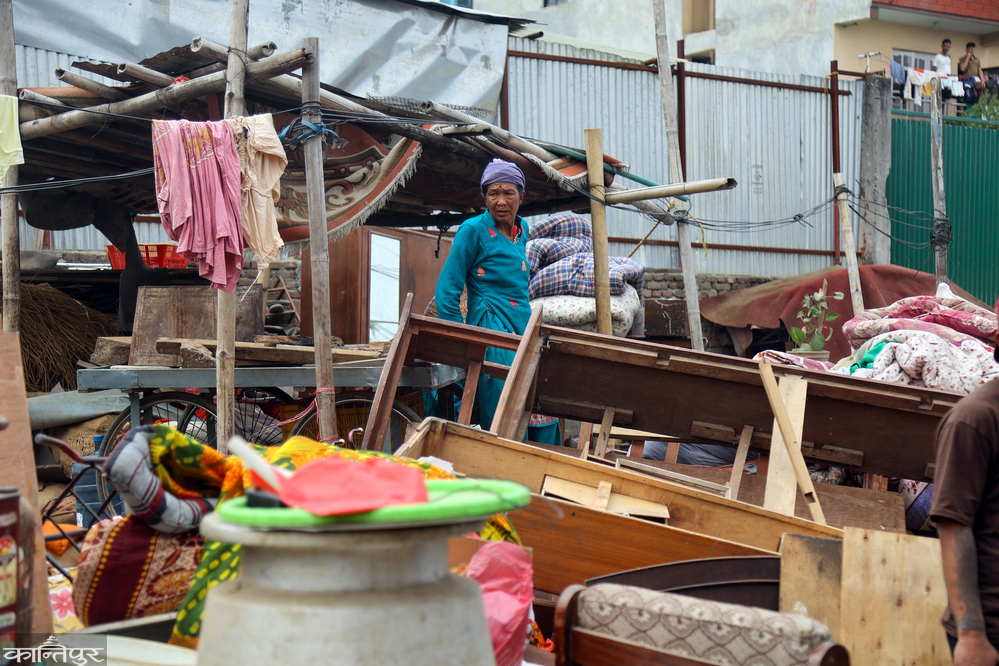
This song has started appearing on social feeds again after the work of resettling the Sakum residents has started. But not in a way that shows rebellion, but in a way that is satirical or protesting. For example, on April 6, a reel was posted on Instagram called 'Nepliz 2082' - in which two girls are crying while demolishing a slum, saying, 'Don't come and get your father!', and the song 'Garibko Chameli' is heard playing in the background. This reel, which has more than 37 thousand views, asks the question, 'Houses are demolished, children are crying. Is this the development we want?' Not only on
reels and TikTok, but also on the social network Facebook, many have questioned Balen by writing 'Jameli'. Raising questions about the slum management process, Gen-G leader Raksha Bam wrote a status on Facebook. 'There is no doubt that our villages, cities and settlements should be made orderly and beautiful by identifying and certifying real landless citizens and arranging proper housing without depriving them of their fundamental right to live with dignity.' But the real issue here is the state's intent and approach. How does the state treat its weakest and most suffering citizens?' Raksha had written, asking, 'After all, being powerful means becoming more responsible and humane.' Well, let's hope that Prime Minister Balen fulfills the promise he made today tomorrow. After all, hope belongs to the poor, Chameli.'
On April 18, UML leader Usha Kiran Timsina wrote the lyrics of this song on Facebook and expressed her opposition to the government. She complained that when she criticized the issue of pregnant women, children and the elderly shedding tears, she instead received abuse. 'Take these cries and cries of the citizens to Baluwatar, people. There is no one to speak the jasmine of the poor,' she wrote.
This song is not the only one used to question or protest against Balendra's work. After becoming the mayor of Kathmandu Metropolitan City, the same song was also used to protest against the treatment of street vendors as part of his campaign to clear the sidewalks.
At that time, a name was famous on social media, Chameli Gang. Many people knew the network created by some youths to warn against Mayor Balendra's work by this name. Yujan Rajbhandari, who was also a member of the Gen-G Front, was in this group. When the sidewalk vendors were driven off the streets, youths from Raksha Bam, E:, Bhavana Raut to Today's Chow, Binod Deuba and others stood with him in protest. Yujan said that they had reminded Balen of their pre-election commitments at that time. According to Yujan, the 'Chameli Gang' was mentioned in some news before their group, and later they started calling us by this name.'
'Garibko Chameli' author Sarjak Ramesh is aware of the use of his song against Balen. 'It is right for this song to be used to remind him of his words. Don't forget this - it is a warning that when you have land, you should not be different when you come to power,' he said. 'You have come singing the song of the poor, it seems appropriate and justified to use this song to say that you are a poor person.'
Gen-G activist Miraj Dhungana expressed his anger by holding a press conference and saying that the Prime Minister has taken steps that go against the spirit of the song he sang, ‘Remove the poor man’s jasmine from YouTube. That doesn’t work.’
Activist Jasmine Ojha says that they used the medium of song to change the dimension of the protest. She argues that they made a parody of it because Balen had also previously protested through song. ‘Earlier, resistance was done by throwing stones.’
We used the medium of song because the dimension of the protest should be different according to the time. Balen was also a singer before becoming mayor, he had also protested through song,’ Ojha says, ‘We also used the medium of song like he did. In the beginning, we sang the jasmine song to protest to say that it is wrong to manage the squatters by sitting on the ground.’
The parody song sung by a group of activists including Jasmine also satirizes the word revolution mentioned by Balen.
The government's revolution has come from 'A'
The poor's jasmine is the 'dozer's revolution'...
This song was also used sarcastically in a protest program held in the capital to pressure the Prime Minister and ministers to disclose their sources of income after the asset details of the Prime Minister and ministers were made public. A pamphlet reading 'No one gives the poor's jasmine gold,' was used in the program. At that time, this pamphlet went 'viral' on social media. Another jasmine song made on gold is also viral on TikTok. This video, posted by a TikTok account called Nepal Sanshar, also shows scenes of the protest in Kathmandu against the management of squatters. In this tiktok with more than 7 lakh views, a woman sings into a microphone:
Sunko Dallo Gharmai
Put it on
Gariblai Chameli
Threw it in the river
This song titled 'Gai Ta Bandhyo' speaks of the pain and suffering of the people of the earth. The Rameshs have been singing this song since 2028. While walking, singing a song of equality, saying that justice, law, property and opportunity should be equal for everyone, Ramesh (Ralfa Group) came across this song. At that time, the Rameshs had reached Manthali in Ramechhap.
A cultural program was scheduled in a village called Mugitar near the Manthali river. A stage was made at the man and the man's house. After the Rameshs sang the song, the villagers said - We also have children who sing songs - let's give them some time! At that moment, two children climbed the stage. Carrying sickles in their hands. Playing the same sickle, they made a rhythm. And they set the rhythm to the rhythm:
We tied the cow to the stone, there is no one who is attracted, there is no one who is attracted
There is no one who speaks the jasmine of the poor
There is no one who speaks the jasmine of the poor, there is no one who speaks the jasmine of the poor...
Then the Rameshs sang this song in protest against the discrimination and oppression of the landless by the state. It was taken to the villages as part of the campaign against autocracy. After about 7 decades, the same song is once again resounding in protest against the inhuman treatment meted out to the landless and the landless by the state.
Error correction:
Earlier, due to an editorial error, the name of poet Muktan Theba was omitted, so the error has been corrected. — Editor

