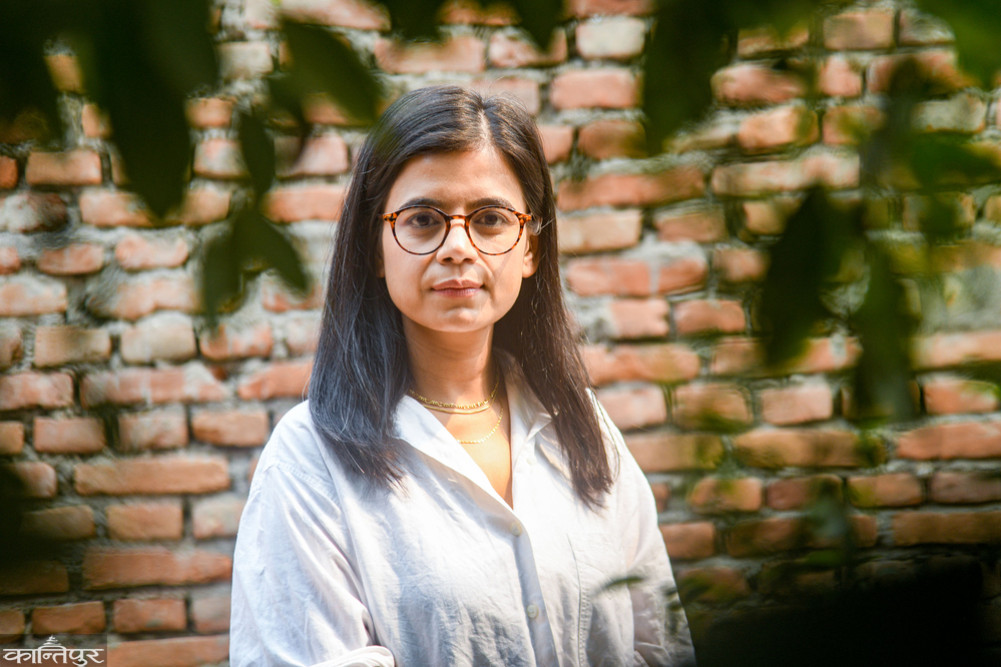
Sahara, the director of 'Ek Muthi Badal', says: It took me a long time to find home within myself. I still don't feel like I have a home in any physical thing. Right now, my apartment is in New York. I have decorated it the way I like. But, I never feel a place is permanent. That's what my film is about.
We use Google Cloud Translation Services. Google requires we provide the following disclaimer relating to use of this service:
This service may contain translations powered by Google. Google disclaims all warranties related to the translations, expressed or implied, including any warranties of accuracy, reliability, and any implied warranties of merchantability, fitness for a particular purpose, and noninfringement.
She grew up in a hostel since she was a child. That too in Lucknow, far from Nepal. She had to wait until April to return home. When she returned to Nepal, the refrigerator in the house had been replaced, but the new refrigerator never felt like her own. The living room looked new, the flowers in the garden looked different. On top of that, her mother had to keep decorating the house. The house was different every day of the year. No house ever felt like home.
What is home? A hostel? Or a place where parents and siblings live? Director Sahara Sharma, who grew up in different places since childhood, was always looking for home. Sometimes she searched for the experience of home in a hostel, sometimes in a house in Bardiya. But, different places did not give her the feeling of home. The search for that same home is the film 'Ek Muthi Badal'.
In this film, which will be released from Jestha 1, Sahara has imagined a house like she wanted . She has told the story by placing characters like mother, father, and sisters in one house . That too, is the story of a young female character who grew up in the city . What is the life and struggle of a city woman ? Where does she stand in the fight for existence ? Did that woman find the house she was looking for ? What is the house she is looking for ? Just a structure or a feeling ?
What kind of house is Miley, the main character of the English-titled 'My Share of Sky', looking for ? What is it ? You will know that only after watching 'Ek Muthi Badal' . For director Sahara, coincidences still make a house in the month of 'April' In 2024, she arrived in Nepal in April for filming. Not only now, sometimes April used to make Sahara feel at home. She always returned to Nepal in April after reaching Lucknow to study. She spent all the remaining months in the hostel. Her childhood upbringing did not allow her to get close to any place. She had barely started considering the hostel in Lucknow as her own, her family called Nepal. She came to Kathmandu when she was in grade 8 and studied at Galaxy School. In Lucknow, she used to call the warden Nani, meaning grandmother. Having grown up with the love of children, she did not get the same environment here. The teachers used to scold her more. Since she did not have that sense of belonging at school, she did not feel at home.
She went to Kathmandu, her parents to Bardiya. Mother is a government teacher, father is a lawyer. Far from her parents. In a special sense, home was never home for Sahara. ‘Everyone’s family is together, why are our parents not with us?’ I understand now, their profession, their dedication at that time. But, I grew up with that experience in my childhood,’ says Sahara. Because she did not have that intimate attachment and belonging to her home, Sahara kept looking for excuses to stay away from her family when she was young. After studying 12th, she went to Bangkok. Then she reached Cambodia.
She kept running away from home on the pretext of doing similar projects of two/three weeks. Later, she stayed in Bangalore to study for 2 years! Sahara wrote the film ‘Ek Muthi Badal’ capturing this life she lived and the subtle feelings within it. ‘In particular, I have lived in pieces. What is home like? How does a person become comfortable in a place? I don't know. It took me a long time to find home within myself. No material thing still makes me feel like home,' said Sahara, 'Now my apartment is in New York. I have decorated the house the way I like it. But, I never have a permanent experience of any place. That's what my film is about.
’ Will women who are raised as 'people who go to other people's houses' ever find a real home? While writing the character of Miley (Aanchal Sharma), Sahara has pondered this issue many times. 'Women always go to other people's houses? They are raised as if they were prepared for other people's houses. Do girls also consider a house as a home? You have your own house, but does that place feel like a home to you?', Sahara said. The character of Miley written by Sahara does not seem so gentle, she is not simple . She is a bit quarrelsome, she does not easily please . Why ? In the initial days of writing the story, many people asked why the main character was shown to be quarrelsome . Sahara's only answer was, 'You do not find yourself attached to any particular place, you have to struggle to live in such a place . It is natural to appear quarrelsome when you speak in a loud voice .'
Cannes story-The light of the mind was opened!
Sahara started writing the story of the film in 2020 . Initially artist Richa Sharma encouraged her to write such a film . 'Feminist film writing', Richa had said . But, how to write such a film ? How to write a commercial film with women at the center ? This challenge added to Sahara's enthusiasm for writing films . During the writing process, the film visited various labs around the world. The only purpose of reaching the lab and the festival was to raise money to make the film.
After the outline of the story was ready, Sahara and producer Abhimanyu Dixit were in a hurry to make the film. So they took a step towards the international market to find money. Wanting to reach the writing lab before the market, they initially reached the 'Open Doors Co-Development' in Locarno. Then the lab and market journey began. In 2021, the film reached the NFDC Film Market in India. Producer Dixit won the 'Rotterdam Lab Award' there. From there, the film was selected for the Cannes Lab. Sahara learned about film writing there. That's where the light bulb went on in her mind.
Sahara had not taken any film writing classes before that. Kimf won the 'Chasing Rainbows' college project. She went to Cannes hoping to gain knowledge about writing. It was another joy to be able to 'pitch' the story she had written at such a big festival. Due to Covid, she had participated in many writing labs virtually. When she physically reached Cannes for the first time with her story, there was a special energy in Sahara and Abhimanyu. 'After reaching there, what did I write?' The thought shook her from within,' Sahara recounts her Cannes trip, 'After reaching there, I thought I had done nothing.'
Where to start when she reached Cannes? At first, they did not get anything. She kept watching films. She also wanted to learn from films around the world. During that trip to Cannes, Sahara met German producer Sara. At Cannes, a mentor encouraged Sahara to make a film - There are too many ears of rice in the story, now let's make a film! By then, 'Ek Muthi Badal' had already reached the European Post-Production Grant Hubert Balls Fund, Locarno's Open Doors, and Bangladesh's 'West Meets East Screenplay Lab', and had already made a decision to put ears of rice on the film's poster. After seeing the ears of rice on the poster, Sahara also felt - now she must make a film.
'At that time, I could have kept applying for funding for the rest of my life. But now I realized that I had to make a film,' she recalls. Even when they decided to make a film, they did not have money at that time. The film industry does not believe in new filmmakers, but despite that challenge, she kept the courage to make a film.
'It is very difficult for first-time filmmakers to find money. "No one gives money easily," Sahara recounts the complexity of filmmaking, "Again, once I start a project, I have to finish it. And we started with the idea of making a film even with a small amount of money." When Sahara's film reached the international market, not a single person was interested in making it. Some came to the film saying, 'I'll put money in if I make the main character marginalized.' Some said, 'I'll spend it if I take the story to the village.' However, Sahara did not compromise with that money. She neither had to show poverty in the film, nor had she taken the story to the village. She had to tell the story of a struggling female character in contemporary times. 'Yes, the story of the village is beautiful. But she had to show me that Nepal is also a story of contemporary times,' Sahara said. 'I am a person who tells stories of contemporary times. I like to tell stories that are relevant to what is happening now.'
That trip to Cannes made Sahara want to break the story she had written again. She completely broke the story after the intermission. As soon as she returned from Cannes, the story began to unravel. She was experiencing a change within herself during the Cannes trip. She changed it to incorporate that change into the story.
'After reaching Cannes, I was experiencing a change within myself. That's why I changed the story. I had to get to the root of what I understood, saw, and found difficult and find an answer to it through writing,' she said.
Sahara started making a film only 4 years after writing the story. After spending a long time writing, Sahara also felt that now she would not only write but also make a film. This thought did not last long in America. She immediately came to Kathmandu. Even then, she had not received any money. She asked her father on the phone - 'How much money can you put into my film'.
She inquired with her husband. She asked her sisters for money. Abhimanyu also started looking for money at home. After reaching out to her family, she realized that she could raise 50/60 lakhs. But around that time, Sahara came across 'Man Productions'. Man Productions was preparing to make a film on the story of a woman. After hearing Sahara's story, Man Productions was ready to invest in the film. Sahara and Abhimanyu, who were preparing to make a film with Man, met. Then a handful of clouds formed. 'Man Productions was waiting for a horse to bet on. And they invested in our story,' said Sahara with a smile. Even though they were struggling to find money before making the film, investors were gradually joining this film.
Female dominance in the production team
It is a wonderful coincidence that women are involved in this film. Sahara became the director. Dan took on the role of cinematographer, who is also a woman. India's Yashasvi Sabharwal was involved in the production design. From Priyanka Gaikwad to Chief Assistant Director Marna James, the audio mixer was there. Kirti Joshi was the head of the makeup department, while Janaki Kadayat handled the costume design.
Aanchal Sharma will be playing the lead role in the film. However, Sahara says that this is not a creative decision, but a coincidence. 'I did not design it to make a woman the head. But this happened when everything came together. I believe in my abilities. I can get the work I need from others,' she said. 'In a story told by a woman, it is important for women to be the heads of various units.' But the story I tell is not connected to my bhajaina. I make the kind of film I feel like making. Even if I were a boy, I would have told the story I like.'
While adding good talent in various departments for the film, Sahara says that most of the genres are female. The lead actress Aanchal is Sahara's first choice. After watching the song titled 'Lajjavati Jhar', Sahara thought of Aanchal for the lead role. It is true that other actors' names did not come to Sahara for this role. But, Sahara believed in herself - that she could get the work she wanted from Aanchal. Now, watching this film that is ready for release, Sahara feels that her choice was right. 'As soon as I saw Aanchal, I knew from within that she could play this character,' Sahara said.
Sahara, who joined film production through journalism, went to Bengaluru and did her master's degree in film. When the film 'Chasing Rainbows' she made at that time won the award, Sahara was surprised - I wonder if I can do something in films too! But it took Sahara time to return to filmmaking. Why? Despite not easily believing in women's abilities, Sahara says that women's progress in this field is slower than men's.
'Making films is especially difficult. It is my privilege to be able to make films even in such difficult times. Another thing is that money is spent on men's abilities. But women have to prove themselves first,' says Sahara, 'Money is not invested in women's abilities. If you don't believe in women's abilities, how will you prove yourself? That's why it takes time - but it doesn't mean that all films take 10 years to make.'