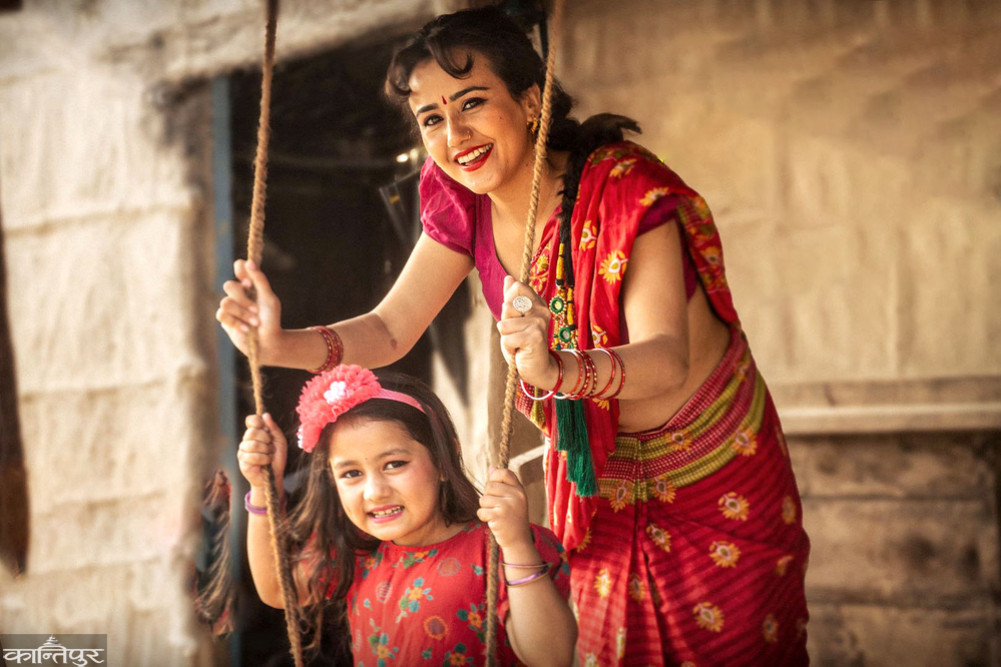
With strong female characters and in-depth research, the film 'Lalibazar' will bring to the screen the tragic and historical stories of the Badi community, which have been silent for decades.
We use Google Cloud Translation Services. Google requires we provide the following disclaimer relating to use of this service:
This service may contain translations powered by Google. Google disclaims all warranties related to the translations, expressed or implied, including any warranties of accuracy, reliability, and any implied warranties of merchantability, fitness for a particular purpose, and noninfringement.
The harsh reality of partnership in the Nepali film industry keeps repeating itself. Some have experienced that a team either breaks up when a film doesn't make money or when it makes a lot of money.
This has not yet happened to the three partners of Hex Arts. This team, which has been together since the struggles of making 'Jatra', seems even more fragile when it comes to 'Lalibazar'. Why is that?
'Money was never the center of our relationship,' says Rabindra Singh Baniya, citing Pradeep Bhattarai as a witness. Pradeep agrees with Rabindra, adding, 'For us, films are not just a means of earning money, they are a way of life.'
They are together not only emotionally, but also on a spiritual path.
Two years ago, they did not just sit back and bask in the warmth of commercial success by merging ‘Jatra’ and ‘Jatrai Jatra’ into ‘Maha Jatra’. Instead, they thought, ‘Now let’s tell a different story.’ They headed west in search of a story. This time, it was not about laughter, but about digging up the dark stories hidden within the laughter.
They wandered through the Tharu settlements. While digging up their stories, they reached out to experts from the community. ‘We needed someone who could understand the stories and emotions here in detail,’ says Pradeep. That’s when they met Yama Thapa. Yama interviewed more dark stories there.
And one day he said, ‘I also have a story.’
The story sent by Yama shook Pradeep and Rabindra’s hearts. It was a story about the oppression of the Badi community. Pradeep recalls, ‘When I printed out the PDF he sent and read it, it seemed like a ‘horrible world’. That story was a story of extreme injustice and atrocities committed by the landlords and petty kings of the Terai against a particular community.’
Ravindra adds, ‘We felt that this was not just a film, it was a historical document that had to be made.’ They decided, ‘We will make a film on this story.’
They felt it was the most suitable story to tell the story of people who have been oppressed and trapped in a discriminatory system for years. They invested about 8 to 10 months in the script and research.
There is a world of difference between sitting in Kathmandu and hearing about the Badi community and going to the ground in Bardiya and seeing tears in their eyes. Rabindra says, ‘When we were children, we used to hear bad things about the Badi community, but when we reached places like Bhauri Tappa, Muda and Jhupra Khola in Bardiya, we found the reality very tragic.’ There, they met mothers who told them horrific stories from around 2043/44. Pradeep gets emotional while recalling the horrific story of one sister, ‘That sister was very hardworking when she was studying in the 8th grade. But when she came to know that she was the daughter of a Badi, the headmaster of the school was pressured to expel her. The society’s negative thinking that studying with the daughter of a Badi would spoil our daughters also pushed that sister back into that dark world.’
Their hearts trembled as they listened to the stories told by the mothers there. Their eyes got wet when they heard the list of kings coming on horseback, huts with no doors, and being forced to hide in the bushes at night. ‘What’s even more shocking is that Badi girls were raped inside government buildings (panchayats) at that time. When they went to the police to seek justice, the police would laugh at them, saying, ‘What if a Badi is raped too?’,’ Pradeep and Rabindra cite stories they heard from mothers there. All these things led Yama, Rabindra, and Pradeep to a decision, ‘This story must be told no matter what.’
During the investigation, they got the opportunity to understand the terrifying form of the ‘Nathiya’ practice. Recalling the scene of the real-life story where landlords counted how many 'nathiyas' there were, just like counting their fields, Rabindra says, 'This was such an evil practice, where young daughters were made into an instrument of pleasure against their will.'
Pradeep adds, 'It was such a cycle, from which it was almost impossible to escape. Streamers and means of transport were also under the control of the landlords, so even if someone tried to rebel and escape, they could not get anywhere.'
Even after working on the script for a long time, Yama did not think, 'I will direct this.' Pradeep himself would come to the image of the director. But while finalizing the script, Pradeep and Rabindra said, 'You will direct this film.' Yama was surprised.
But the Hexagon group believed that the film would be made by a team, not by an individual. ‘In those days, we were also close to Yamaji’s own story. He himself is from Bardiya. We believed that he could do justice to the story of the Badi community,’ says Pradeep.
The film directed by the same Yama is ‘Lalibazar’, which is releasing on April 18.
In ‘Lalibazar’, the character of ‘Madhubala’ played by actress Swastima Khadka is a representative character of hundreds of such mothers, who fight to get out of that hell and for their identity. They had searched very seriously for the role of ‘Madhubala’. They conducted ‘look tests’ and auditions of famous actresses. In the audition, they had observed the character’s gestures, accent and emotions that were closest to her. Finally, Swastima Khadka was selected. Ravindra says, ‘We felt that Swastima could do justice to the pain and strength of those many mothers on screen.’
The experience of shooting in Bardiya was unforgettable for them. Pradeep recalls that the locals, especially the Sonahar and Tharu communities, treated them like members of their own family. ‘The 10-12 houses we shot in were like our own. They cooked food for us, were supportive and gave us selfless love.’
An emotional turn also came during the shoot. The news came that the mother-in-law of the lead actor Swastima Khadka was ill. Ravindra says, ‘For us, people are bigger than cinema. It was not humane to put pressure on someone to finish shooting when they were in trouble.’ So they stopped the shoot and sent Swastima to Kathmandu and only later could they work on the second schedule.
Ravindra and Pradeep argue that 'Lalibazar' is not just made for entertainment. Pradeep believes that its main objective is to change the way the Badi community is viewed and to provide them justice.
Ravindra adds, 'This community had fought with the government for 48 days in the past and reached an agreement, but it is still pending.' They consider themselves successful if this film creates a national debate rather than a business. 'We should make them proud to say 'We are Badi'. No one has the right to insult the current generation over the compulsions of the past,' says Pradeep.