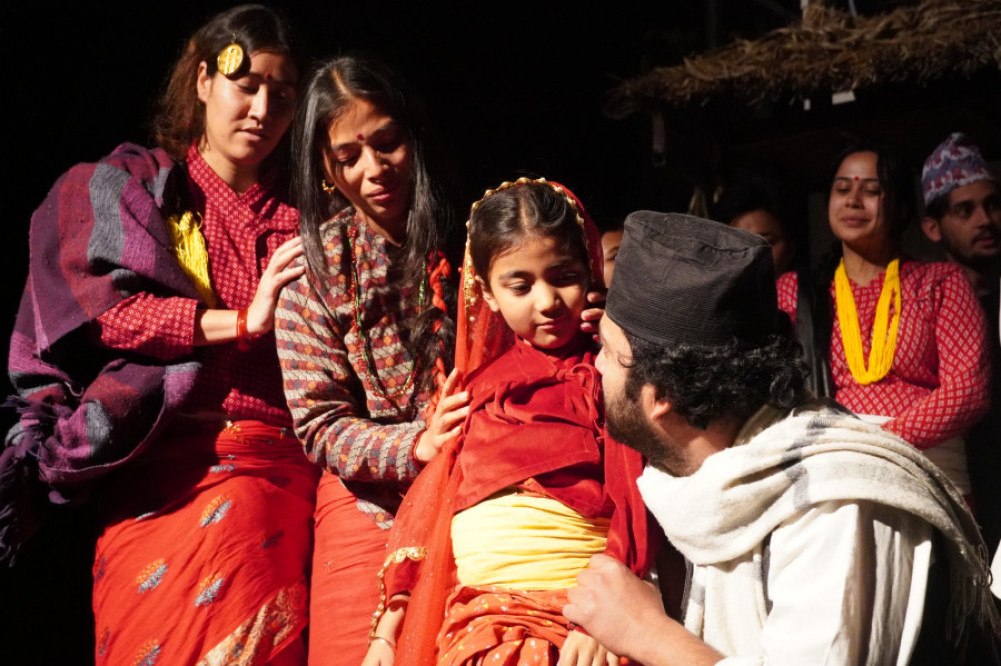
Amar's immortal work 'Seto Dharti' is currently being staged at Kantipur Theater. How does it feel to be a spectator watching a story that you yourself have written? Amar says, 'While watching the play in the theater, I felt like two plays were going on inside me simultaneously.
We use Google Cloud Translation Services. Google requires we provide the following disclaimer relating to use of this service:
This service may contain translations powered by Google. Google disclaims all warranties related to the translations, expressed or implied, including any warranties of accuracy, reliability, and any implied warranties of merchantability, fitness for a particular purpose, and noninfringement.
The characters of the story were standing on the stage. Their eyes and feelings were telling a deep story. The light moving from darkness to light was showing those characters, which the storyteller Amar Neupane had created in words.
Amar's immortal work 'Seto Dharti' is currently being staged at Kantipur Theater. How did he feel while watching the story he had created as an audience? Amar says, 'While watching the play in the theater, I felt that two plays were going on inside me simultaneously. One play was physically happening on the stage of Kantipur Theater, while the other was going on inside my mind while I was writing the novel. I feel like the play written in my mind will probably never be staged.’
In the final scene of the play, when the same character ‘Tara’ was performed by three actors of different ages (7 years old, 16 years old and an old woman) in the same house, that scene touched Amar deeply. ‘When I saw the little Tara in the window and the old Tara at the main door, I felt that this was exactly the Tara I had imagined,’ he says.
How was this play conceived? What did it look like? ‘Seto Dharti’ itself is a work with a great literary heritage. It was not easy to bring such a heavy and profound story to life within the limited confines of the stage. However, this ambitious effort led by director Sundar Dhital not only provided physical presence to the characters of the novel but also succeeded in leaving a deep impression on the audience.
The balance of the two periods
The stage concept of the play has a distinct sweetness. On the left side of the stage is the house of the elderly Tara living in Devghat, while on the right is her childhood home. The play begins with Tara's welcome speech on the banks of Devghat and gradually turns to the reflections of her past, which have shaped her present existence. 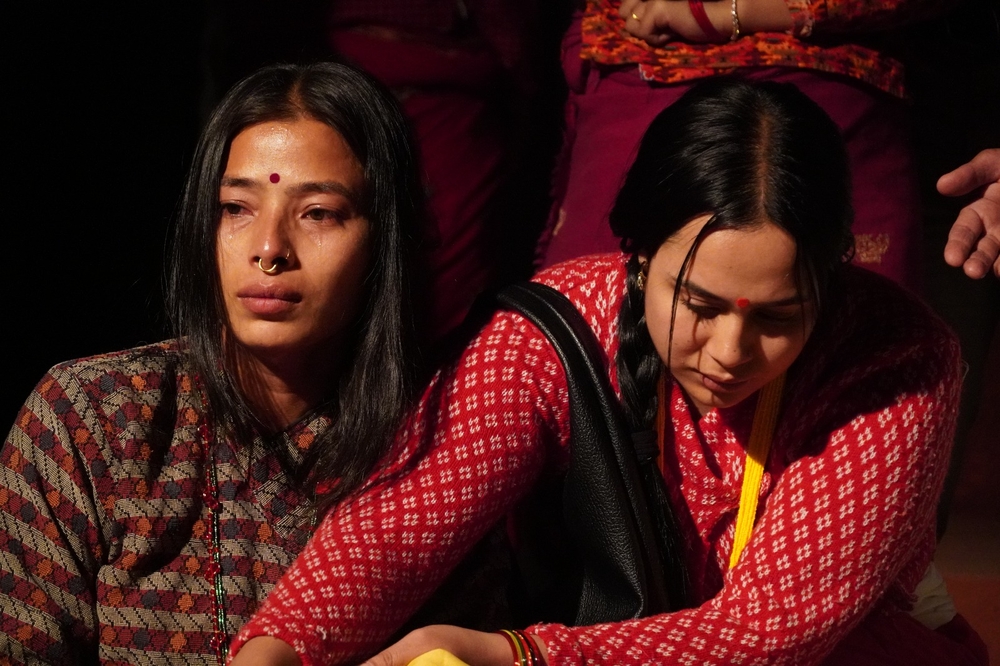
Seven-year-old Tara (played by Benisha Hamal) seems very restless and mischievous. While playing 'wedding game' with her friends, she becomes a bride and her friends play the roles of mother-in-law and nanda. However, when she returns home from the laughter and fun of this game, the play suddenly takes a serious and real turn. A large crowd of relatives and the expectation of the birth surround her at home. She is made to sit in the mandap under the pretext of a normal puja. The confused Tara falls asleep there. When she wakes up, she sees her husband on his deathbed for the first time.
Attempts to stop the past and feelings
The powerful aspect of the play is the clash between the past and the present. Tara, an old woman living in Devghat, tries to wake herself up by screaming on a journey of memory and asks her father to stop this marriage. This failed attempt by a woman who has understood the pain she has suffered to change the fate of the past makes the audience emotional. Some find their own story in it, while others sympathize with Tara's pain. 'I read the novel again and again before making this play. I always had a fear in my mind that I would not be able to do justice to this story,' says director Dhital.
Color and psychology
Colors have great importance in Tara's life. After the death of her husband, her entire life is limited within a circle of white - in mourning for her unknown husband. The director has tried to show the world from Tara's perspective, where colors fade and eventually everything fades into white. 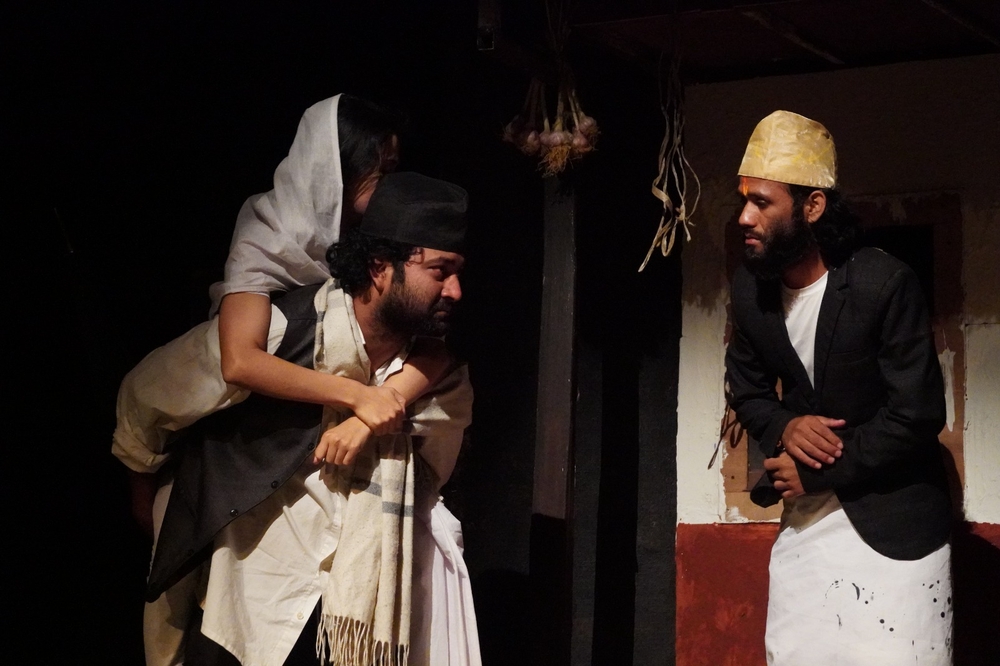
When Tara reaches adolescence and menstruates for the first time, the color red is very alien and disturbing to her. For her psychology, which has been bound by the color white and strict rules for years, the color red does not seem like a joy but a disturbance. In the name of society and culture, she is forbidden to see the sun and meet the male members of the family. This oppression from her own family members makes Tara even more lonely and helpless.
Technical aspects and sound
The emotional impact of the play is further heightened by the dialogue, lighting, costumes and stage decoration. The live music of the 'Pokto' group in particular has brought life to the play. Later, the use of instruments like dhime, madal, damaha, guitar and windchime has made the rhythm and climax of the story more weighty.
In the final scene of the play, three stars (childhood, adolescence, and old age) stand on the same ground. The young and young star is imprisoned inside the window frame, while the old star appears free. The question arises - what is the meaning of this liberation or freedom achieved after a lifetime of oppression and frustration?