According to distributor Prachandaman Shrestha, about 70 percent of films fail due to poor content. The remaining 15 to 20 percent, despite being good, cannot survive due to a lack of coordination between time, society, and circumstances.
We use Google Cloud Translation Services. Google requires we provide the following disclaimer relating to use of this service:
This service may contain translations powered by Google. Google disclaims all warranties related to the translations, expressed or implied, including any warranties of accuracy, reliability, and any implied warranties of merchantability, fitness for a particular purpose, and noninfringement.
Recently, Nepali films are rarely made for less than Rs 10 million. The experience of some producers who are making regular films says, ‘You don’t have to worry about anything less than Rs 20 million.’
The earnings of Nepali films, which are constantly climbing the graph of investment above Rs 10 million, is worrying. According to the box office report of the Film Development Board, the film ‘Hami Teen Bhai’, released in Chaitra, earned only Rs 653,000. Director Dinesh Raut, who is also making regular films, ‘Kumari’, released in Magh, also failed to do business above Rs 662,000. However, according to the production team, the film’s investment was above Rs 30 million when it was released. According to the data released by the Film Development Board from 1 Baisakh to 18 Chaitra 2082, out of the 56 films released this year, 37 films earned less than Rs 10 million.
Once upon a time, the famous face of Nepali film actor Dilip Rayamajhi's 'comeback' film 'Hello Kashiram', released last Jestha, earned only 34 thousand 200. Only 19 films had a business of over 10 million. Out of that, only 4 films earned over 10 million. Those who managed to secure their investment and make a profit.
Director Ashant Sharma kept the actors in shares while making the film 'Taraharu' released last Bhadra. Even if he kept the actors in shares without adding the money of the director and writer, his investment in the film was 10 million. Even when he planned to make the film on a low budget, he had to bear the expenses twice or three times more than he expected. After the huge success of the film 'Purna Bahadur Ko Sarangi', the cost of making Nepali films has increased significantly. Not only the daily wages of technicians and equipment rental, but also the costs of post-production work like editing and sound design have increased. Shooting locations that were previously available for free or generously now have to be paid a hefty fee,' says Ashant.
However, the film only did business for Rs 387,000. For a producer, this result was not less painful. 'This is not just my money. I also earn money from this. Financially, it feels like my back is broken,' says Ashant. He is now in lakhs of rupees in debt. Still, he has not lost heart. 'If it had been anyone else in my place, he would have probably left the film industry and fled, but I am struggling with this,' he adds.
Ashant expresses his sorrow not only for his film, but also for the fact that most films are making losses. 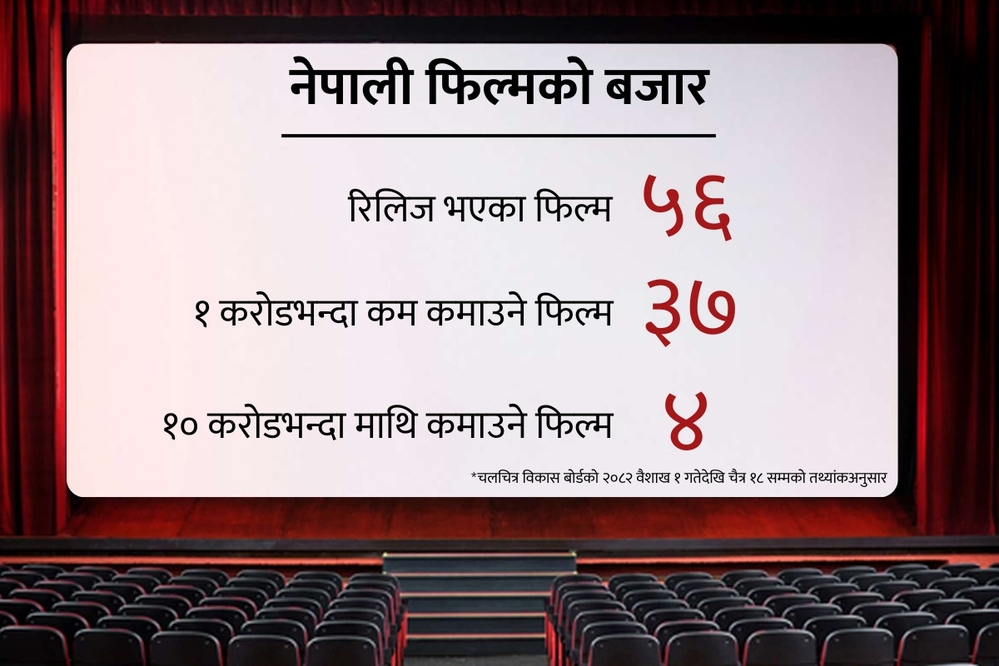
The 2081 blockbuster film 'Purna Bahadur's Sarangi' did business of Rs 48 crore in Nepal alone. However, his new film 'Abhimanyu', released in 2082, did business of only Rs 21 lakh. Whereas, the film was made at a cost of around Rs 1.5 crore. Binod, who shared his experience of making a historical record with the film, is also keen on the loss of Rs 1 crore due to another film. During the release of 'Abhimanyu' in Mangsir, the release date had to be postponed repeatedly due to protests, bandhs and bad weather (floods and landslides). This only increased the marketing expenses. 'Apart from that, the 'filth politics' within the Nepali film industry hurt me a lot. The tendency of distributors and hall operators to give priority to only big films and not show or block small films also affected me,' he says. Nevertheless, he thinks he is not upset. She says, ‘I am not upset, because I believe that even if good content does not run in theaters, viewers will definitely look for it on digital platforms like YouTube and OTT.’ She is currently preparing to release her new film ‘Roll Number One’. According to her, the film has been made with an investment of Rs 20 million.
Samudra Bhatt’s ‘Gunyu Cholo: The Dress’, which won the Best National Film Award at the NIFF, was released last Bhadra. However, the film did only Rs 6.748 million in business. Whereas, Bhatt had already spent about Rs 1.77 crore on the film’s post-production. ‘However, its ‘production value’ cannot be judged by the Nepali investment figure alone. If we look at the collaboration with Oscar-winning international technicians like Marlowe, outsiders consider it a $ 1 million (about 130 million Nepali rupees) project,’ she says. 
She attributes some technical and social reasons to her film not being as commercially successful in the market as she had hoped. ‘First, we had to rush the film to the theatres due to the pressure to release it within the stipulated time frame for the Oscar race, when big commercial films like ‘Chhakka Panja’ were dominating. There is still a misconception in our community – many people think, ‘This is a film only for gender minorities, not for the general public to watch,’ she says. ‘Rather than understanding the depth of the subject matter, the film was limited to a certain group and did not gain wide support from the general audience.’
Meanwhile, Deepak Acharya, the director of ‘Paran’, which is doing the best business this year, is also happy that the film is running. According to Acharya, the cost of ‘Paran’ had reached Rs 40 million by the time it was ready and reached the theatres. The cost of the film was expensive as it was shot in Dharan, east of Kathmandu. The film did business of over Rs 17 crore. Acharya says that along with the content, publicity also played an equal role in the film's good business. 'On top of that, the 'word of mouth' that happens when the audience likes the film really drew the audience to the theater,' he says. 
'Paraan', which was released in Kartik, had very low earnings in the initial days. However, as the production team invested more in publicity during the release, the business graph started to rise. Acharya is currently preparing for a new film. The lesson he learned from 'Paraan' is that there is no rush to go on the floor. 'The more time is spent on pre-production and script, the more the film's budget decreases,' he says.
are only good on average, but some makers also mislead the audience by unnecessarily promoting even crappy films. This is why about 95 percent of the audience distrusts Nepali films. According to The problem of other films not even securing investment is not only this time, but also every year. Why? In the experience of film distributor Govinda Shahi, skimping on promotion is also a problem. ‘The first condition is that the content of the film should be good.’ The second is that the film will reach the audience only if its promotion is good,’ he says. Films that run on
distributor Prachandaman Shrestha, about 70 percent of films fail due to poor content. The remaining 15 to 20 percent of films, although good, cannot run due to the lack of coordination between time, society, and circumstances. Sometimes, he has experience that good films fail commercially due to technical reasons such as competing with big foreign films or famous Nepali sequels at the time of release, not being able to attract the audience due to inconsistent marketing strategies, or having more films than the demand in the market. When he digs into the reasons for the film's failure, he comes to the filmmakers' haste. 'There is a wrong tendency among filmmakers to start making films in 'hurry and desperation' without a solid budget plan. When they go on the floor with a rough estimate that they will come from somewhere or as soon as they have a little money, the film is stopped in the middle and the filmmakers suffer a lot,' he says. 'Because of this, many films do not reach the release stage. Even if they reach it, they cannot attract the audience.'
Film director Ashant's experience is different. There is also an experience that films that did not run are much better than those that did. 'The films that are running are only average, but some makers are misleading the audience by unnecessarily promoting even crappy films. This has led to distrust in Nepali films among about 95 percent of the audience,' he says.
He also believes that they are failing in terms of promotion. He adds, 'Nowadays, the media is very fragmented and due to the algorithms of digital media, it is very difficult to reach every person's device. Even though we make good films, we are not able to reach people's devices.'