Four decades ago, at a time when stories were imported from Bollywood, he not only preserved originality in films, but also sent a message to the entire film industry.
We use Google Cloud Translation Services. Google requires we provide the following disclaimer relating to use of this service:
This service may contain translations powered by Google. Google disclaims all warranties related to the translations, expressed or implied, including any warranties of accuracy, reliability, and any implied warranties of merchantability, fitness for a particular purpose, and noninfringement.
"Making a film is one of the most unique and difficult jobs in the world," says Neer Shah, who is still directing his eighth film.
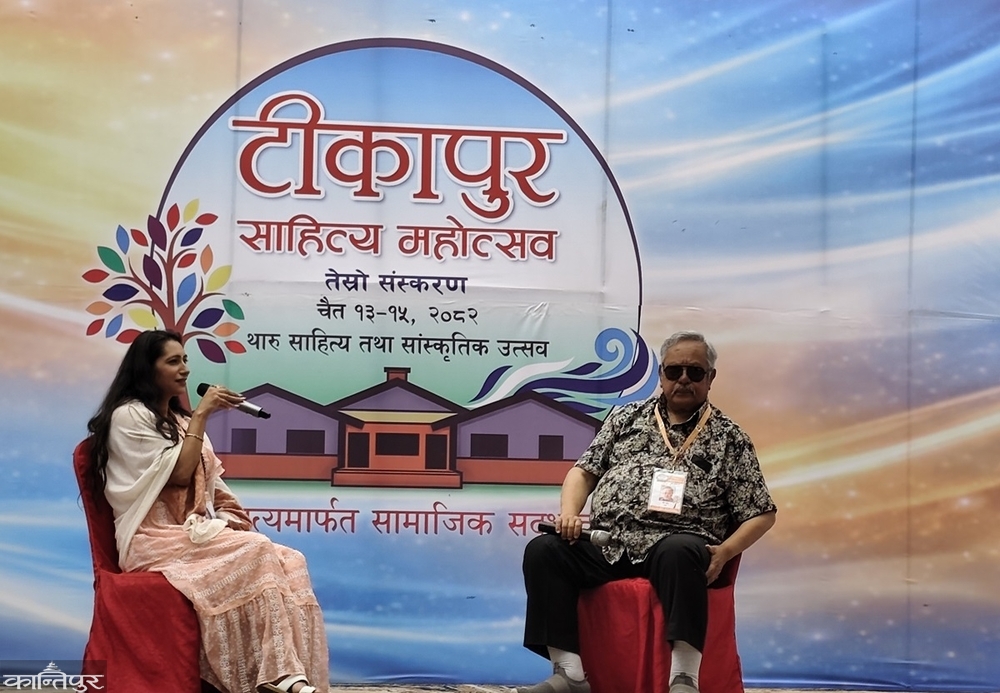
He had reached Tikapur last Friday after taking a few days off from the editing of his new film ‘Kamala Miss’. From the stage of the Tikapur Literature Festival, he had shared his latest directorial experience, saying, ‘I believe that you should not touch a film until you are completely free from mental and work commitments and can think only about it.’
Although he was always seen on screen in different characters, director Shah was somewhere absent after the release of ‘Seto Bagh’ in 2072 BS. ‘Where has director Neer been all these years?’ I had asked him outside the festival stage. He explained politely but in his own style, ‘What do you mean, this specific work requires concentration and complete dedication. I was not able to give that.’ Therefore, when the right time and circumstances arose, I turned to directing again.'
Three years ago, at the book launch of the film 'Paniphoto' directed by actor Khagendra Lamichhane, Shah had made an announcement, 'I want to make a film on the story of Kumar Nagarkoti.' The surreal characters of Nagarkoti had called Shah a unique flight of imagination. He was trying to fit the characters of the writer he loved very much within the scope of the film.
'Kamala Miss' is currently giving shape to his creative deception. Even now, director Shah, who is busy filling the life of cinema with the raw scenes of 'Kamala Miss', is making another innovative experiment in the cinema field.
He is making an experimental attempt to 'blend' Nagarkoti's experimental writing style in the play 'Kohi Kin Raabda Hos' by writer Vijay Malla. Mixing the Nagarkoti style with a realistic story is an interesting and unique effort in itself. He says, ‘This is a psychological and experimental film.’
Dhruva Chandra Gautam also came to watch the shooting. At that time, Shah requested, ‘Darshab. Can I have your coat?’ Dhruva Chandra took off his coat. Neer Shah is a director who always challenges the current trend and carries it. Four decades ago, when stories were imported from Bollywood, he not only preserved originality in films, but also gave a message to the entire film industry. And films like ‘Basanti’, ‘Vasudev’, ‘Rajmati’ are equally worth churning today.
He is one of the Birlakoti directors of Nepal who is ruthless with his own films. He had corrected the mistake during the release of the book ‘Paniphoto’ three years ago. ‘I made Vasudev based on the work. There was dissatisfaction that it was a bit too commercialized. Could it have been made as artistic as possible...’
He also regretted not making Diamond Shumsher’s novel ‘Basanti’ ‘artistic’. He recalled the pain of lengthening Gopal Prasad Rimal’s play ‘Masaan’ and shortening Diamond Shumsher’s ‘Setobagh’. ‘Masaan was stretched and made long. Wherever it was lengthened, it got damaged. I shortened Setobagh as much as possible. That was the biggest mistake of his life. Even when it was shortened, there was no happiness. Even when it was artistic, there was no happiness. Even when it was commercial, there was no happiness,’ he said with self-criticism, ‘That is why making a film is a very difficult task. The most difficult task was done from the easiest place and it went wrong.’
Towards the end of the ‘Nepali Cinemako Paran’ session at the Tikapur Literature Festival, I had asked from the audience, ‘You made a very different effort at a time when Nepali stories were being imported. But why couldn’t you leave that same commercial trend?’
 Around 2039 BS, Shah was making a film based on Dhruva Chandra’s novel ‘Kattel Sarko Chotpatak’. The name was ‘Vasudev.’ Harihar Sharma, who played the role of Professor Vasudev, was not happy with the coat given by the production. The shooting was going on at Durbar Marg. Shah sensed that Harihar was uncomfortable wearing the coat. Writer Dhruva Chandra Gautam had also arrived there wearing a coat to watch the shooting. At that time, Shah urged Dhruva Chandra, ‘Darsab.’ Can I have your coat?' Dhruva Chandra took off his coat. He acted wearing the same coat throughout the shooting. The writer thought that his story would hardly have had the same place as Dhruva Chandra's coat worn by Vasudev throughout the film. When the original story came to the scene, there were fights, songs and the current topics of that time. One day, someone asked Dhruva Chandra, who was feeling hurt by the story, 'Darshab, what is your role in this film?' Dhruva Chandra replied, 'My coat is in this film.' Shah admitted this from the stage of the Tikapur Literary Festival. Instead, he said in a joking tone, 'As long as I have money in this film, it is good. When I ran out of money while making the film. I looked for investors. Investors not only poured money, they also started pouring ideas . Wherever the film has gone bad, when you reach there, you realize that your money has run out .’
Realizing that he could not do justice to the original work, he also made another announcement, ‘That is why I feel that Vasudev’s film should be remade .’
He also remembers the difficult time while making ‘Rajmati’ . ‘The organizing committee at that time refused to consider it a national film, saying that it was made in Nepali language. We are the ones who experienced that ‘Kaalratri’, which made today’s ‘Uzyalo Bihani’ possible,’ says Shah .
He does not only give credit to the actors and directors for reaching this far in the film industry . Instead, he equally praises the passion and dedication of the technicians .
'While watching Paran, I deeply realized one thing - it smells of Nepali soil. The characters there have appeared as living Nepalis and Nepaliness is reflected from every angle and triangle of the film. Perhaps it is because of this Nepaliness and the aroma of Nepali soil that 1.5-2 million respectable viewers liked it,' he said in his analysis. Actress Sobita Shimkhada was asking Shah questions on stage at the festival. Shah's recent film 'Paran' directed by Deepak Acharya, in which he played the lead role, not only won the respect of the audience, but also proved to be excellent at the box office. Shah's acting was praised by many viewers. Shah himself said, 'This film is the climax of my acting journey.' He also shared his experience of watching 'Paran' as a viewer on the program, 'Many people ask me about the success of my latest film Paran and what was the 'Paran' or meaning in it.'
He looks back at the history of Nepal's film industry. Perhaps Shah's career also begins from the opening pages of history. He was born at a time when there was not only a film industry in Nepal, but also a 'T' of television. 'About three years before I was born, DB Pariyarji had made the first Nepali language film 'Harishchandra' in Calcutta, India. However, its entire shooting was done outside Nepal and it was only shown to a limited number of wealthy classes. When my acting journey began, the film industry in Nepal was even younger,' he recalled.
Nepal Television in Nepal was started only in 2041 BS. The person who brought it in also goes to that Shah. His chest swells with pride when he realizes that he has gone from that situation to the present. Today, Nepali cinema is being shown commercially in more than 40 countries around the world. 'Nepali cinema is being shown in theaters in many cities in Europe and states in America,' he claims.
He does not only give credit to the actors and directors for the film industry reaching this far. Rather, he equally praises the passion and dedication of the technicians. 'This industry is not only about the directors and actors.' He says that the light-boys, camera and sound technicians, dubbing and studio technicians, writers and musicians who work in the field of lighting equipment, have a collective contribution,' he says.
Neer Shah started acting in films at the age of 15. His first film was 'Parivartan', directed by director Hira Singh. He completed the shooting at the Soaltee Hotel in one take. That day, the director was impressed and told him, 'Don't give up acting in movies.' He was overjoyed. He returned home with boundless joy. But when he was happy, everyone in the house was sad.
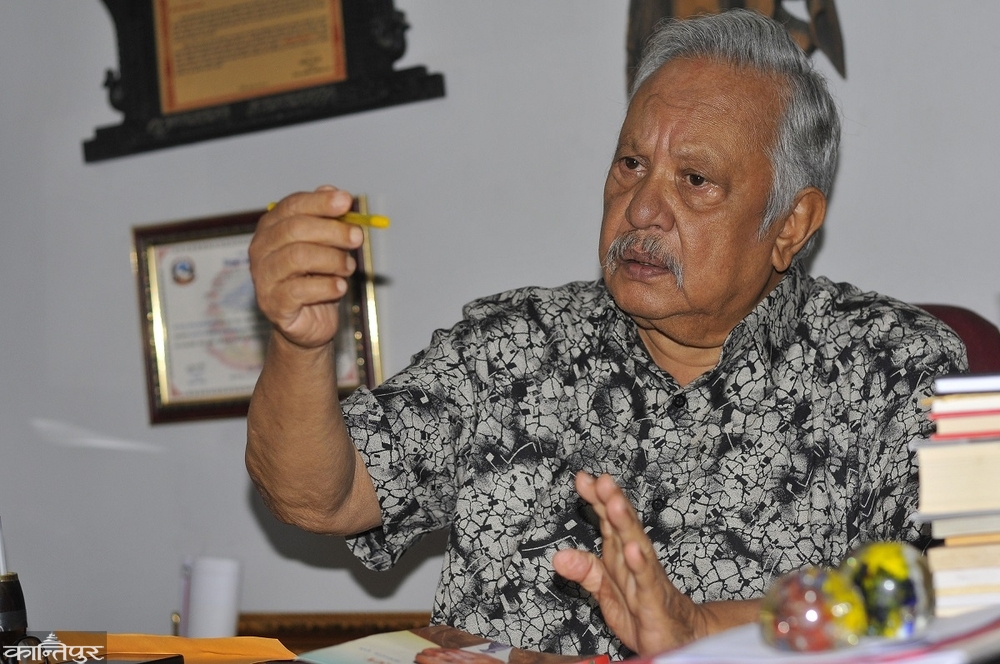
He was studying in the 'Young Diplomats' course of the Ministry of Foreign Affairs. His father wanted him to become a diplomat. Even when everyone was sad, one person was happy. She blessed him by placing her hand on his head, saying, 'Whatever you do in life, you can do it. But do it with sincerity.' After his mother's blessing, Shah took a stand from that day on, 'I will do this work, but I will do it with sincerity.'
He achieved unprecedented success in the film industry during his lifetime. And, now, remembering his mother, who has become a Brahmalin, he proudly says, 'Mother, I have become the Neer Shah of Nepal.' And I am still doing my job with integrity.’
The way Shah lives his life, will his character also live his life? What is the process? He returns to the characters he has traveled.
Nepal’s culture cannot be reached by selling cement bags or noodles to the world. That can only be reached through art.
As soon as he sits down at the makeup table, he slowly enters the character. And when the shooting is over, after wiping off the makeup, he returns to Neer Shah. Sometimes, once you enter the character, it is very difficult to get out. He recalled the time when he played the role of 'Ni:Shabd Shamsher' in Kumar Nagarkoti's play, 'I got scared after 32-33 shows of the play and I requested director Yuvrajji to close the show. I keep fearing what will happen if I cannot get out of the character for the rest of my life.' ‘Acting is not just a profession for me, it is a penance and loyalty. When I play a role, I try to keep myself separate from myself,’ he says of his character in the movie, ‘The more I separate myself from Neer Shah and get closer to him when I play the role of Dharmanath in Paran, the more successful I am.’
In his eyes, there is another life beyond life. Which he considers to be literature and music. 'The life we have lived is life, but the life we have not lived, the life we are living, is literature. The characters of literature live by taking shape in the pen of the writer. Music is even more the heartbeat of life. Cinema is the art that presents both of these in a balanced way,' Shah ponders deeply.
Art is the medium through which Nepali culture reaches and conveys it to the world. How can that be achieved? ‘Nepal’s culture cannot be achieved by selling cement bags or noodles to the world. That can only be achieved through art,’ is his precise answer.
He is constantly annoyed that we have not been able to bring the works of Devkota, Lekhnath Paudyal, Bhupi Sherchan and Sarubhakta to the world. He believes that if we can only achieve that, our stature in the world will increase.
He is not only a skilled reader, viewer and listener of literature, cinema and music. He is also an equally skilled creator in all three areas. Will these creators bring out their books in their lifetime? Writer/editor Bimal Acharya had asked Shah. Neer left a wry sarcasm, ‘The day people who don’t have to write stop writing. And then I will start writing.’

