When does consensual sex between a couple amount to rape? Or why is forced sex without anyone's consent considered rape?
We use Google Cloud Translation Services. Google requires we provide the following disclaimer relating to use of this service:
This service may contain translations powered by Google. Google disclaims all warranties related to the translations, expressed or implied, including any warranties of accuracy, reliability, and any implied warranties of merchantability, fitness for a particular purpose, and noninfringement.
Rape of women. Problems in justice. Patriarchy, police administration and judicial battles.
'Prima Faci' covers such women's issues, making this play powerful in itself. By making the female character who can speak for herself and fight for the rights of others a victim, this play makes us feel the pain of raped women and the problems of the justice system.
This play, written by Suzie Miller, has been translated by advocate Durga Karki. The 'regular show' of this play, which was staged for some time before and after the elections, has already been stopped by Kausi. However, if someone books it, director Akanksha Karki's team will be ready to show 'Prima Faci'. Last Sunday, a similar group staged this play. Actress Pashupati Rai - the only artist in the play was on stage. Like a play, sublime and unique!
This play, which raises the issue of a heinous crime like rape, is truly a strong debate on women's issues, the pain and struggle of victims. Measuring the depth of a sensitive topic, this play closely presents the mental, social, family and legal struggles of a woman who has been sexually abused. The central theme of the play is not how a man reaches the point of rape. However, when does a sexual relationship between two couples that has reached the bed with consent become rape? Or why forced sex without anyone's consent is rape, the very sensitive topic has been left open for debate. The play also aims to show how painful a journey a victim has to go through in the justice system. Standing in the middle between consent and disagreement, this play satirizes - on the society that protects rapists and the justice system. On the patriarchal society.
Prija Yonjan (Pashupati) is a 'defense lawyer' living in the UK. That is, a lawyer who fights on behalf of the defendant. Yonjan, who came from the lower class, is the kind of lawyer who defends herself in a crowd of male-dominated legal professionals, who always advocates for the perpetrator. She never loses a case.
How? In her own words, when she wins a case, she is 'first', when she loses, she is 'second'. Because this is how this profession is, one day - first. The next day - second.
However, they believe in one amazing rule - the taxi line rule. The driver standing at the taxi stand must follow the rules that the driver must accept the request of the customer and take him to the destination. He cannot say no after the customer has said so. The game of litigation is also similar. Whether the defendant is the perpetrator or the victim, the case has to be fought on whose side.
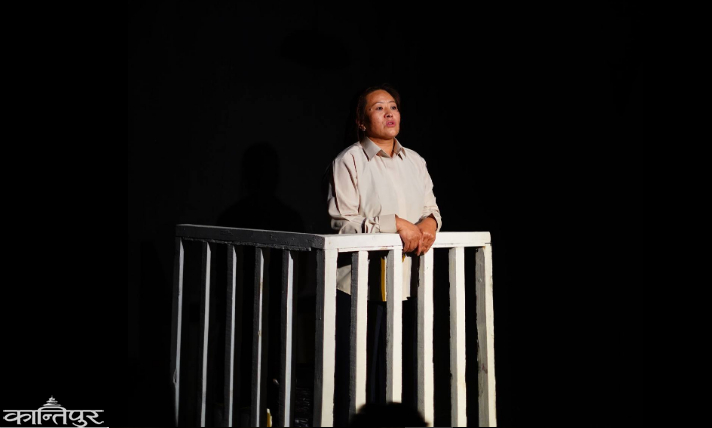
Prija's job is to win the defendant in criminal cases. Most of the time, Prija is defending the defendant in rape, sexual violence, and abuse. Prija, who has been the first to present strong evidence and protect the perpetrator, is raped by her boyfriend Julian (a defense lawyer working in the same chamber). What will Prija do to get justice for herself after being a victim herself? When Prija stands in the courtroom as a victim herself, she finally realizes - the power of the defense lawyer who presents strong evidence and protects the perpetrator! And she understands that in some cases, feelings are more important than visible evidence. Justice is greater than the law.
This play is a strong example of the struggle that victims of heinous crimes like rape and sexual violence have to face in the justice system. We find many examples of women victims who have approached the police for justice feeling unsafe at the courthouse door. For example, Prija approaches the police within hours of being raped. Trembling in fear. With a deranged state of mind. However, there is no female police officer there to listen to her. She confides in the male police officer about the crime committed against her. However, instead of believing her, questions are showered on her. She herself is suspected. In this scene, how does the police not believe the victim's statement, how do they repeatedly ask questions about the same incident to make the victim suffer even more? How insensitive is the police administration in such cases? The play illuminates the structure of the justice system where the victim keeps on becoming more and more victimized by remembering the same incident that haunts them.
Why is family support necessary in such a case? The play also makes us think about this aspect by showing Prija's mother's support. As soon as her daughter talks about the abuse she suffered, Prija's mother trusts her. No questions or suspicions! In Nepal, sometimes even family members are questioning the victim. If someone is talking about sexual violence against them by breaking through society, family and various barriers, what role should we, civil society and family, play in the beginning? Prija's mother is a strong example.
This play, which raises the issue of a heinous crime like rape, is truly a strong debate on women's issues, the pain and struggle of victims. In that sense, it is better not to miss this play.
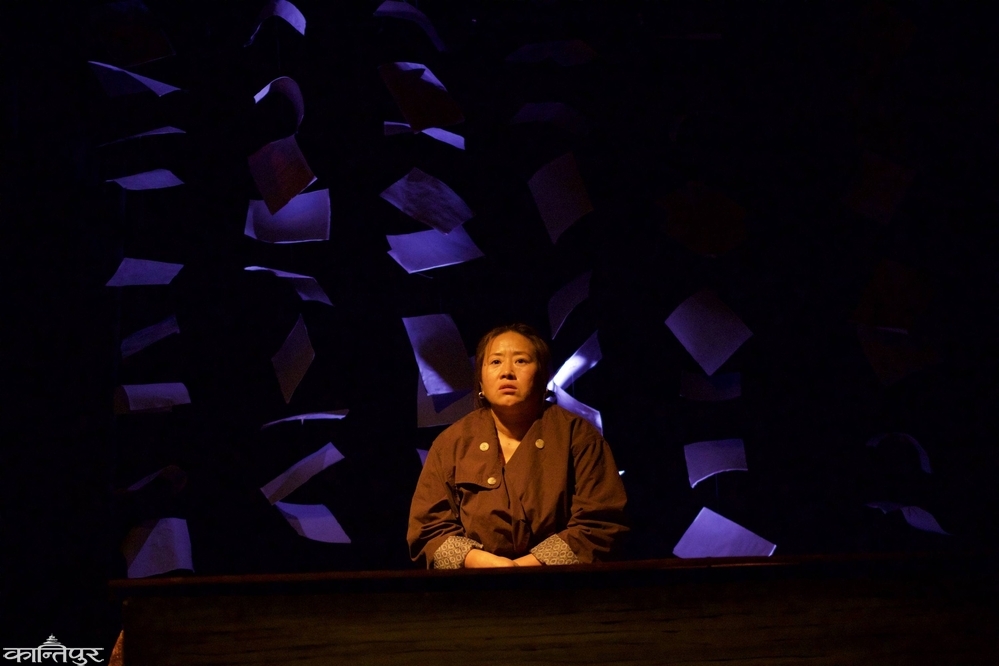
For example, there is a scene of a mother and her on stage. There is also a scene with a lover. She becomes a mother at one moment, sometimes a lover. She becomes a lover at one moment, sometimes a crying lover, sometimes a policeman who is shaking her. Sometimes she advocates as a lawyer for the defendant and sometimes as a plaintiff standing in the courtroom. The way Pashupati brings many actors on stage at once, capturing the different emotions and gestures of the characters that change in seconds, demonstrates her strength and power in acting. Pashupati has brought the dazzling magic of acting to the stage. Instantly changing the voice of a heavy-throated policeman while crying, changing gestures and acting by capturing that mood - Pashupati has brought many such characters to life in the play. Being able to extract this kind of acting from her is also the directorial ability of director Akanksha. Moreover, this play also clarifies why the presence of a female director like Akanksha is necessary for plays on such women's issues that have not been talked about before and have not been brought up for debate. Once again, 'Prima Feci' has proven why women are needed to tell women's stories. The only issue that is touched upon in the Nepali translation of 'Prima Feci' is 'setting'. The play is set in the UK. That is, it is the story of a Nepali woman, but she lives in the UK. Living in the UK, Prija always travels by train to meet her mother. However, if this setting had been linked to Nepal, the audience would have been able to get closer to the character. If Prija had taken a bus instead of a train and reached a village in Nepal to meet her mother, how much closer the play would have brought the audience to the character and her journey. This play is a must-watch to witness the two decades of actress Pashupati's mature acting skills. She is the main link that binds this play for 2 hours. In this play, she has lived many characters alone. She has brought different characters on stage along with the description of long dialogues, time and situation (e.g. where is the character talking to whom) and why is a woman necessary to tell a woman's story.


