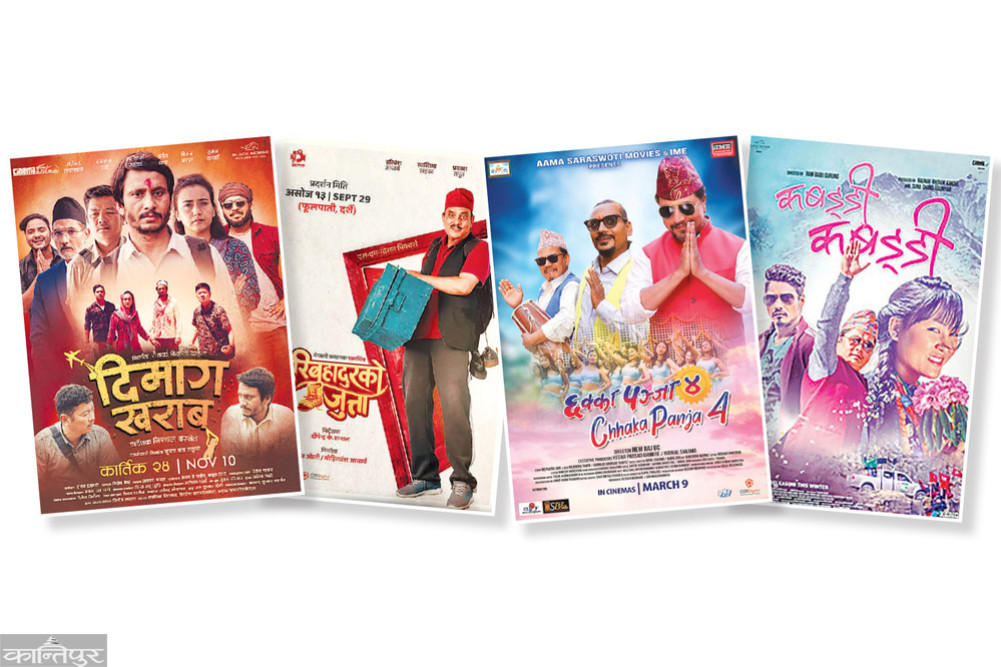
In the nearly six-decade history of Nepali film industry, which has undergone a transition from a panchayat to a republican system, relatively few films have been made on political subjects. A few notable films like Tulsi Ghimire's 'Balidan' are exceptions. But in the last decade, not only politics but also elections have started to feature strongly in the stories of Nepali films.
We use Google Cloud Translation Services. Google requires we provide the following disclaimer relating to use of this service:
This service may contain translations powered by Google. Google disclaims all warranties related to the translations, expressed or implied, including any warranties of accuracy, reliability, and any implied warranties of merchantability, fitness for a particular purpose, and noninfringement.
Recently, three Nepali films were released on YouTube – ‘Senti Virus’, ‘Dimaag Khabar’ and ‘Jharipchiko Indreni’. The main storylines of all three films are political. But apart from ‘Jharipchiko Indreni’, ‘Senti Virus’ and ‘Jharipchiko Indreni’ have one thing in common – election-centric themes. Be it ‘Rajaswati’, ‘Nayak’, ‘Newton’, ‘Sarkar’ in Bollywood or ‘The Ides of March’, ‘All the President’s Men’, ‘The Candidate’, ‘Election’ in Hollywood, election-themed films are popular.
Foreign language political films are being made in abundance. But in the Nepali film industry, which has experienced a republican system since the Panchayat system in its nearly 6-decade history, relatively few films on political topics have been made. A few insignificant films like ‘Balidan’ directed by Tulsi Ghimire are exceptions. But in the last decade, not only politics but also elections have started to feature strongly in the stories of Nepali films. The film ‘Kabaddi Kabaddi’ directed by Ram Babu Gurung, shot in the Mustang region, not only told a love story, but also integrated the election chhakkapanja into it. The number of election-focused films starring actor Dayahang Rai is increasing one after another. Examples are – ‘Kabaddi Kabaddi’, ‘Nango Gaun’, ‘Dimag Kharab’ and ‘Senti Virus’.
Why are political films being made?
The common message given by most of the films is – the fight against wrong trends. Every film has tried to expose wrong practices during elections. Actor and writer Deepak Raj Giri considers it pleasant that such films are being made in recent times. He claims that Nepali filmmakers always ‘follow the trend’ and such films have started being made as a result of that. ‘When we made Chha Maya Chhapakkai, not many political films were made. Later, they started following trends. Political cinema started being made because it was relevant to the time,' he says.
'Ainchopancho' or director Krisha Chaulagain also says that filmmakers project that the film's story will do business if it is in line with the audience's mood. 'The situation in our country is always unstable in terms of the political scenario. People are always angry when there is no right decision in politics. When it is shown in cinema, it becomes relevant to the time. That is why political-centric cinema is made,' says Krisha, 'To make people aware through cinema, election-centric films are also being made.'
Director Rambabu Gurung, who has told the story of elections in films like 'Senti Virus' and 'Kabaddi Kabaddi', emphasizes that politics also affects people like the activities taking place within society. 'Politics affects society and the culture of society. Films are the stories of society. That's why it's natural to come,' he says.
Director Dipendra Kumar Khanal, who directed 'Hari Bahadur's Shoes', assesses that such films have increased in recent times due to the increase in political dissatisfaction among the people. 'Recently, there has been great dissatisfaction among the people regarding politics. Since films highlight the issues of society, that dissatisfaction can also be felt by the filmmaker. Since the collective problems experienced in personal lives have a political tendency, that has also come into the film,' he says.
Film director KP Pathak argues that such films have started being made because showing people's dissatisfaction with political parties in political films and portraying them in a slightly negative light can win the 'sentiment' of the audience. 'This has also become a strong 'commercial element'. Cinema has a big hand in the narrative that 'old leaders are wrong' that has been created in society today,' Pathak says. He says that these films do not emphasize much on how to strengthen or improve the democratic system. 'Instead, the system and everyone who runs the system were presented only in a negative light. By sending the message that ‘everything old is bad, so we need something new’, it also served to arouse discontent towards the system itself,’ Pathak says critically, ‘This commentary created by cinema has also played a big role in the rise and rise of new forces seen now.’
‘Everything old is bad’ became the commentary: KP Pathak
There is currently a lack of diversity in the content in the Nepali film industry and even ‘love story’ films are losing their appeal to the audience. In addition, since the Censor Board has stopped working on very serious and sensitive topics, it has become easier for makers to take politics as an ‘easy’ and ‘effective’ subject. By showing people’s dissatisfaction with political parties in films and portraying them in a slightly negative light, the ‘sentiment’ of the audience can be won, which has also become a strong ‘commercial element’. Cinema has a big hand in the commentary that ‘old leaders are bad’ has been created in society today.
In my opinion, cinema should not only act as a mirror of society, but also as a medium of warning. A creator is a kind of opposition to society. It is also the responsibility of a creator to warn those who run the country and the system and point out their mistakes. In the last few years, filmmakers have started openly expressing their views and criticism on the current political situation. Cinema is such a powerful 'visual' medium that has the power to influence and motivate people through stories on a large canvas.
I had said a few years ago that such films are creating an environment that supports new political forces. However, one aspect is that these films did not emphasize much on how to strengthen the democratic system or where to improve it. Instead, they presented the system and everyone who runs the system only in a negative light. By sending the message that 'everything old is bad, so we need a new one', it also created distaste for the system itself. I think that this commentary created by cinema also plays a big role in the emergence and rise of new forces that are seen now.
00
9 films in the election story
Kabaddi Kabaddi
The film ‘Kabaddi Kabaddi’ is a successful ‘sequel’. The fifth series of ‘Kabaddi’ is currently being prepared for release. The second series ‘Kabaddi Kabaddi’ was focused on love and politics. The story of this film, released on 11 Mangsir 2072, is based on Naurikot in Mustang. The film shows the confrontation between two characters, Birkaji (Dayahang Rai) and Bamkaji (Saugat Malla).
This confrontation is not only to win the love of ‘Maiya’ (Rishma Gurung), but also to gain political dominance in the village and win the election. The film presents the factionalism, manipulation and election propaganda that takes place during elections. Directed by Ram Babu, the film stars Dayahang Rai, Saugat Malla, Rishma Gurung, Vijay Baral, Buddhi Tamang and others.
Chha Maya Chhapakkai
The film ‘Chha Maya Chhapakkai’ is an interesting mix of politics and love. Directed by Dipendra Lama, this film was released on 24 Asoj 2076. Deepak Raj Giri and Keki Adhikari play the lead roles in the film. In the story, they are members of a family who believe in different political parties.
The film satirically shows the social turmoil caused by village politics, water problems and love between people from two opposing political parties.
Senti Virus
The film ‘Senti Virus’, released on 9 Falgun 2076, has recently been released on YouTube. Directed by Ram Babu, this film stars Sitaram Kattel and Kunjana Ghimire in the lead roles. The story of this film is also election-centric. In the film, members of the same family (father and son) are affiliated with different political parties. The film presents the ideological conflict that arises between them during the election in an interesting way.
Chhakka Panja 4
Released on 19 Falgun 2079, this film is directed by Hemraj BC. The story of this film revolves around 'Raja' (Deepakraj Giri). The main character of the film is Raja, a local gangster, who is used by political parties for their own interests. The main story of the film is the wrong trends and rigging of elections. The film is written by Deepakraj himself. Along with Deepakraj, the film also stars Deepashree Niraula, Keki Adhikari, Benisha Hamal, Nirmal Sharma, Kedar Ghimire (Magne Budha), Buddhi Tamang, Rajaram Poudel and others in the lead roles. This film did business of over 20 crores.
Prasad 2
The film ‘Prasad 2’ directed by Sudarshan Thapa, released on 15 Baisakh 2080, also centers around the story of elections along with caste discrimination. The film, written by Sushil Poudel, is a story of struggle between Baburam (Bipin Karki) and Narayani (Keki Adhikari), who got married between castes. This couple, who returned to their village after 12 years from the city, faces the caste discrimination, radical thinking and political manipulations that are prevalent in the society even after the republic and the new constitution. The film stars Bipin Karki, Keki Adhikari, Arpan Thapa and Mahesh Tripathi in the lead roles.
Ainchopanch
This film, released on 14 Bhadra 2080, was directed by Krisha Chaulagain. This is her debut directorial film. How does a common man win over a powerful politician in the election field? The film focuses on this question. The film emphasizes that public opinion becomes stronger with an honest person who fights against wrong tendencies. The film is written by Abhimanyu Nirvi. The film stars Mukun Bhusal, Swastima Khadka and Varsha Raut in the lead roles.
Nango Gaun
Directed by Dipendra Lama, the film 'Nango Gaun' examines the consciousness and political distortions of Nepali society. Released on 29 Bhadra 2080, the film stars Dayahang Rai and Shishir Wangdel in the lead roles. In the film, Dayahang represents an honest teacher and Shishir represents a shrewd political leader who has been in power for years. The story of the film mainly revolves around the elections of a village, where the struggle of an honest person for political change and the tendency of voters to fall for momentary temptations are shown. The film also features strong performances by Miruna Magar, Karma, Samragyee Rajya Lakshmi Shah and Buddhi Tamang.
Dimag Kharab
The film 'Dimag Kharab' directed by Nischal Basnet has recently been released on YouTube. Released on 24 Kartik 2080, this film focuses on how a common man fights against politicians in power and an independent candidate wins. The story of the film revolves around an ordinary citizen Indra (Khagendra Lamichhane). Along with Khagendra, the film also stars Dayahang Rai, Swastima Khadka, Vijay Baral, and Arpan Thapa in the lead roles.
Hari Bahadur's Shoes
The film 'Hari Bahadur's Shoes' directed by Dipendra Kumar Khanal is also an election-themed film. This film was released on 19 Magh 2081. The film focuses on Hari Bahadur and his shoes. This film presents how a shoe affects politics and turns the election atmosphere upside down. This film also contains the story of a common man fighting against power. The film stars Haribansh Acharya, Prakash Saput, Swastima Khadka in the lead roles.