This year's 76th Berlinale became controversial when head of the jury, director Wim Wenders, suggested that filmmakers should stay out of politics. His response to the question, ”What role can film play in the current political climate?”, led to the Berlinale focusing on political debates rather than awards.
We use Google Cloud Translation Services. Google requires we provide the following disclaimer relating to use of this service:
This service may contain translations powered by Google. Google disclaims all warranties related to the translations, expressed or implied, including any warranties of accuracy, reliability, and any implied warranties of merchantability, fitness for a particular purpose, and noninfringement.
'When people ask, "What happened?" Tell them, Palestine will remember everything. We will remember all those who stood with us. We will also remember those who stood against us, who stood against our rights and dignity. We will also remember those who chose to remain silent.'
This is the statement made by director Abdullah Al-Khatib after his film "Chronicles from the Siege" won the 'Best First Feature Award' at the world-renowned Berlin International Film Festival (Berlinale).
He is a Palestinian refugee living in Germany. Stating that the German government is a partner in the massacre committed by Israel in Gaza, Al-Khatib stated that Palestine should be free. He also envisioned a day when Palestine would be free, which should be a festival that stands for freedom rather than beauty.
‘One day Palestine will be free . And we will see a big festival held in Gaza or we will see festivals in other cities in Palestine . And our festival will stand in favor of the unity of people who are living under siege, living under dictatorship,’ Al-Khatib said, ‘We will talk about politics before cinema. We will talk about resistance before art. We will talk about freedom before beauty. We will talk about humanity before culture.’
Not only Al-Khatib, but most of the winners at the festival expressed political views in favor of Palestine . This year’s 76th Berlinale became controversial when head of the jury Wim Wenders expressed the opinion that filmmakers should stay out of politics . In response to the question, ‘What role can film play in the current political climate?’ Wim’s opinion made this year’s Berlinale political .
Trisha Tuttle, artistic director of the Berlinale, said that while people came to the Berlinale this year with great sadness and anger, they did not ignore those voices. ‘Many people came to the Berlinale with great sadness, anger and deep concern about the world we live in now. All of this was experienced not only outside the walls of the film theater, but also inside. These feelings are very real and they are part of our community. We hear your voice,’ Trisha said before the awards ceremony began. She said that raising her voice and criticizing is part of democracy, and Trisha honored the speakers from the stage.
‘This year we are being challenged publicly, which is a good thing. It may not always feel good, but it's good, because it shows that Berlina matters to people,' said Trisha. 'We live in polarized times and I think we all need to accept this reality and embrace the community we've built together. Because criticizing and speaking up is part of democracy. That's what dissent is. Sometimes it takes a lot of courage to speak up.'
Marie-Rosa Osta, who won the Golden Bear for best short film, said there is no superpower that can protect Palestinian and Lebanese children from Israeli bombs. 'I'm torn between two things right now. The filmmaker in me is happy to have this beautiful beer that will change my future. The other is the humanity in me. I made a film about a child who has superpowers. But that was a movie,' she said, who won the award for the film 'Someday is a Child', 'In real life, the children of Gaza, all Palestinians and the children of my country Lebanon do not have such superpowers that can protect them from Israeli bombs.'
The slogan 'Free Palestine' also echoed from time to time at the closing gala. Host Desiree Knoxbusch had to address them and say, 'We heard you.' On stage, Desiree mocked the head of the international jury, Wim Wenders, saying, '10 days ago, you came to Berlin for a holiday, you said you would watch films for 10 days. But, this holiday did not go as you expected?'
'It did not go as you expected. First of all, everything changed. The weather was so windy on the first day,' Wim said, looking at Desiree.
Before Wim could finish, Desiree added, 'Sometimes when the weather is bad, there is a possibility of slipping.
Why did Desiree use the word slipping here? Everyone present at the Palast easily understood.
Wim shared his thoughts with the Palast audience, borrowing the words of Tilda Swinton, who won the Golden Honor Award in 2025, saying that being on someone's side does not mean being against someone else.
'A film can resist more than being forgotten, and it can certainly last longer than the short attention span of the internet,' Wim said. 'Tilda Swinton made a beautiful point in her brilliant speech when she received the Golden Bear last year - being on someone's side does not mean being against someone else.'
When Wim spoke, when another winner spoke, when someone else spoke, Palast would remain silent. When Nina Rosa spoke, Palast also fell silent. 'The film tells the story of those who were driven from their homes. We must stand up for people who are at risk. All voices are important. Let's fulfill our political duty to care for each other,' Nina said.
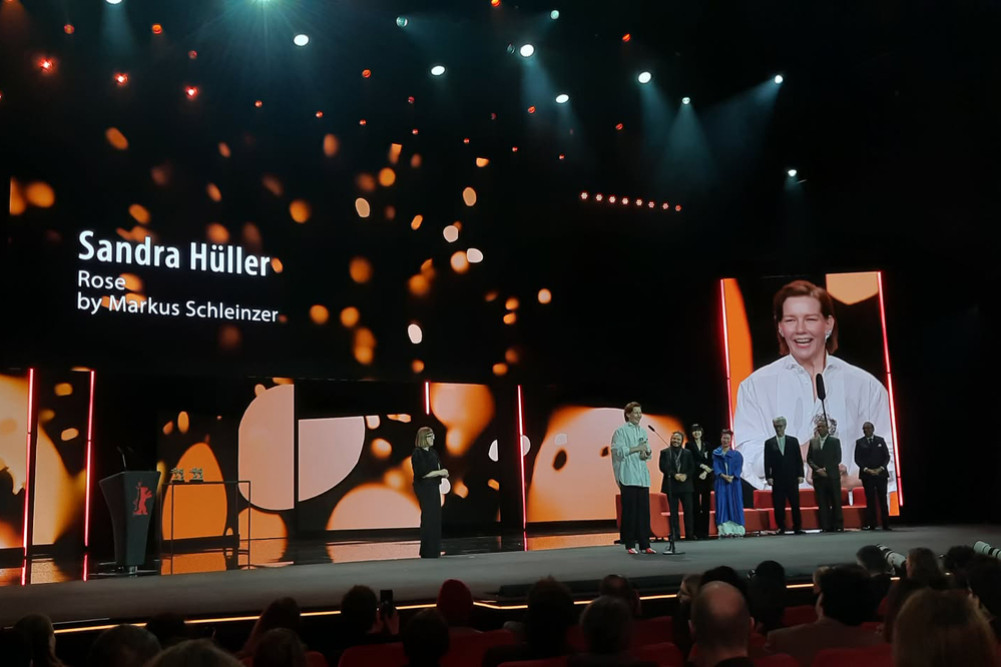
At the event, some winners left the stage without meeting the international jury and receiving their awards. In particular, Sandra Hiller almost walked away without looking at the jury. But, later, she went to meet Wim. However, after receiving the award, Sandra said, 'I was listening to everyone now. And, I think what you are saying is true.' And I am in a room where everyone can speak the truth, thank you.'
Emin Alper, who won the Silver Bear for Kurtulus (Salvation), also spoke out in favor of Gaza. 'When you lose your rights day by day. When you take a pill bought with your own taxes. When you are bombed without realizing that you are a human being, you become alone. When you realize that no one cares about you, you become the only person in the world,' Emin said. 'If there is anything we can do here now, it is to break the silence and tell them that you are not alone. Palestinians in Gaza, no matter how difficult the situation is, you are not alone.'
After Emin finished speaking, there was a long applause in the palace. Some at the event also openly praised the head of the jury, Wim. Director Ilkar Katak, who won the Golden Bear for Best Film for 'Yellow Letters', said it was special to receive the award from Wim's hands. He said, 'Wim, you are one of my teachers. It is special for me to receive this award from your hands.'