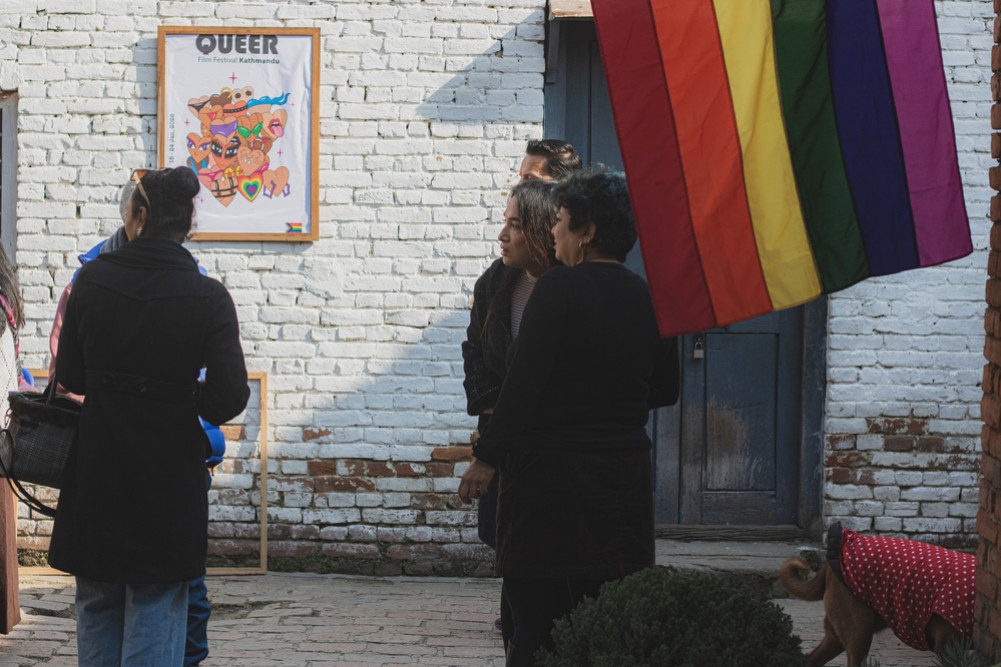
The Queer Film Festival has emerged as a powerful force to debate issues that are taboo, suppressed, and normalized in society.
We use Google Cloud Translation Services. Google requires we provide the following disclaimer relating to use of this service:
This service may contain translations powered by Google. Google disclaims all warranties related to the translations, expressed or implied, including any warranties of accuracy, reliability, and any implied warranties of merchantability, fitness for a particular purpose, and noninfringement.
A quiet place amidst the noise of Kathmandu. A small hall that can accommodate 40 spectators. But, a large courtyard. It seems to stand in this courtyard, Airawat Picture House. Here, a colorful flag is hung. On the side wall, there are film posters. And on a large banner, it is written, 'Queer Film Festival Kathmandu'.
A different festival is being held at the 'Airawat Picture House' in Thapathali, Kathmandu since Magh 1. This is a festival with a very different taste and style from the crowd of other festivals in the city. Neither much pomp nor much fuss is seen in it! This festival, which is being organized in a quiet style, has been proving itself different through films and discussions. According to Kshitij Adhiraj, co-director of the
festival, the 'Queer Film Festival' Kathmandu started in 2024. Although this festival was also started in 2023. However, this festival was launched under the 'Something Like a Film Festival' organized under Docskul. Docskul has been starting the 'Something Like a Film Festival' with the aim of promoting the films and content of young filmmakers and providing a platform.
However, from 2024, Kshitij's group realized the need for this festival and started it as a separate festival. Its purpose also seems to be similar to Docskul. Docskul was established in 2008 as a 'screening room' for filmmakers.
Since then, Docskul has been showing films on sexuality and female representation. It has also been promoting films that raise such issues. As a continuation of that, 'Something Like a Film Festival' was started in 2011. But at that time, some people opposed Docskul, saying that it 'showed a loose film'. After receiving such a response from the audience who came to watch the film, Kshitij's group did not continue the festival. In fact, Docskul does not organize a festival only for film screenings. He wanted to establish the festival as a place for discussion and interaction on issues related to society. 'Some films became incomprehensible to the audience. We stopped the festival for a while after they gave us bad feedback,' said Kshitij.
In 2023, DocsSchool organized a program bringing together filmmakers and queer activists. At that time, a film was screened among the participants. And from the discussion of that program, the 'Queer Film Festival' was born. There are still many issues that are not included in film debates, and some voices are never included. 'Queer Film Festival' is also a representation of those unheard voices. Many may think that the title of the festival is a program to show films from gender and sexual minority communities. However, according to Kshitij, the festival not only raises the voice of that community but also that films 'should not be just one type'. The festival has also been raising the question that films should not be one-sided, that films should be diverse. 'This festival celebrates the identities of gender and sexual minority communities. It also debates their issues. It also says that films should not be the same,' said Kshitij, 'Other festivals may have their own impact. But, our festival also covers issues that are not covered.'
'Queer Film Festival' has emerged as a powerful force to debate issues that are taboo, suppressed and normalized in society. The active participation of queer groups including the Blue Diamond Society, Queer Youth Group, Trans Man Collective is visible in this festival. These groups have also experienced belonging in this festival. And, Kshitij sees this as a strong achievement of the festival. 'We consider our presence at this festival necessary to support Nepal's queer identity campaign and to add diversity to the established narrative of Nepali film,' said Kshitij.
By the second edition, more than 170 films have been screened at the festival this year. Out of 800 films received from around the world, 170 films have been selected and screened. Four Nepali films are also being screened at the festival. In particular, queer does not believe in patriarchy and gender structures. Few films are made with such faith. However, this time, surprisingly, a lot of films have come to participate in the 'Queer Film Festival'. The films 'The Silent Slow' and 'Sabnam' are being screened on the Nepali film side. Four Nepali film festivals, including two others on Nepali themes involving foreign filmmakers, are being screened. The festival, which will be held until Magh 10, has 22 features and short films. Kshitij says that there are plans to start a lab and workshop at the festival from next year. This time, the festival is holding a discussion on the new censorship procedures introduced by the Censor Board, from the 'Queer Film Appreciation Course'. The 'Queer Film Appreciation Course' has been completed. According to Jyotsna Maske, co-director of the
festival, 'Movie That Matter' has also helped to run the festival. However, Maske says that the support of this festival in the Netherlands is not enough. 'It is difficult to find funding for such a festival. Another thing is that our Queer Film Festival is different, that is why it is difficult to raise money,' Jyotsna said, 'There are other festivals in Nepal, compared to which we do not receive support from the government. That is why we are also organizing this festival with our own personal investment.'
According to Jyotsana, because the festival is a bit different, some people do not extend a helping hand as soon as they hear the name. 'There are also those who say, 'We will buy tickets but we will not come to watch the film,'' she said. Maskey says that despite this struggle with lack of funds, they have been organizing the festival with a community focus and working within the community. The festival has planned to reach 2,000 viewers in 10 days.