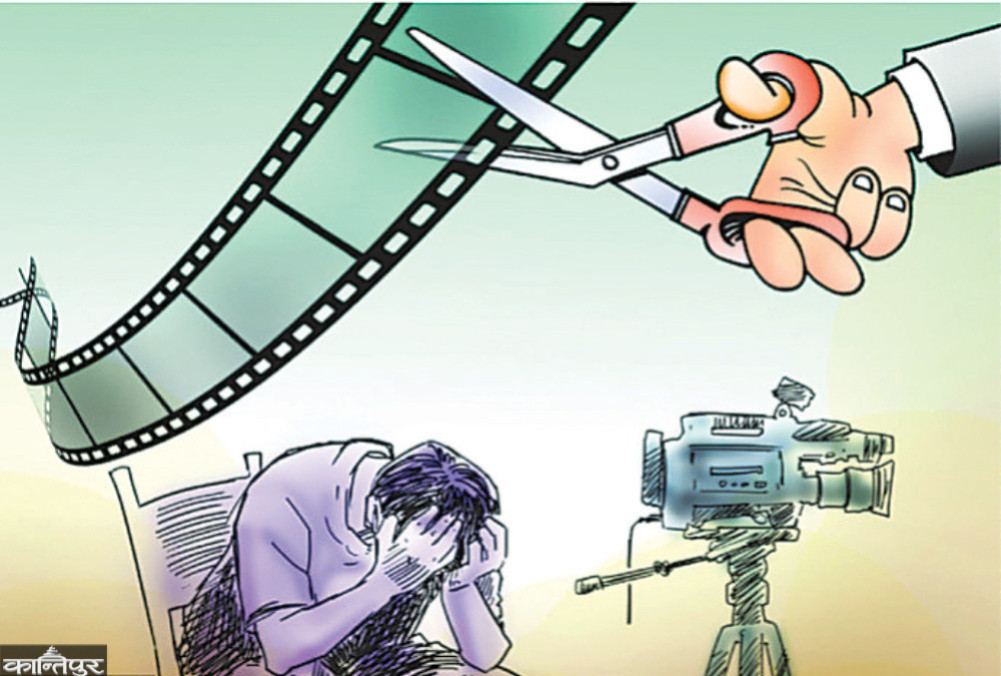
Minister for Communications Jagdish Kharel said that 50 percent of the dissatisfaction of filmmakers regarding the working procedures related to the Censor Board has been addressed and the rest remains unchanged due to legal constraints.
We use Google Cloud Translation Services. Google requires we provide the following disclaimer relating to use of this service:
This service may contain translations powered by Google. Google disclaims all warranties related to the translations, expressed or implied, including any warranties of accuracy, reliability, and any implied warranties of merchantability, fitness for a particular purpose, and noninfringement.
The 'Film Censorship Procedures, 2082', which was brought into effect from December 2, is set to be amended. The Ministry of Communications and Information Technology has changed the procedure after nine film-related organizations, who questioned the procedure as being control-oriented, demanded an amendment.
Minister for Communications Jagdish Kharel said that 50 percent of the issues that filmmakers expressed dissatisfaction with have been amended in the working procedure. 'In the context of the Censor Board, there were 20 issues earlier. We have reduced that issue to 10. This means that 100 percent of the issues were yesterday, but now we have reduced it to 50 percent,' Kharel said, 'The remaining 50 percent of the issues that filmmakers have felt. Since all of that is in the act, the Council of Ministers and the minister could not go against it.'
Minister Kharel had meanwhile gathered the employees of the ministry and filmmakers in one place and discussed the working procedure. The minister claims that the amendment was finalized after this discussion and that the filmmakers are happy with it. 'Meanwhile, the filmmakers have expressed dissatisfaction that some of the rules are still not suitable. Again, we have put in the working procedure the issues that are favorable to them by holding discussions on each section with the filmmakers and the ministry team. Filmmakers are now 100% happy with the censorship procedure,' said Minister Kharel.
Director Pandit says that although some issues of the act remain unchanged, they have agreed to the decision to amend it, including issues that cover the main problems of filmmakers. 'Since this procedure has to be made within the 2026 BS Act, we have adopted a middle path in order to address some of the issues determined by the act and cover our current problems today,' said Pandit.
In particular, the Film Bill also includes a policy that the Censor Board can ban the editing and even the screening of films. However, Pandit says that they have demanded that films be classified and the ministry is ready to amend it. According to Pandit, filmmakers had previously demanded that films be 'classified'. Filmmakers have been raising the voice that instead of editing any scene or dialogue of the film, the certificate should be given based on the genre and structure. While adopting a middle path, it seems that some related issues will be cut and paste for classification.
For example, the Censor Board has been giving four types of certificates to films based on different themes. Universal (U) for all age groups, Adult (A) for those above 16 years of age, and Parental Guidance (PG) certificates for films that can be watched with parents under 16 years of age. To get the certificate, the filmmakers had to make mandatory cuts on the topics directed by the Censor Board. However, now the amendment has been made with a provision to classify films except for certain topics, said Rajesh Thapa, head of the Ministry's Legal Branch.
According to him, the board can make changes on issues such as sensitivity to the nation, nationality, geographical integrity, religion, and culture. Other films will be given certificates based on their content. 'We will make changes on some sensitive issues related to the nation, nationality, geographical integrity. We will classify the rest,' he said, 'We have prepared a draft of the procedure to make it easier than before.' According to Thapa, who is also the member secretary of the Film Development Board, a draft of the amendment to the procedure has been prepared. He said that the approval process will proceed after 'briefing' the minister tomorrow. Director Pandit adds that the revised procedure aims to regulate rather than control the creators. 'The procedure is specifically geared towards classification, but the 2026 Act says to make changes. How can changes be made without affecting the value of classification?' We have agreed on the issue. It regulates rather than controls the creator's right to create,' Pandit said. In a conversation with Kantipur, Minister of Communications Kharel said that they will change the word 'censor' in the bill. 'We will now call the Censor Board 'certification' in the Film Bill. We will not use the word 'censor', we will replace it with certification. Through the act to be made, we are making the 'Censor Board' more flexible, more relaxed, more easy and more filmmaker-friendly than the current bill,' he said.
Thapa, head of the Ministry's legal department, says that this issue cannot be changed in the working procedure right now. 'Since the act itself mentions a film review committee, a 'certification committee' cannot be formed in the working procedure right now. "We, on behalf of the ministry, have now proposed that we should call it certification in the bill," he said. Minister of Communications Kharel has said that the 'Janchpass Committee' will include representatives from the film industry, from good writers, directors, artists to technicians and film journalism.