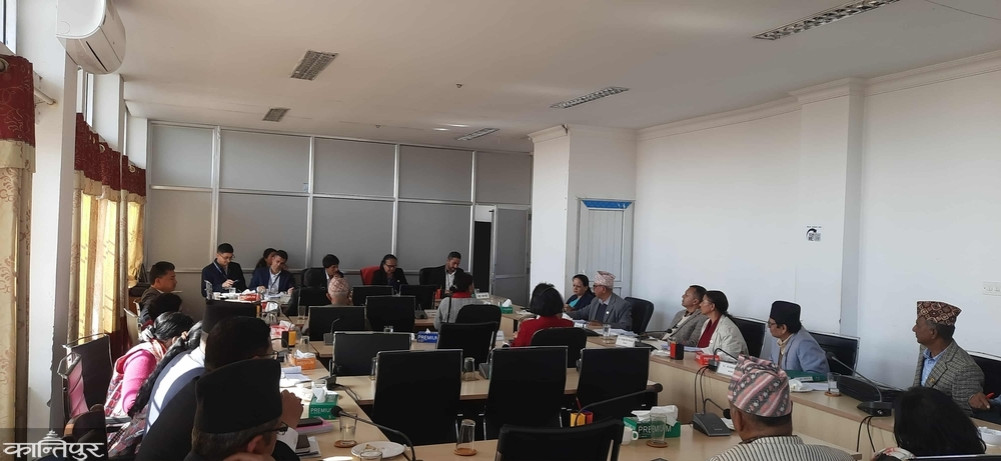
Lawmakers have pointed out the need for in-depth discussion, comprehensive amendments, and improvements to the bill to ensure the development, inclusion, and independence of the film industry.
We use Google Cloud Translation Services. Google requires we provide the following disclaimer relating to use of this service:
This service may contain translations powered by Google. Google disclaims all warranties related to the translations, expressed or implied, including any warranties of accuracy, reliability, and any implied warranties of merchantability, fitness for a particular purpose, and noninfringement.
The issue of amending the 'Film Bill 2081' has been raised in the Legislative Management Committee. In a principled discussion held between the government and MPs on Wednesday, the issue of the need for amendments to many issues related to films, from the censor board to the development board, was raised.
Minister for Communications and Information Technology Jagadish Kharel said that the bill was not even 10 percent timely, and most of the lawmakers present in the meeting raised the issue of amending the bill.
Beduram Bhusal said that the amendment was necessary because the purpose for which the bill was brought would not be fulfilled. 'Theoretically, this bill is not sufficient to fulfill the purpose for which it was brought,' he said, 'so how can it be amended?' There are 199 amendments in the 53-section bill.' Rajendra Lakshmi Gaire believed that there should have been in-depth discussions and expertise in the relevant subject for the amendment. 'The amendments that we have brought here should be focused on whether the same words are also compatible,' she said.
Madan Kumari Shah believed that they should make the necessary policies to develop the film sector as an industry. 'Whether it is film or tourism, we want to develop every sector as an industry. Therefore, while making policies, we should take the bill forward by keeping in mind how we can develop it as an industry,' she said. Shah is of the opinion that the current bill should be enriched by discussing clause-by-clause issues as it does not address the issues of technology, development and industry. Krishna Bahadur Rokaya said that this bill was brought to make the Film Act enacted in 2026 BS relevant to the times. Rokaya argued that the current bill did not address the issues of indigenous, national and various mother tongue films. Another MP Suresh Kumar Ale Magar said that even though the law is status quo, the film sector has already developed as an industry. He presented the argument that Nepal should be developed as a filming location. 'Our country's territory should be developed as a location for filming foreign films. Nepal's film industry is worth 40 million. However, we can use the beauty of Nepal for filming. This bill does not follow the federal model of the
bill, Taraman Swar sees a need for revision. He also raised the demand of filmmakers to take the film sector to the Ministry of Culture, not the Ministry of Communications, in the discussion. 'The Minister said that the bill is not even 10 percent progressive. A door has opened to change it, to make it progressive,' Swar said, 'Another issue that needs to be raised in principle is - under which ministry should this film sector be placed? Looking at the world's practice, it seems that it is placed under the Ministry of Communications, and it is also placed under the Ministry of Tourism and Culture. The debate in our country is that it should be placed under the Ministry of Tourism and Culture. We should be clear about this. It is important to be clear about whether the film bill will be regulatory or controlling. There is also talk of checking, pass/fail here. The ministry has full control. Therefore, we should discuss this issue and move forward,' he said.
Minister Kharel said that film should be kept under the Ministry of Communications. Since film involves issues from audiovisual to technology to production, Kharel argues that it should be kept under communication, not culture.
Another MP Maya Prasad Sharma said that the bill would be progressive if it was amended by not only 10 percent but 90 percent. He said that since this bill covers the social, cultural and entertainment sectors, it should also be strengthened in terms of inclusion. Shri Krishna Prasad Adhikari said that a theoretical solution should be found to balance the imbalance between freedom of expression and state regulation. Adhikari believes that the bill should be amended as it is related to film, culture and tourism and needs to be modernized and promoted towards industry. 'We have also put a lot of issues that need to be amended in this bill. How to make it relevant and modern today? It is related to making laws while fulfilling today's needs,' he said.
MP Nar Bahadur Bista argued that the film sector should be independent but the bill does not provide that freedom. 'Discretion should be used in films, but it is not allowed in the bill,' Nar Bahadur said. Since it is difficult to shoot foreign films in Nepal, he sees a need to work hard to bring a law that should be mentioned in the bill to make it easier. 'Film is beneficial in terms of tourism. That is why we need to amend this law,' Nar Bahadur said.
Jhakku Prasad Subedi said that the film sector should be developed as an industry by making the Film Development Board independent. 'The point of 2026 BS has been moved a lot in this bill. But today there is democracy, there is a republic. The preamble says that the film sector will be regulated, but in Chapter 4 there is a matter of the Film Censorship Committee. There is a matter of all the panchayats,' said Subedi, 'Swedashi, before screening foreign films, the film has to be drafted by that committee. In the panchayat, everything could be done with the permission of the government. What is the difference between that 2026 law and the current law? Let us make the current law 100 percent progressive.' Renu Chand also expressed the view that the Film Development Board should be kept independent to develop the film sector as an industry. Similarly, Padam Bahadur Pariyar said that since the Film Censor Board uses a lot of scissors on films, a law should be made with a system for certifying them. Minister Kharel says that the
bill should facilitate the film sector rather than rules and controls. 'It is never control, it is regulation. It is more than that, it is facilitation. The state is always a facilitator,' Minister Kharel said, 'The film sector is a very creative sector and one should not use scissors in it from the beginning. That is why amendments are necessary in this regard,' he said.