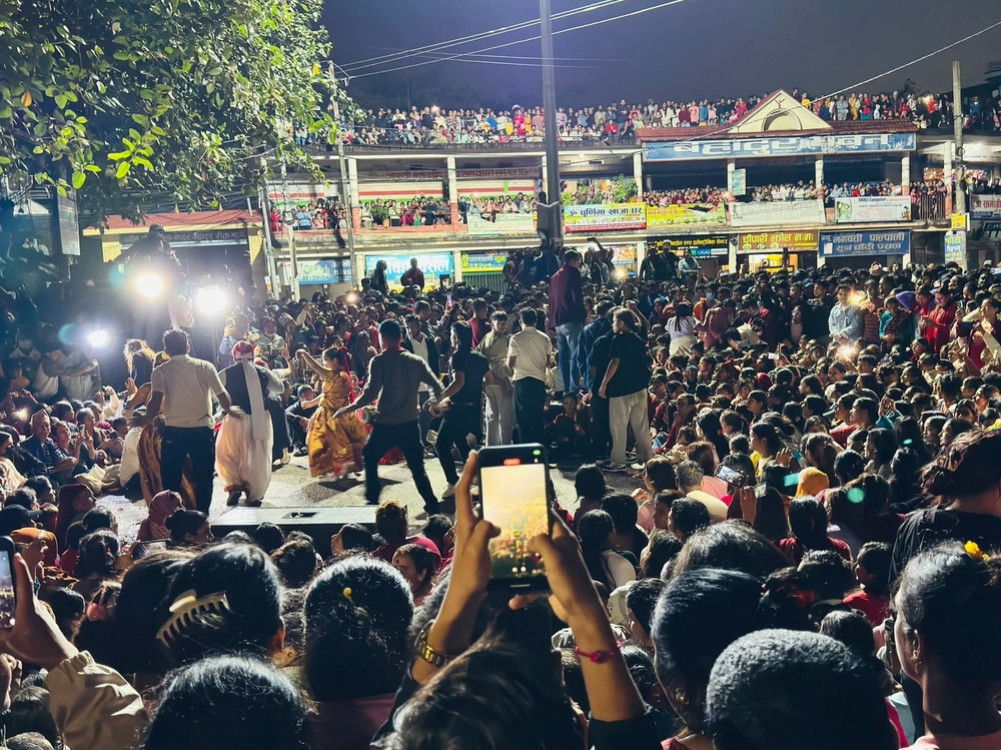
Resham Babu Khanal, coordinator of the Bhailo program, said that he spent three weeks teaching the members how to sing, play musical instruments, and dance. He said that after the artists became proficient, they traveled to various places with the Bhailo program.
We use Google Cloud Translation Services. Google requires we provide the following disclaimer relating to use of this service:
This service may contain translations powered by Google. Google disclaims all warranties related to the translations, expressed or implied, including any warranties of accuracy, reliability, and any implied warranties of merchantability, fitness for a particular purpose, and noninfringement.
Artists from Arghakhanchi Hanspur Sampark Samaj Rupandehi were scheduled to perform Bhailo at the Chautari in Devinagar, Butwal-11, on the evening of Ekadashi, 6 pm. Before the artists arrived, the audience in Devinagar Chautari and the surrounding area had already filled up.
After the squares, roads and surrounding empty spaces were filled, spectators climbed onto the roofs of local Naveen Industrial Secondary School and houses to watch the Bhailo. The artists had a hard time breaking through the crowd of spectators and reaching the field set aside for playing Bhailo.
According to locals, more than 10,000 people were present that day to watch the traditional Deusi/Bhailo. Even before the performance there, the Bhailo of Arghakhanchi Hanspur-Rupandehi Sampark Samaj had gone viral on social media. Not only in the district, but the viral Bhailo of Butwal was being talked about across the country. That is why the public had reserved their vehicles to watch the Bhailo of Devinagar.
Not only in Devinagar, this time it seemed that people were looking for information about where the artists of Sampark Samaj would play Bhailo during Tihar. The artists had chosen the main squares of the villages and cities to present their art rather than the houses of the people. Even though the program was Bhailo, their performance seemed like a play on stage.
Bhailo program coordinator and vice-president of the society Reshambabu Khanal said that they spent three weeks teaching the members how to dance, play the rhythm of the instrument, and dance. He said that after the artists became proficient, they went to various places with the Bhailo program. The society started organizing the Deusi Bhailo program last year with the aim of preserving culture. ‘We did not perform Deusi with the aim of earning money,’ he said, ‘We performed Deusi with songs and dances that reflect our culture, the identity of Arghakhanchi, and Nepaliness.’
He said that although it was not easy to gather artists and teach them dance and manage them day and night to make the program successful, they joined the campaign with the idea of passing on culture to future generations. He said that 11 artists were deployed for dance and instrumental performances. The artists became popular because they danced to the rhythm of Madlu in traditional costumes. Khanal said that every member of the society played a role in making the management process easier. He said that he was even happier to see his Bhailo go viral on social media this year. ‘In addition to reserving vehicles to see us in person, Nepalis from all over the world gave us even more encouragement after seeing our Bhailo on social media,’ he said. ‘This has given us the courage to work for the preservation of culture. Next year, we will celebrate Deusi in a different way.’
The Deusi Bhailo program organized at Devinagar Chowk on Kartik 15. 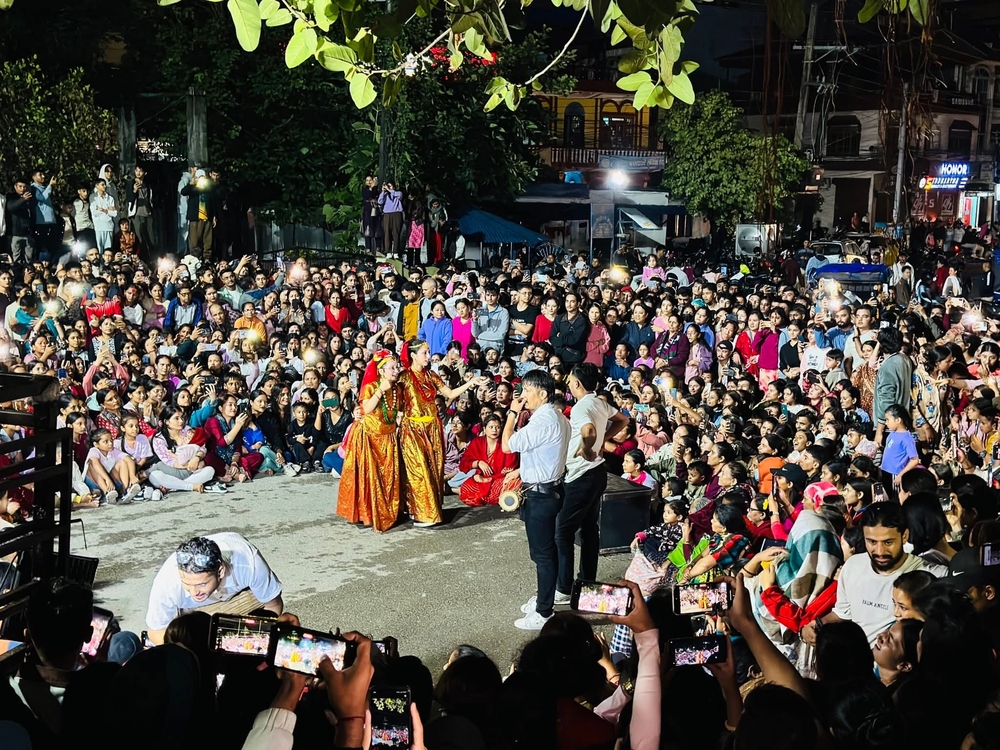 He said that while preparations were underway this year, preparations could not be made as planned due to the Gen-G movement. "We had estimated that many people would come to see our dance by the day of Ekadashi, and we wanted to put up a display accordingly," he said, "But when I saw the crowd, I was scared, it seemed like I wouldn't be able to handle it. We couldn't manage it accordingly, thinking that there might be some problem." He said that last year, another organization had requested them to dance for the Deusi Bhailo program, giving them Rs. 200,000, but this year they collected Rs. 400,000 by playing it themselves. ‘We have deposited some amount in the society’s account and spent the rest on the artists, sound system, and vehicle management,’ he said, ‘At least we, who are studying and working in Nepal, have been able to preserve Nepali culture and raise Nepal’s pride.’
This time, the artists of the Bhailoma group sang the song ‘Shirai Shirphool, Bahini Jyule Magchhin Ho, Aa Base Maiti Rajai Ma Ta Janu Swamiko Saath’. It also seems that many people liked the dance performed in this song. Resham had invited artists to his DGS Dance Arts Center in Belbas and taught them the dance.
‘I even took my siblings who were not interested in Bhailo with me, even though I had to pay for their lunch,’ he said, ‘The aim is to instill a sense of culture in them in the future.’ Khanal himself had danced to songs like ‘Zindagi Ma Malai Dua Kurale Thugyo, Eto Oppana Rupaile Ho Arko Maya’. The audience had filmed the videos of their dance performances and posted them on social media. Their dances are viral on TikTok the most. After seeing them on social media, many people came from Butwal and surrounding areas to watch Bhailo.
Sanjana Adhikari, the main artist of the group, from Butwal-11, Tinkune, said that this time’s Deusi program was memorable. She said that even now, many people call her about Bhailo’s performance, congratulate her, meet her and take pictures with her. ‘I am very happy,’ she said, ‘that crowd, that moment of being able to perform in front of so many people, of being able to show originality has become a memorable moment.’
Sanjana is a class 12th-passed student. Her father works in India. brother is in Dubai. On the other hand, her mother used to go to watch her daughter dance, cook food for her, and encourage her to do well. ‘I don’t feel like dancing to songs other than the one we danced to Bhailo,’ she said, ‘I felt like we were not just playing Deusi Bhailo, we were doing an exemplary job for society.’ Sanjana said that she was happy when people praised her as a child who danced to Bhailo while walking on the road and going to the shop, and when neighbors and relatives told her mother that her daughter’s dance made Tihar fun.
This time, Anoj KC from Butwal danced in the same group of artists. He is studying in his fourth year of graduation. He said that he started learning dance by joining this group last year. ‘I remembered my grandparents dancing like this in the village,’ he said, ‘Now the elders proposed that we should preserve the Maruni culture, so we started dancing.’ Stating that it took time to learn at first, he said, ‘Now no matter how much I dance, I don’t get tired.’
This time, he said that after the Deusibhailo program, the number of people following him on social media TikTok has increased dramatically. ‘It is good to have more fans on social media,’ he said, ‘It is even happier to play a role in preserving culture.’ He said that he was happy to be recognized as the main attraction of Bhailo artists among the general public. Vice President Khanal said that the society, which was formed since 2072 BS, has been moving forward by organizing various support programs and other programs at various times.