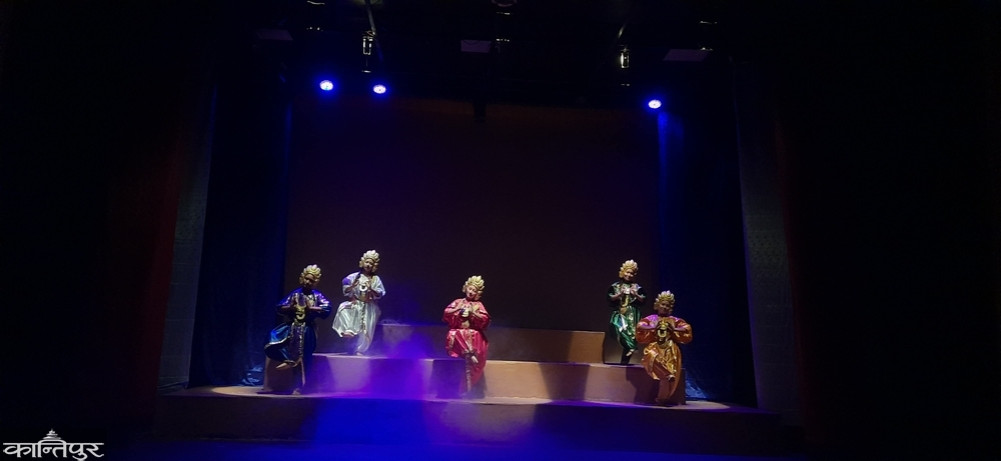
The play is being staged from Kartik 18.
We use Google Cloud Translation Services. Google requires we provide the following disclaimer relating to use of this service:
This service may contain translations powered by Google. Google disclaims all warranties related to the translations, expressed or implied, including any warranties of accuracy, reliability, and any implied warranties of merchantability, fitness for a particular purpose, and noninfringement.
Think about it, you made a huge mistake in your life! That mistake haunts you forever. It brings you regret, tears, and pain. If you had the chance to atone, what would you do? Would you admit your mistake and atone, or would you continue to burn in the same agony?
A murderer who massacred 80 people by following this path of penance later becomes a great yogi. In Buddhism, he is called a great siddha. Milarepa, who is worshipped as a god by Tibet, destroyed an entire village through tantra when he was young. Thopga, who committed a crime out of a sense of revenge, became known as the great guru of Buddhism through his apology.
A play has now been made on this Buddhist guru Milarepa, who also spent time in Nepal for a long time. The play titled 'Milarepa', directed by artists Buddhi Tamang and Umesh Tamang, is being staged at Mandala Theater from Kartik 18.
After Rabin Tamang adapted the story written by Chang Deon Heruk into a play, Thopga's life has now come alive on stage. In this play, how does an ordinary person become a great yogi and a poet? The story is presented. The only character who climbs Mount Kailash who follows the right path despite taking the wrong path. The play basically focuses on the story of how an ordinary person like Thopga turns into an extraordinary person.
Thopga is born into a wealthy family in Tibet. However, when he was 7 years old, his father passed away. Before his death, his father wrote a letter and left the world. Until Thopga was 15 years old, he entrusted all his property to his uncle and aunt. However, Thopga, his sister and mother have to pay the price of that letter. After grabbing all the property, the uncle and aunt keep Thopga, mother and sister as servants. These three endure suffering for 15 years, eating fake food. Thinking that the uncle will fulfill the letter that says, ‘When Thopga turns 15, return all the property,’ they drink away their sorrow with tears. But, as the letter says, nothing happens.
After losing hope of getting her own property back, the mother imposes revenge on Thopga. Learning tantra in the name of revenge, Thopga turns the village into a village through hail. Now, how does Thopga with such violent feelings become a great Buddhist guru? You have to watch ‘Milarepa’ to know.
The play has tried to present the beautiful dance of the dakinis, the pain and revenge that Thopga has suffered, and her spiritual journey in a subtle way. From the costumes worn by the actors, the dialogues spoken, and the music playing in the background, an attempt has been made to transport the audience to the time of Milarepa, bringing the pain he endured and the self-realization and self-knowledge he gained on stage. However, in order to cover all the important events in Milarepa's life, the play gets a little too long towards the end. It is indeed a difficult task to put the entire biography of a person on stage.
However, Buddhi Tamang, Umesh Tamang and Rabin Tamang have tried to put Milarepa's life on stage in the simplest possible style. For that, they have used the beautiful elements of the play. That is why a melody that makes you feel Tibet keeps echoing in the background at all times. From animal props to digital scenes through projectors, the stage has been used. However, that depth, that region and the environment are not reflected in the dialogues. Some artists, trying to capture the charm of Tibet, speak clear Nepali. The disorganization at that time loses the sweetness and regionality that the scene can give.
For example, towards the end of the play, another pretender guru arrives to compete with Milarepa's guru! In that scene, the dialogue spoken by the actor who has become a pretend guru and the style of expressing it does not reflect the era of Milarepa. That sweetness is not found in his emotional expression and style of dialogue. The pretend guru is given a special place in the play. There are many places in the play where the scene with that character can be shortened. However, a long time has been spent showing his competition with Milarepa. As a result, the scene with that pretend guru does not really keep the audience connected to the play. In terms of
dialogue, the actors have captured the charm of Tibet in some scenes. They have also captured the same language. However, there is no continuity in the dialogue. When the actor who has been speaking in Tibetan charm speaks clear Nepali, the audience's attention is quickly diverted from the character and the environment. In that sense, if the mood, situation, and time of the story had been put into words, the life of 'Milarepa' and the message that he lived through would have been communicated to the audience in a powerful way. After all, dialogue is also the main weapon of the play, to connect with the audience!
Digital visuals have been used in a very artistic way in the play. The scene of Milarepa attaining enlightenment has been made even more powerful by digital visuals. Neither dialogue nor any action is necessary in that scene. The audience knows from the scene where only the projector is shown that Milarepa attained enlightenment. However, in some places where the sound needs to be loud, the echo is heard as if it were zero. For example, when Milarepa uses his tantra, the hall becomes resonant with the sound of rain and hail falling from the sky, only then will the audience be able to experience that scene.
However, the actor's acting makes these aspects seem secondary to the play. For example, Rupesh Lama who becomes Milarepa. Whether it's the innocence of living with his uncle or the revenge after learning Tantra, Rupesh Lama has perfectly portrayed Milarepa throughout this one and a half hour play. The character's acting is delightfully reflected in his acting. For example, Milarepa's innocent nature, the maturity that came in his voice after becoming a Mahayogi!
Actor Ramila Moktan has also presented herself in a sublime manner through the acting of Milarepa's mother. Whether he is an actor who becomes a Marpa guru or a teacher of Tantra, the acting of actor Pushkar Karki takes the audience to the 15th century.