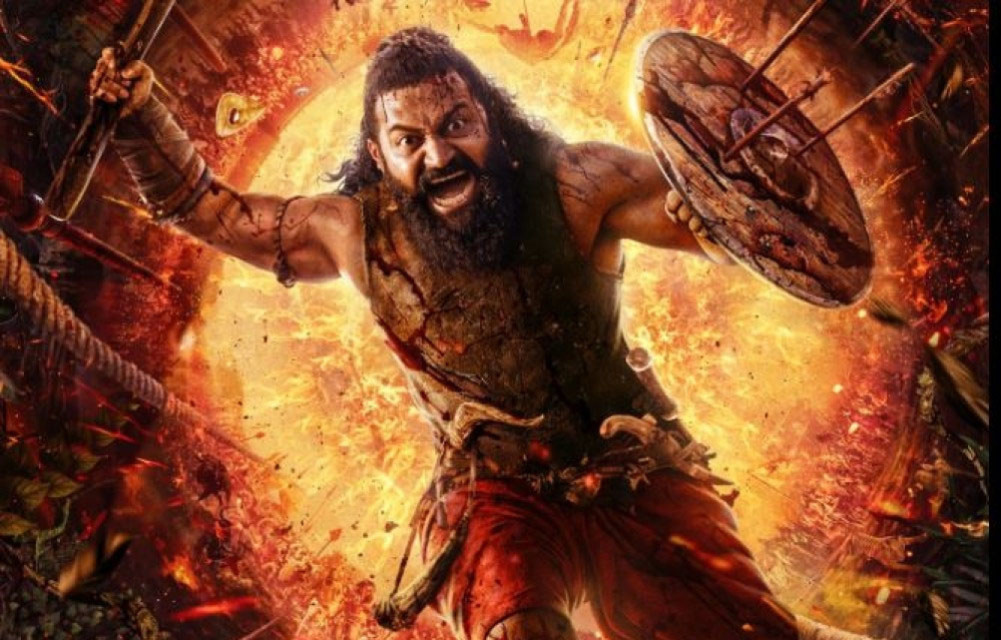
The film does not fail to show the identity of the indigenous people, their disappearing culture, and their changing way of life.
We use Google Cloud Translation Services. Google requires we provide the following disclaimer relating to use of this service:
This service may contain translations powered by Google. Google disclaims all warranties related to the translations, expressed or implied, including any warranties of accuracy, reliability, and any implied warranties of merchantability, fitness for a particular purpose, and noninfringement.
The final scene of 'Kantara' is very powerful. While the lead actor, director, and screenwriter Rishabh Shetty's character Shiva is dancing in Bhootkola (Kannada's goddess dance), he repeatedly shouts "Waha!" and scolds the landlord in a loud voice.
The trembling body, the incarnation of a god and on top of that, Rishabh's powerful acting! The same acting, the unique music and the wow... used in the last 20 minutes of the film resonated in the minds of everyone who had watched 'Kantara' in 2022, so much so that the audience was waiting for the sequel to experience the same.
Once again, Rishabh had taken the story of the film to such a mysterious place and concluded it, from where only Khulduli kept coming out.
The main character of the film, Shiva, after Bhootkola, merges into the forest in such a way that his name is not found after that. Shiva's son is also growing up. Will Shiva's son become a dancer of Bhootkola? Will Shiva, who suddenly disappeared, come back? The sequel to 'Kantara' became highly anticipated among the audience for this reason.
The low-budget Kannada film, which made a surprising profit by beating Hindi-language films, made the buzz about 'Kantara' reach Nepal as well. When the film thrashed Hindi-language films at the box office, its impact was seen in Nepal's domestic box office. The film based on Kannada tradition collected a huge amount of money from Nepal in an unbelievable way at that time. 'Kantara Chapter One', which is currently showing in theaters, is repeating the same scene. The Nepali film, which was released on the eve of Tihar, had a hard time competing with Rishabh's 'Kantara: Chapter One'.
Why did Nepalis like 'Kantara Chapter One' so much, leaving behind Nepali films made in the country? What was the element in Rishabh's storytelling that made the Nepali audience unable to watch this film? Was this film really good?
This time Rishabh surprises the audience at the beginning of the film. A 'surprise' of the prequel for the audience waiting for the sequel! The audience was waiting for the sequel of the film. But, Rishabh tells the story of the prequel here. That is, the story after 'Kantara' of 2022 is not shown in 'Chapter One', the story before that has been connected. He has not forgotten to mix the original flavors of Kantara, Bhootkola and Devi Shakti.
The story of 'Kantara: Chapter One' is the story of a forest where gods live. The story of the film revolves around that vast forest Kantara and the tribal people living there. Panjurli and Guliga are considered to be the two forms of the tribal gods living in Kantara, which has not been touched by external forces. And, they think that with the protection of God, they have been able to enjoy that land, that forest, and their culture. Rajendra, the king of the vast empire near that forest, has already observed that divine power in his childhood. That is why he prevents the scoundrels of the empire from entering Kantara.
But, as time passes, the new king Kulasekhar, who is about to ascend the throne, becomes more and more fascinated with discovering the secrets of the forest that his father had forbidden. As soon as Kulasekhar enters Kantara, problems arise in the tribals, their beliefs, culture, and the place where they have been living. How will the tribal leader Burme (Rishabh) find a solution to this problem? 'Kantara: Chapter One' is the answer to this question.
But while telling this story, the director has tried to cover a lot of topics at once. For example, on one side there are the tribals and their beliefs. On the other side there are the royal family and their power. On top of that, the myths and background of the two forms of God, Panjurli and Guliga. However, the content is scattered everywhere due to the failure to integrate all these topics into the screenplay. Therefore, the audience is not able to get into the main topic of the story.
Earlier, in 'Kantara', the main question was who has the right over the forest. However, this time, a lot of topics come together with the question. However, the rhythm of the story is disturbed due to the failure of the screenplay to integrate all these topics together. Therefore, the story of Panjurli and Guliga seems long. The director has also spent a lot of time explaining these two forms of God. Instead of explaining the heavy topic in a simple way, he has made it even heavier. On the other hand, the topic of tantra mantra is strongly linked in the film. After the story became difficult to convey, director Shetty ended the film by adding black magic. In fact, if this sub-story had also been shortened, the film would have held the audience's attention till the end.
This film leans a little more towards exaggeration. The director seems honest about the story. He seems to have worked hard on various elements of the film to present the beliefs and myths of the tribals in the scene. However, when combining multiple topics together, some topics are too connected. For example, the scene where the tribals enter the king's kingdom is shown with exaggeration. Even if the scene had been shortened, the story would have progressed. However, since the main actor himself is the director, the character has been given a lot of space in many places.
The fight in Bangra Bazaar, the snowstorm with the king's sister Kanakawati, the attraction. At one point, it seems that the story is more about Bermeo than about nature and the indigenous people. Keeping this character at the center, trying to establish him as a 'hero' has wasted important time in the film.
The interesting topic, indigenous beliefs and their way of life, is present in the film from beginning to end. How does power try to marginalize the indigenous people? 'Kantara: Chapter One' has proven true in that aspect. How does power always try to suppress the downtrodden, the voiceless? The film brilliantly shows the issue of how it seeks their voice and rights. With the entry of Kulasekhara in power, the indigenous culture is gradually being destroyed. The indigenous people, who have been enjoying themselves in the forest, start trading. Their original identity is shaken.
The film does not fail to show the identity of the indigenous people, the disappearing culture and the changing way of life. If the director had delved deeper into the core issue rather than exaggerating the story, 'Kantara: Chapter One' would have reminded the audience of the sweetness of 'Kantara' again. But, this time, the opportunity to preserve that beauty and sweetness of the story has been lost at the hands of Rishabh!