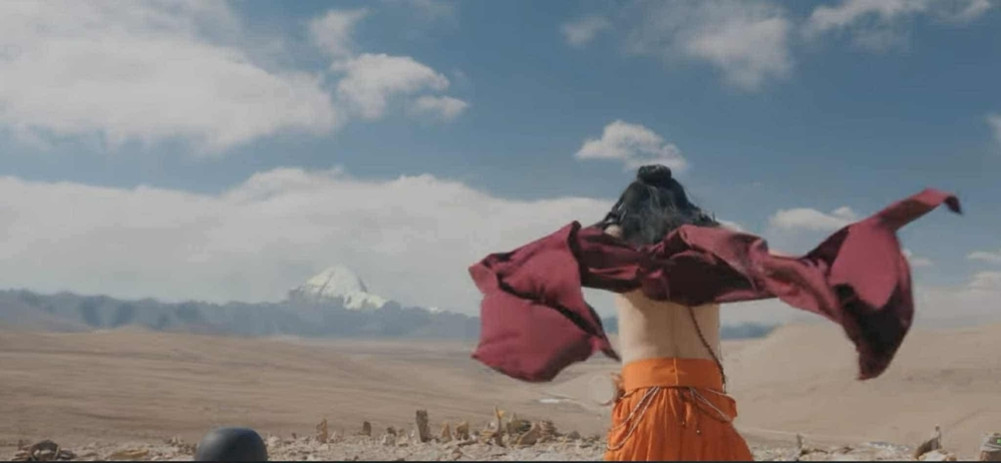
As Kailash mountain and Mansarovar lake can be seen, this place has great potential from religious, cultural and tourism point of view.
We use Google Cloud Translation Services. Google requires we provide the following disclaimer relating to use of this service:
This service may contain translations powered by Google. Google disclaims all warranties related to the translations, expressed or implied, including any warranties of accuracy, reliability, and any implied warranties of merchantability, fitness for a particular purpose, and noninfringement.
The hymn 'Jai Jai Shankar' filmed for the purpose of promotion of Lapcha of Humla has been released.
The video of the song was shot at Lapcha (5100 m) in Limi Valley of Humla. As Kailash mountain and Mansarovar lake are visible, this place has great potential from religious, cultural and tourism point of view.
A devotional hymn dedicated to Mahadev in the voice of Sugam Pokharel was launched in Kathmandu in the presence of Congress General Minister Gagan Kumar Thapa and former Chief Minister of Karnali Province Jeevan Bahadur Shahi. Additional words in the song have been given by Vijay Adhikari. In the
video, actor Badri Prasad Tiwari has a solo act and directed by Vijay Adhikari. Choreographed by Kiran Thapa, this video is directed by Hari Humagai and edited by Bharat Regmi.
Jeevan Bahadur Shahi, who is also the former Minister of Tourism, said that the video will contribute greatly to the promotion of tourism in Karnali. He said, 'This video will shock us all. Our resources are abundant, but if the legal structure is strong, this is the place where we can sustain the country.'
Mahamantri Thapa expressed his appreciation for the song and said, 'Sugam Pokharel's powerful voice and Badri's acting have made the song come alive. It has given the message that Karnali is not only sad but also has such unique places. The initiative taken by this team is commendable where the government has to play responsibility.'
director Vijay Adhikari recalled the story of the Sri Lankan King Ravana, described in the Puranas, when he reached Mount Kailash and said, 'We also reached Lapcha and saw Kailash and Mansarovar directly and brought this song alive at that place.'