'Kagtali' staged at Kaushi Theater presents a mixture of tragedy and laughter, highlighting the finer dimensions of relationships.
We use Google Cloud Translation Services. Google requires we provide the following disclaimer relating to use of this service:
This service may contain translations powered by Google. Google disclaims all warranties related to the translations, expressed or implied, including any warranties of accuracy, reliability, and any implied warranties of merchantability, fitness for a particular purpose, and noninfringement.
Sheetal (Vasana Timilsina) has invited Suraj (Rupesh Lama) to her house, covering the chance that her husband is out of the house. Suraj Sheetal's campus friend! After tearing the manuscript of the book he was writing, Suraj reaches Sheetal's house. They don't even think that Sheetal's husband will forcefully come to Tuplukk when they are the only two.
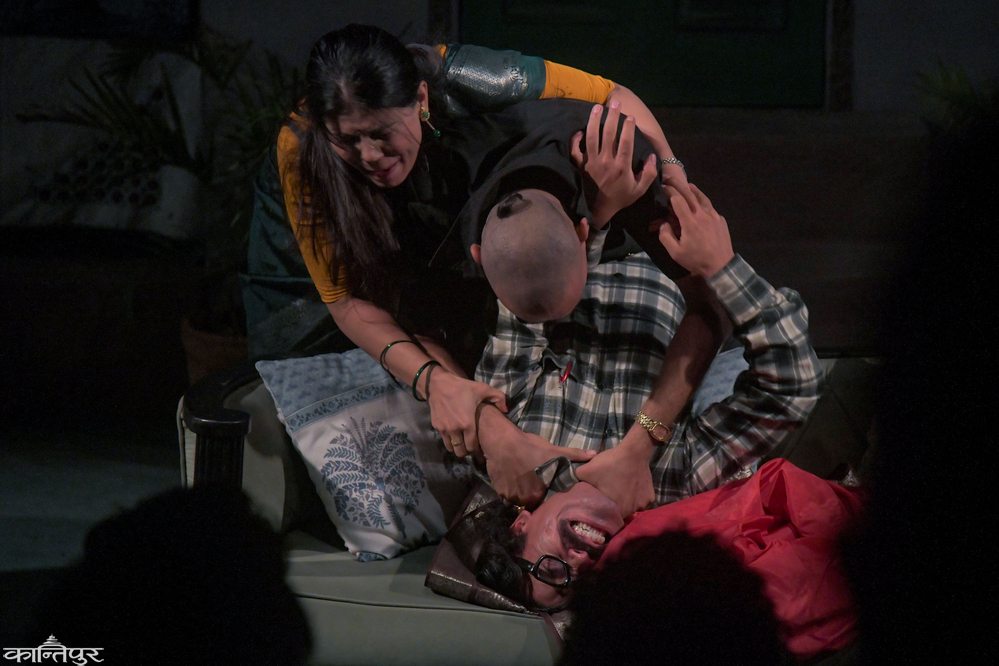
To give a 'surprise' of the wedding anniversary to the forced wife who returned home Can't see with another man . Gorkhe Khukuri tries to splash Suraj . Between that attack and resistance, they fight lifelessly on the ground. At the same time, the guests who were invited to the house on the occasion of the anniversary come one by one to ring the house bell . Kagtali goes like this; Now Sheetal and Suraj will play the role of waiting for Vivas. Hides the fear of the face and laughs with the guest . And, repeating this thing again and again!
The funny aspect of the one and a half hour play 'Kagtali' is that it keeps you laughing even in the midst of separation . Staged at Kaushi Theatre, this play keeps the audience laughing from the beginning to the end at the events created by the serious situation. This drama of the 'Tragic-Medie' genre raises complex issues of women's empowerment by discussing the finer dimensions of relationships. There are some such scenes in the play, where the audience sinks into the depth of emotion for a while. However, the hashya rasa that arises immediately helps to float away from that feeling . Director Navinchandra Aryal has presented the hypocritical nature of Nepali society, suppressed female voices, toxic masculinity and complicated love through the play. Masculinity is satirized in the play through
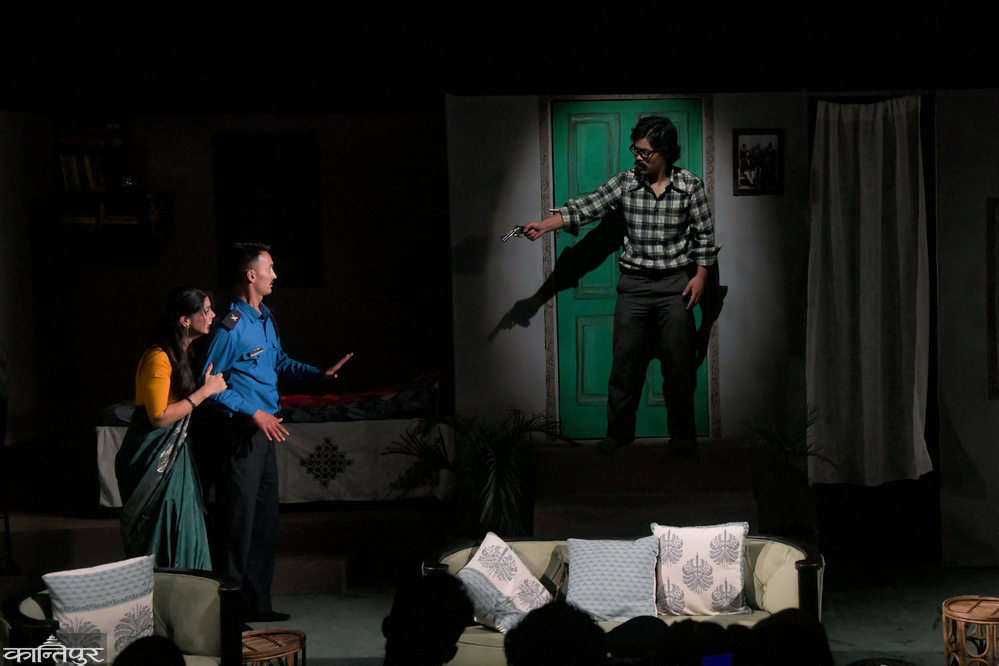 . Vivasa's entrance is in a very loving, loving style. At a glance, it seems that other men in the world cannot love their wives as if forced! He has not forgotten the wedding anniversary, he has bought a neck necklace that his wife likes . He continues to express his love to his wife. However, when the truth that the wife invited Suraj to the house in the name of Pooja is revealed, the toxic masculinity inside him cannot bear it . Therefore, without understanding the situation, he immediately starts violence on Sheetal . Other such male characters are also presented in the
drama, who do not forget to sing the glory of women . But, only in appearance . The colonel character raises the issue of women's freedom, but confines his wife to the house . And confidently says, 'He has a big hand behind my success!' Some such male characters have also been put on the stage, who consider themselves protectors . When two of Sheetal's friends Pooja (Yuvina Bhattarai) and Deeksha (Akriti Budhothoki) head towards the restaurant in the middle of the night to find Vashta. Police inspectors Digvijay (Dipendra Shahi) and Tekjung Kunwar (Jeevan Dahal) quickly get up and run after them to protect them. Because the colonel couple (Amrita Kaucha and Sushma Niraula) wants to go there to protect them. However, Diksha and Pooja reply that they can protect themselves . A balance is maintained in the play through a character like Suraj, to show that not all men are filled with masculinity. Vulnerability, softness and innocence in men are shown through Suraj.
This play is strong in women's empowerment . For example, the main character of the play Sheetal . Sheetal, who always ranks first in the class, is bound by marriage. For them, the forced home is like a prison. She quit her job because of her marriage and is fighting for freedom. So his decision makes Sheetal move forward towards freedom . The change in the character, the decision taken by Sheetal represents the strong women in the society . Pooja and Diksha are other examples . Those who can speak for themselves in the patriarchal society, have created their identity by breaking the norms of the society.
Pooja works in Radio Nepal and Diksha is a nurse. The play also satirizes women who are oppressed in the structure of patriarchal society. The colonel's wife was locked up at home after marriage, compromising her freedom with marriage. She was working before her marriage and after the birth of her child, she was pressed by the responsibilities of the house. She is ignorant of the fact that the patriarchal structure has restrained her. On the contrary, she says, "We women need to be more capable! It is very important for us girls to be educated and independent in order to be able to distinguish the truth that is happening in the society and to keep our things clear.' This dialogue has also satirized women like the Colonel's wife .
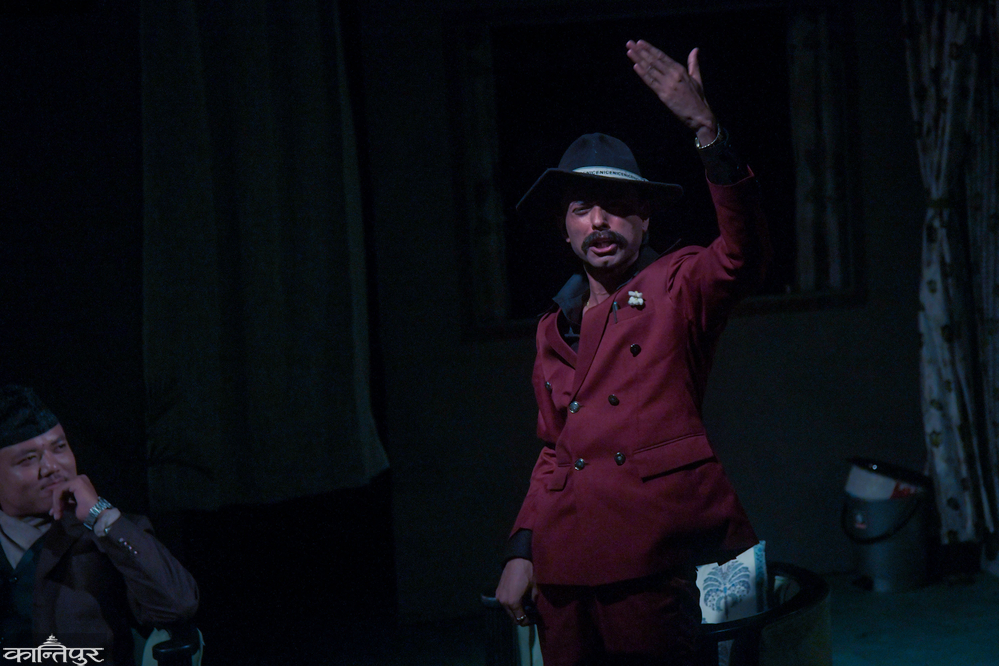
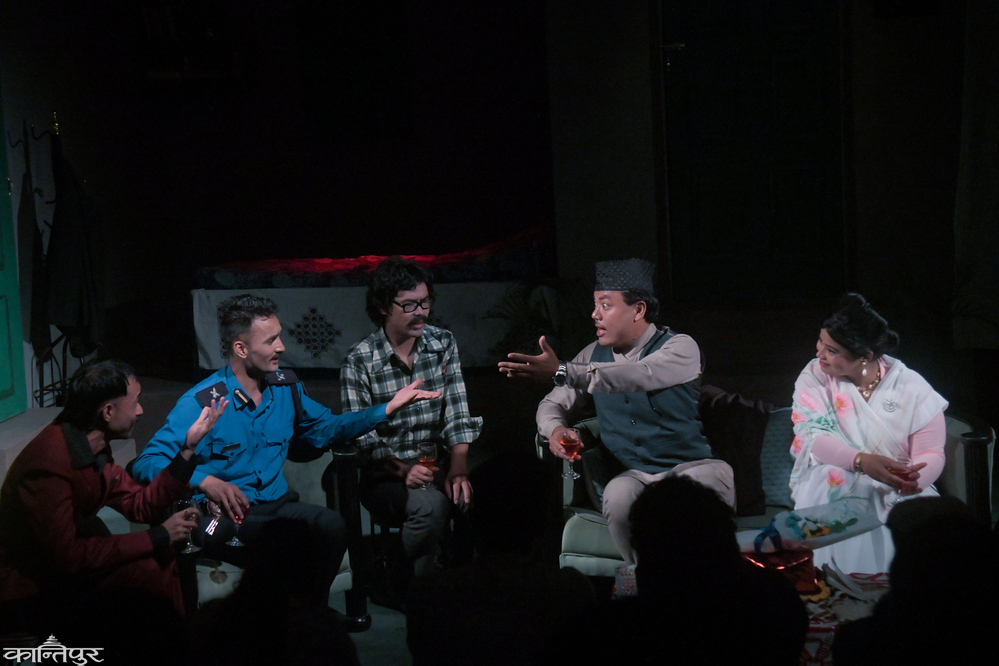 'Kagtali' is not only the Colonel's wife, there are many other interesting characters . Their roles have some influence on the original story. For example, there is a character who makes a film here, Teku . He is presented in a satirical style throughout the play. From the clothes he wears and the sheer hat, one can guess that he can be no other than a filmmaker . He looks very filmy from the way he speaks and his body movements. The presence of this character is the element that makes the audience laugh. Arka Vaihale, Colonel couple . The style of speaking of these two, even from their thoughts, the patriarchy that is held by the elite class is pouring out . The character who arrives to deliver the cake is just as funny .
Complicated love is at the center of this drama. Sheetal and Suraj have been trying to show love from the beginning. The eyes of the two still have the remnants of their college days of love . But, that love is latent . That feeling is also manifested in Suraj's poems memorized by Sheetal. Diksha also loves Suraj. She also offers love. However, in the original story, this love does not have much harmony. Even if their scenes are removed, 'Kagtali' looks complete . There is also a complex relationship between Vivas and Pooja, to find that out, watch the play itself.
 A new flavor given by 'Kagtali', it uses story recitation and music . Music is also not used on the stage. When playing the radio, the song plays in the background . The same song conveys the feeling of a certain scene . Classical music is used in the play, which connects the audience during that event . In that sense, the music used in this play also speaks a lot. Except for a few scenes, the reason why the song plays most of the time is revealed there . There is either a song playing when the radio is playing or characters humming . In the first scene of the play, the music of Om Vikram Bishta's song 'Ma Mauntama Aljhainha...' is playing in the background . As the character turns off the radio, the music The ringing stops . Not only the
song, Prakash has been used in this play as well. Lighting clearly focuses on what a character is trying to do. Like, every time Sheetal goes to the door to open the door for Divas, Prakash shows Sheetal and her face . In the same way, when only the view of the kitchen is shown, the light used there only shows the activity of the kitchen.
Prakash also recites the story there to present one-by-one activities of many characters on the stage. For example, there is a scene in the play, where three men go to a bardli and smoke cigarettes. At the same time, women are busy preparing food in the kitchen. Meanwhile, the sun continues to shine. Prakash has presented these three scenes beautifully. Red light is used to show the lifeless fighting force on the same stage . Vivash's character assumes the form of a crow in the middle of the play, applauding Suraj and Sheetal's hypocrisy.
 is an 'absurd' scene full of satirical use by crow . Kaag is not only a hypocrite character, but satirizes the reality of a hypocritical society. The most powerful scene of this play is the psychology presented through the torch . Especially in this scene, the psychology of the police is shown through the use of torches. Digvijaya's attention has come to some suspicious scenes seen in Vivash's house.
Even though the situation seems normal, it would be natural for the police character to smell suspicion in that house . Torch is used in the play to show the scene in his mind . When all the characters are in black shadows, the character shines a torch light in the corner of the house and searches for evidence of the incident . This is a scene that reflects the psychology of Digvijaya .
Disengagement is a fact of life . To keep smiling in the midst of separation is life . In that sense 'Kagtali' means life . Also, mocking hypocrites keep clapping .

