The backbone of the film is the screenplay. However, if the screenplay is weak, what kind of film will be made?
We use Google Cloud Translation Services. Google requires we provide the following disclaimer relating to use of this service:
This service may contain translations powered by Google. Google disclaims all warranties related to the translations, expressed or implied, including any warranties of accuracy, reliability, and any implied warranties of merchantability, fitness for a particular purpose, and noninfringement.
Actor and screenwriter Deepakraj Giri, who has been writing films for a year, always feels that, 'If I were a good screenwriter, the burden of writing would be reduced. 'Jatra' director Pradeep Bhattarai also has a similar experience when he sits down to write a film. Meanwhile, Pradeep tried to write a film in collaboration with some screenwriters. Couldn't find a satisfactory writer, then got fired.
Actor Deepak, who prefers to act only, is led to write by the lack of film writers. This is not only the experience of Deepak and Pradeep, due to the drought of film writers, most Nepali filmmakers are writing stories and making films by themselves.
Everyone's complaint is the same, there is a real shortage of good screenwriters in the Nepali film industry! The
is the backbone of the film, the screenplay . However, if the screenplay is weak, what kind of film will be made? Nepali film is failing in this aspect. Every film review also quotes the weak points of the screenplay . After all, when the Nepali film industry has been completing decades, why is there a shortage of screenwriters?
director Dipendra Lama says that due to the lack of writers, some screenwriters in the film industry are forced to write a lot of films in a short period of time. In addition, Lama told that there is no atmosphere to be excited about the writer who is writing because the investment to be made on the writer is also low. It takes an average of 6 months to write a
film. However, filmmakers here are always in a hurry. Not only the producer but also the actor seems to have a compulsion to finish the film in a limited time. 'The script doesn't turn out as the writer thinks when writing under such pressure . Another thing is that there is no time to discuss and correct the same script,' Director Lama said, 'Unfortunately, the writer is still not being paid properly here. 60 lakhs have been given to the hero, 40/50 lakhs to the director. The filmmaker wants to write the writer for 2/3 lakh.'
As Dipendra said, a good budget has been allocated for various departments of films in Nepal. However, the budget for writing is still low. Even now, some producers are found bargaining with writers for a small amount of money. 6 months sure writing salary is not allocated . How can a writer who doesn't get a living wage get excited! In this case, the writer is also required to write many scripts in a short time for his daily life.
How will the story be written in a short time? Regarding the author's question, screenwriter Sampada Malla has gained experience in the neighboring country, India, which has gone far ahead. If we look at India, the writer is safe there. There are laws to protect the author. But while writing a film here for 6 months, the salary is not enough for the writer to support his family, says Sampada. 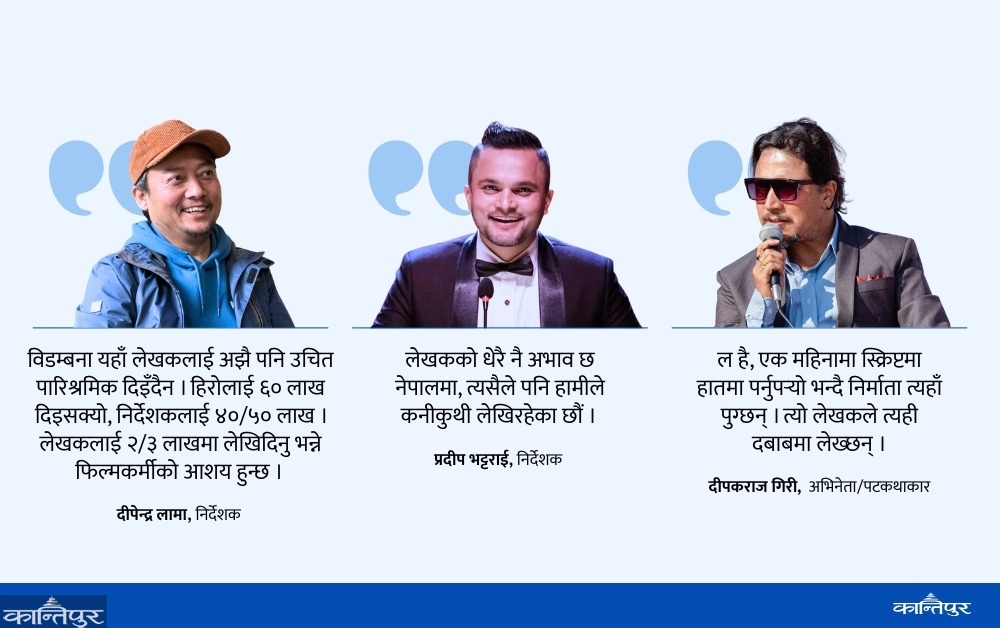
She finally sees that Nepali filmmakers are getting serious about screenplays . The history of Nepali films, which started making films by transferring screenplays from the Indian film industry, spent a long time imitating Bollywood. It is true that filmmakers are starting to understand the importance of screenplay. Especially the previous generation did not know the structure of film writing. Now the filmmakers have started to know about the structure of the screenplay . The next generation is going to read more," Sampada said, "Nepali filmmakers have started to understand that script writing has its own grammar rather than copying foreign films and writing whatever they get. This is a positive step .' She has seen that there is a lot of potential in the current generation. She says that the writing in the film sector is not strong because those who do not have the basic knowledge of
script writing are not sensitive. 'Scriptwriting is a combination of science and art. The process of understanding it has increased now,' she added . Director Pradeep Bhattarai sees that Nepali films are still moving to the left when it comes to
screenplays. If a skilled writer is found, Pradeep also wants to close his pen and direct only. However, due to this vacancy in the Nepali film sector, he is also forced to write a 'script'. Therefore, he says that he is learning and progressing in screenwriting.
'We moved forward learning that we have to tell our own story . That's why there is a shortage of skilled writers,' says director Bhattarai, 'There is a shortage of writers in Nepal, that's why we are writing Kanikuthi.'
Screenwriting is definitely not an easy subject. The story is not just a fable. As literature, its story cannot be told. Along with the story, the technical aspect should also be taken into consideration. The story, characters, events and incidents had to be mixed . It also had to be molded into the grammar of the film.
At the present time, while telling the story of a community, the question of being sensitive to their feelings and representation is being raised. There is a need of the time for narrators to come from the same community to tell the stories of Dalits. On the other hand, the portrayal of female characters was not written from a misogynistic point of view. Along with film writing, it is definitely not possible to cover such deep topics through a film in one/two days of writing . 'This is visual writing . Within a limited time, you have to write the story along with the technical aspects. Especially now we are practicing this writing,' said the writer Bhattarai. He also sees the need for the state to invest in the field of screenplays. Filmmakers are looking for an alternative to 'script doctor' to strengthen the screenplay .
filmmaker Dipendra Lama argues that even though the filmmakers cannot trust the new screenwriters, the vacancy in this field is not filled. 'The producer, the director has not been able to find a new writer . which The film is being written, believe only in him . How many directors don't even have the ability to decide whether the script written by a new writer is good or not,' he said critically, 'they are likely to like the script that they have seen in many films and have the plot of a Hindi/English film . Therefore, there is an environment where many writers who write creatively are discouraged now.'
rush writing
A good film needs a strong screenplay . However, there is a lot of lack of time in screenwriting in Nepal. For example, Pradeep Bharadwaj is a busy writer in Nepal. In 082 Pradeep wrote 'Vir and Vadhu', 'Anjila', 'Pitambar' and 'Jante Bakhro' came to the stage. Currently, 'Citamol' and 'Rial Ringette' are being prepared, while 'Kazi' and 'Asarfi', which are yet to be shot, are being written .
Most filmmakers who come to Pradeep who has written about 50/60 films with a request to write a script are in a hurry. Writer Vikas Subedi, who has emerged in
film writing, also comes from producer to director in this way. Most of them advance the film screening date with the condition that the film should be written within a certain time frame. Those filmmakers are in a hurry to announce the release date of the film without 'script lock'.
The director/producer comes to Pradeep with the pressure that the film should be a hit. In this way, Pradeep and Vikas have been rejecting those who come with the urge to write a film in a hurry. 
Why is it necessary to finish the script of the film in a hurry?
'Now finally the writer was able to get 1 million . He started taking 3/4 lakh as he started writing films. Earlier it was limited to 50/60 thousand,' says actor Deepakraj Giri. He says that even if
has allocated a good 'budget', the producer will still try to squeeze the writer in terms of time . 'The producer reaches there saying that he had to get hands on the script in a month . That writer writes under the same pressure,' he says, 'Such a script comes to the actor saying that he has to go to the shooting in a month.' He is of the opinion that the screenplay is becoming weak because he cannot understand the process of
film writing. 'The story came to weave . We may have understood the structure. The script doctor will also explain the three act . The style of telling the story is different. But even for such a screenplay, time is required,' he says, 'In Hollywood, there is a lot of churning among writers on the same script . We have the idea of hiding it to see if it will find out.'
If a film becomes a hit, he does not like the practice of making films of the same style. 'The producer who came to listen to the melody of sarangi soon tries to recite the melody . They don't know how difficult it is to make a sarangi tune,' he sarcastically said, 'Especially they are seeing 46 crores in that tune . After hearing the sound of money in that tune, the producer approaches the writer in a hurry to make a similar film.'
After the release of 'Prakash', 'Pujar Sarki', many producers came to Vikas Subedi saying that he should write a film. Most of them were in a hurry to finish the film immediately and bring it to the screening . However, seeing that it takes time to reach the sensitivity and depth of the social theme, Vikas returned the producer . He says, 'I don't write films about things that can be written immediately . Writing is a time-consuming field. Therefore, I have decided that I will definitely write a film even if the money is not enough for the daily life.' Pradeep Bhardwaj, who is busy writing
s, says that filmmaking is another part of the weakness of writing. In his words, no film is made in Nepal as much as the script. The film falls apart at the stage of production, blame it on the writer . Eg: The producer goes into the shooting with the screenplay which is 'locked' from the writer . Now, before going to shooting, there is an increased trend of consulting two/four writers/directors on the script. And after the shooting, the film is made on the post-production table . Where, the film reaches many stages from sound, color, editing to dubbing. Bhardwaj has the experience of how many scripts are being released at this stage when a
film is made in teamwork. He has also experienced the situation of 'script one, film another'. "Films are not made just by writing, films are teamwork". Foreign films are made better than the script, but not here . After the script is finalized, our film is falling on the table of shooting, sound and post-production,' he says, 'however weak the script is, it cannot be said that the making is not weak.'
Pradeep wrote 'Lilibili', 'Anjila', 'Var and Vadhu' for director Milan Chams. 'Asarfi' is writing for him . Wrote 'Devarbabu', 'Hifajat' and 'Zhingedau' for Gyanendra Deuja . 'Jhyanakuti', 'Hattichhap' and 'Jante Bakhro' for Simos Sunuvar. 'Kazi' for Laxman Rizal. For Ghanshyam Lamichhane, 'Panchebaja', 'London to Paris' . Guru Prasad is also writing 'Chhimeki' based on Mainali's story.
Thus, Pradeep, who is writing films for new/old directors, admits that the screenplay is not strong due to lack of time . "The producer comes to us with the release date fixed at the beginning . The artist asks to write that Yoyo should be kept . And when the same actor doesn't have the time, they run the script,'' he tells his experience. When they add and give opinions, it is getting worse . Producers don't even know who to get advice from.' Bhardwaj says that the filmmakers do not pay attention to allocating time for the screenplay while they are busy in the film production process under the pressure of making a
hit. 'Filmmakers are under pressure to make a hit film . That's why the film is deteriorating due to that pressure. Instead of making a good film, filmmakers will come saying that they should make a hit, keep this artist, mix this song,' he said.
Advising that old writers should update themselves, director Lama points out the need for big banners and producers to invest in 'script lab', 'script factory' and 'workshop' to strengthen the script. In such a platform, the author can write films 'Mentorship' is given for . They can proceed to strong screenwriting from the learning there . Many film festivals produce good screenwriters through such 'labs'. The same platform connects screenwriters to filmmakers and producers.

