We use Google Cloud Translation Services. Google requires we provide the following disclaimer relating to use of this service:
This service may contain translations powered by Google. Google disclaims all warranties related to the translations, expressed or implied, including any warranties of accuracy, reliability, and any implied warranties of merchantability, fitness for a particular purpose, and noninfringement.
In the film, when the main character gets into trouble, he tries many ways to escape from it. As we move forward towards the found solution, more and more problems are added.
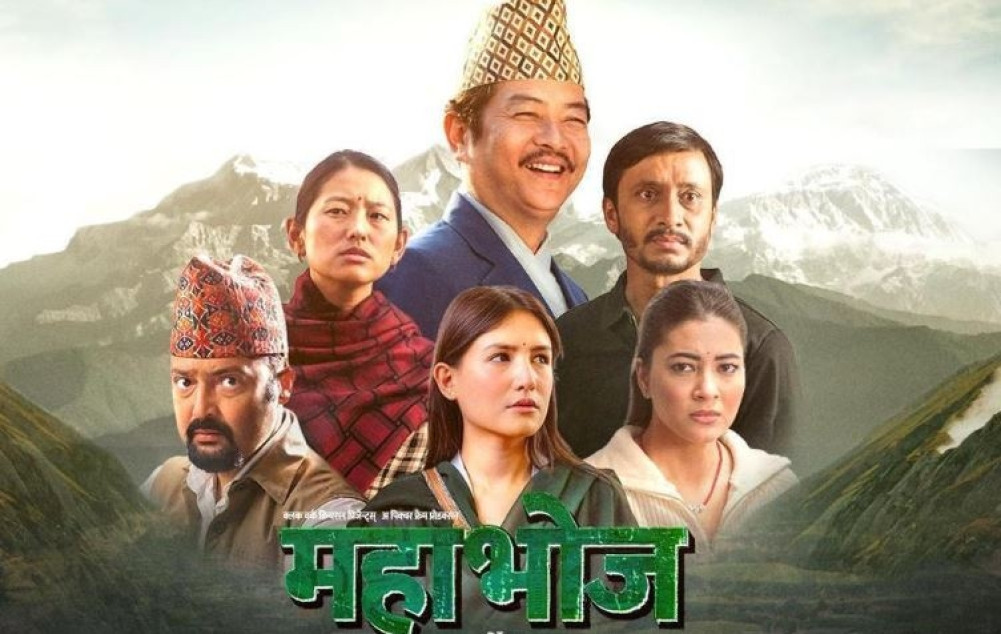
The character starts looking for different ways to solve the problems that are piling up one after the other. This style of narration keeps the audience's attention in the film. The conflict the characters face drives the story forward. However, when the character tries to get out of such problems easily, then the story goes astray. And the audience's attention is finally diverted. This is what happened in 'Mahabhoj' directed by Dinesh Raut.
In this film centered on the problem of cooperative victims, the rhythm of the story is broken when the character takes an easy way to solve the problem. As such, the film progresses in a realistic manner until the interlude . However, when the character starts to find a way to solve the problem, then the tide of the story disappears. Other subplots to be added also do not seem believable . The
has been linked to the revolution to get the character out of the problem . To escape from the problem, the characters suddenly take a revolutionary path, which is not faithfully established . To solve the problems seen in the cooperative problem, this revolution held by the character seems to be very unexpected . For example, Surya Prasad Koirala (Aryan Sigdel), the director of Mr. Multi-Purpose Cooperative, wins the election by misusing the money there, and becomes the chairman of the village.
Chandrakaji (Dayahang), the newly appointed president of the cooperative, begins to realize this truth only when he learns that all the money has been withdrawn from the cooperative in his name. Gradually the villagers will start needing savings. One day Vishwa (Khagendra Lamichhane) along with his wife (Anjana Baraili) reaches the village from the city to withdraw the savings. At the same time, they know that the cooperative is empty .
President Surya Prasad has misappropriated all the money of the cooperative. Now Chandrakaji, the world will start looking for solutions to their problems due to the example of Mr. Multipurpose Cooperatives. However, the character does not have to struggle much to get out of the problem. What if the main character didn't have to struggle at all to achieve his goal ? There is no empathy and sympathy for that character.
Bringing the depth of this issue to the debate by making the cooperative problem the main topic is a strong step taken by 'Mahabhoj'. Director Dinesh, who is making commercial films, has a positive side to approach such problems in Nepali society.
Raising this kind of serious issue faced by thousands of savers through a mainstream film is the strong part of the film . Especially in mainstream films, this kind of issue is rarely raised . Such There are few risk takers in the story . However, Mahabhoj has taken this risk and has tried to draw the attention of the concerned bodies by presenting the suffering of the earthlings through the film.
While making a film on such an issue seen in the cooperative circle, if the director Raut had told the story through the point of view of the ground person, the nature of the debate created by the film would have been greater.
, especially cooperative problem is the central issue of this film. However, while raising this issue, the film has presented the oppression by those in power. From a Marxist point of view, those in power always oppress the weaker sections. In this film as well, President Surya Prasad, who is in power, oppresses not only Chandra, but also the villagers who are weaker than him.
Surya Prasad returned from abroad, opened a cooperative with the capital brought from there. It has been shown that through the same cooperative, Surya has exploited the 'eating' class. How do those who reach under the guise of power and power try to suppress the powerless and the voiceless? The film satirizes .
It is an amazing example of how the powerful in Nepali society have made the poor and marginalized people suffer by standing over the corpses of the poor, the cooperative problem . By working like selling Panipuri, garbage management and cleaning toilets, the poor common people kept all their life's earnings in the cooperative. They actually gave not only their lifetime earnings, but their lives to the cooperative. However, the same people who are in power, active in politics, embezzled their savings .
How many politicians counting on billions of savings are not being brought to justice. How many have not been arrested by the police? The savers who are hoping to get back the savings amount for their daily living are waiting for justice . They are on the streets for their own money, they are shedding tears. However, the powerful are still trying to suppress this issue .
Some of those embezzling savings were arrested. However, what if the common people who saved money while they were being caught got their money back ? How can the powerless get justice here? Lost account of the mental stress experienced by all of them since the cooperative was closed? Let alone the interest, when will they get the deposited amount? The film has raised such important questions.
When it comes to portraying female characters, 'Mahabhoj' looks very weak . Especially in this film, it is shown that most of the women speak loudly, and their speech is not restrained. Like, in most of the scenes Vishwa tries to rein in his wife's mouth, saying 'Volume is small' . In the
film, not only his wife, but also other women are depicted in the same way. Every time the audience tries to laugh through the dialogue 'Volume Sano', it is meant to portray that women keep talking about unnecessary topics. Male control is seen in the thoughts they express in these scenes. If sensitive issues like the cooperative problem were being raised, the character of 'Mahabhoj' would have been stronger if it had been aware of women's issues as well.